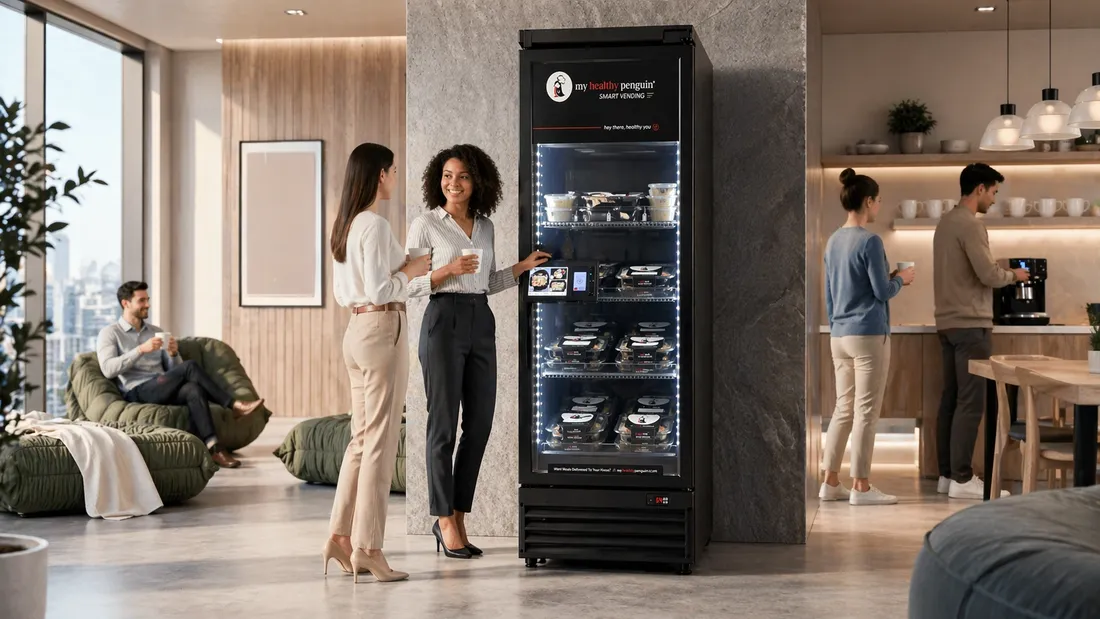









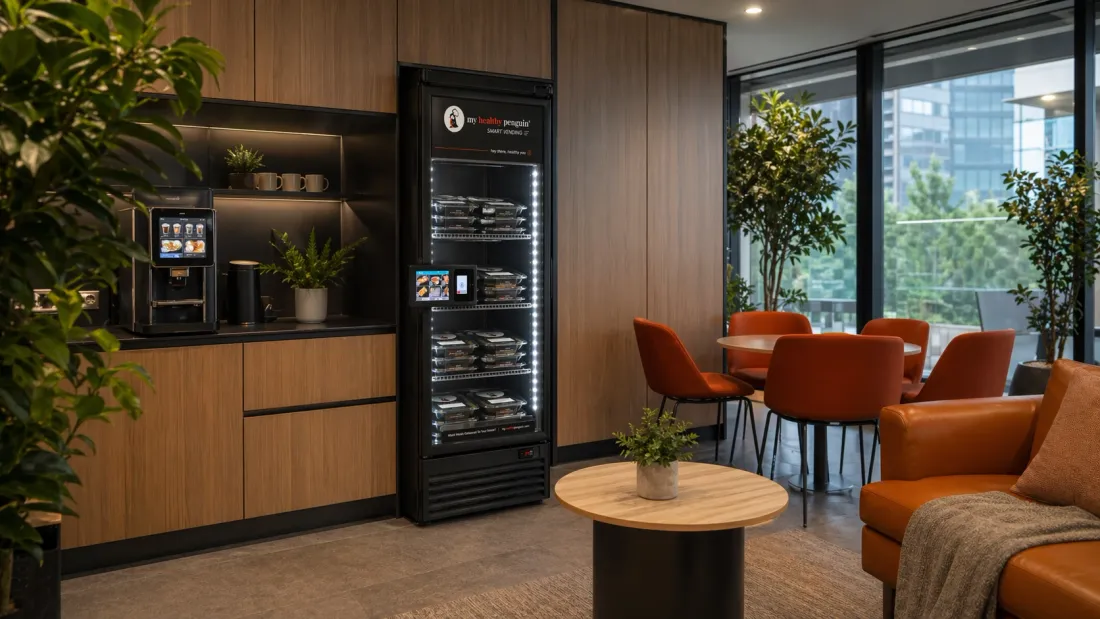
MHP Smart Fridge in a Southern California workplace break room, alternative to vending machines
Compare / Smart Fridge vs. Vending

Same tap-and-go. Real food instead.

Vending machines and micromarkets give workplaces 24/7 snack access. The MHP Smart Fridge runs on the exact same convenience model — tap, grab, go — but stocked with chef-prepared meals instead of granola bars.

Price a Smart Fridge Read the breakdown
Trusted by Southern California workplaces
The decision underneath the decision

You are not really choosing between machines.
You are choosing what your team eats at 2am.

Vending machines and micromarkets exist to solve one problem: 24/7 access to something you can chew. They are very good at the snack — granola bar in the afternoon, chips at 10pm, can of soda before a shift. That is the lane they were designed for.

The Smart Fridge runs on the same tap-and-go convenience — same footprint, same break-room real estate, same 24/7 access — but stocked with chef-prepared real meals from one kitchen. Lunch for the warehouse swing shift. Dinner for the hospital night crew. A real meal at hours when no cafeteria or restaurant is open.

If your team only needs the afternoon snack and the coffee run, vending or a micromarket handles that cleanly. If the actual gap is "how do night staff eat a real meal," the Smart Fridge is the model built for that question. Most workplaces end up with both — different problems, different solutions.

Vending vs. real meals

Four numbers that tell you which one fits.

Same footprint, same convenience, different category of food.

11.6
Out of 100. Average hospital vending nutrition score on standard rating scales.
24/7
Access on both. Smart Fridge stocks real meals; vending stocks snacks.
2-3x
Per week typical Smart Fridge restock cadence, set by live usage data.
2 sq ft
Floor footprint for a Smart Fridge unit — same as most vending machines.
What is actually different

Six places the two models diverge in practice.

Not abstract differences. Things you would notice on the floor.

Chef-prepared real meals, not shelf-stable.

Each Smart Fridge stocked from one Rancho Cucamonga kitchen. Full meals, full nutrition info. Vending stocks shelf-stable packaged snacks. Different category.

Tap and go — no app required.

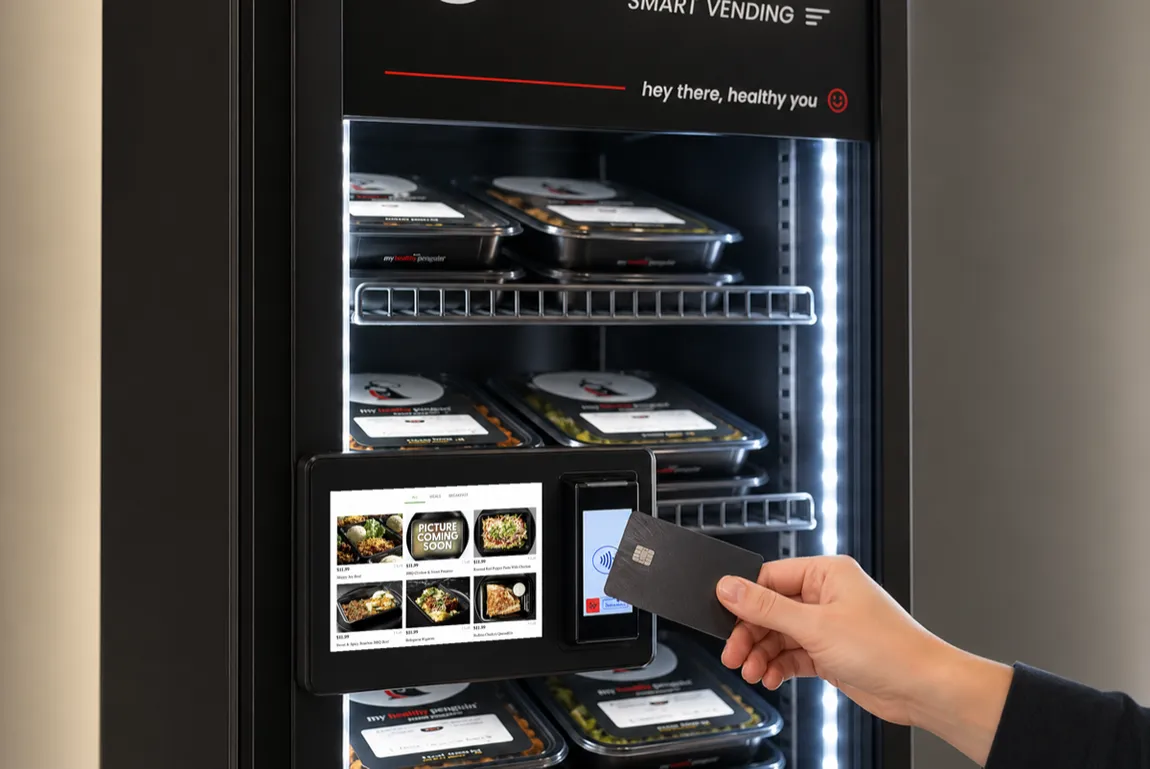
Card tap, door opens, pick a meal, door closes, charged at the unit. Same simplicity as a vending machine, no app downloads, no scanning a QR code with greasy fingers.

Restock cadence set by live usage data.

Our team restocks 2 to 3 times a week based on what the unit reports. Sites that move a lot of beef bowls get more beef bowls. Vending runs on a fixed route schedule, not your team's appetite.

Same footprint as vending.

Roughly two square feet of floor, standard 110V outlet, no plumbing. Drops into the break room where vending already lives. No micromarket-scale buildout.

Three payment models, your choice.

Pay-per-meal (employees pay), subsidized (employer covers part), or fully funded (employer covers all) — you pick what fits the site economics. Vending is typically pay-at-the-machine only.

When something goes wrong, you call the kitchen.

A meal that did not vend, an allergy question, a request for more of a popular item — same business day, same number, same team. Vending operators run on route schedules.

"Thank you for your assistance with this service! I continue to receive positive feedback every day about your services."
Santa Monica Police Department
Lt. Kristina Cochran
Santa Monica Police Department
Pricing, in plain English

What this actually costs, in two scenarios.

Real example math, not a quote. Your worksite varies.

Smart Fridge install at a 50-employee SoCal site
Scenario one
50-employee site,
vending only today.

Vending today. One snack vending machine and one drink machine. Roughly 30 transactions a day, mostly chips, granola bars, sodas. Free to the employer (machines are operator-funded). Nutrition score: low.

Add a Smart Fridge. Same break room, same footprint, no plumbing. Stocked with chef meals 2-3 times a week. Three pricing models (pay-per-meal, subsidized, fully-funded) — the call is about what the site economics support. The vending stays for the snack lane; the fridge picks up the meal lane.

50-employee site with the Smart Fridge added
Scenario two
Multi-shift warehouse,
night crew has nothing.

Vending today. The graveyard shift comes in at 10pm and the only food on-site is chips, candy bars, and energy drinks from the machine. People bring lunch from home or skip it.

Add a Smart Fridge. Same break room. Now at 2am there are real meals available — a beef bowl, a chicken plate, a vegetarian option. Tap and go. The chef meal stocks the lane vending was never designed for.

This is where the Smart Fridge is doing real work — not replacing the snack, filling the meal gap that vending was never built for.

Same break room. Same moment. Different model.

Tuesday at 11:50am.

Someone is hungry, the break room is open, and they have 10 minutes. Here is what each model puts in front of them.

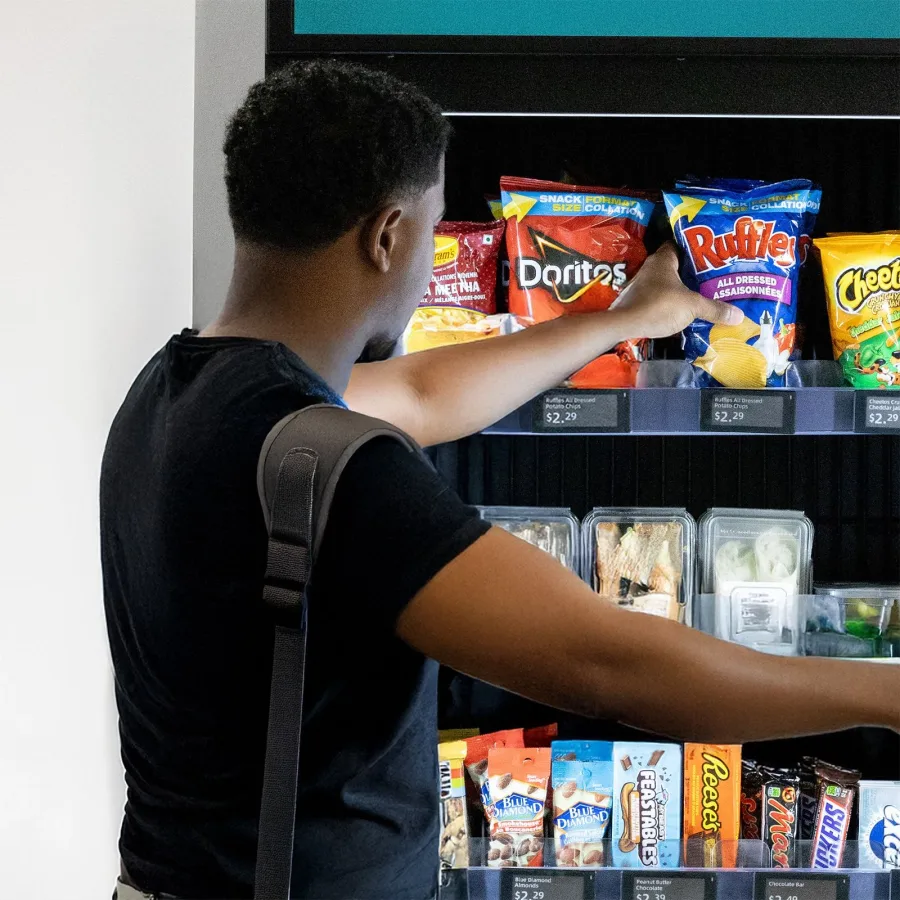
Hungry employee at a vending machine grabbing a granola bar
At the vending machine

A granola bar. Maybe a bag of chips.

They tap the machine, pick the least-bad option behind glass. Granola bar. Maybe peanut M&Ms if it has been a long morning. Bottle of Diet Coke for the caffeine.

That covers the calorie gap until they can find a real lunch. It does not cover the meal. The nutrition score of what they actually picked sits around 11 out of 100.

By 1:00 they are hungry again.

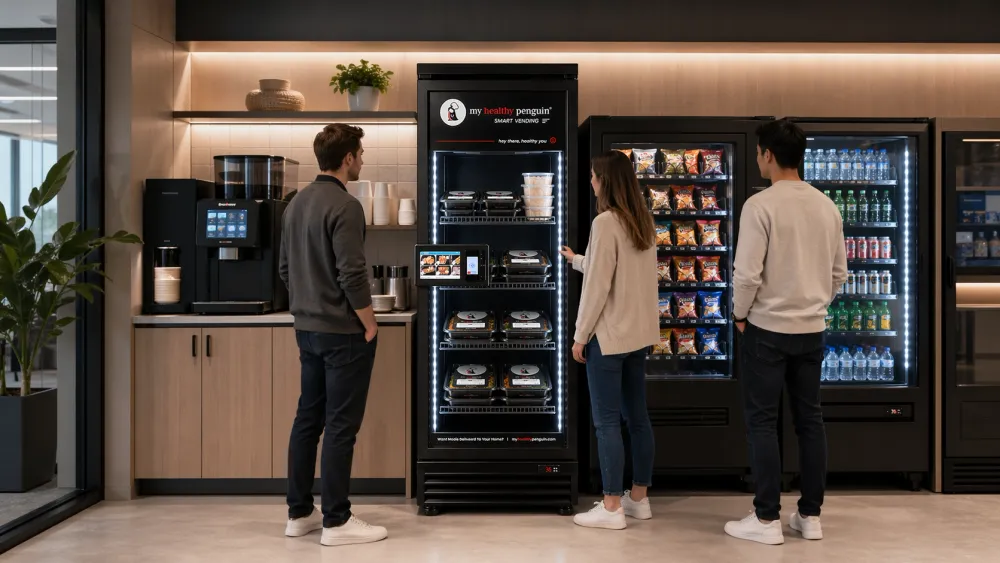
MHP Smart Fridge tap-and-go, employee grabbing a chef-prepared meal
At the Smart Fridge

A real meal. Tap, grab, microwave, eat.

They tap their card, the door opens. Beef bowl, chicken plate, vegetarian option — whatever the rotation has that week. Pick one, door closes, charged at the unit. Same simplicity as vending, different category of food.

Microwave for 90 seconds. Sit down with coworkers. Full nutrition info on the package.

By 1:00 they are full and back at the desk.

The same comparison, in a table.

For the facilities reviewer who wants to scan and decide.

MHP Smart Fridge Vending machine Micromarket
Stocked withChef-prepared real mealsPackaged snacks, drinksSnacks, drinks, packaged sandwiches
Counts as a meal~
FootprintSingle fridge unit (~2 sq ft)Single machineSection of break room (shelves + cases + kiosk)
Access modelTap-to-open, no appCoin / card / appSelf-checkout kiosk
Restocked byMHP, on live usage dataVending operator, route scheduleMicromarket operator
Replaces vending entirely~ Often coexistsN/A~ Sometimes
Nutrition baselineChef-prepared, full nutrition infoShelf-stable, lowMixed
Multi-shift / 24/7 fitBuilt for itSnack-only at 2amSnack-only at 2am
Right fit atSites needing real meal coverage 24/7Sites where snack access is the needSites with break-room real estate and snack volume
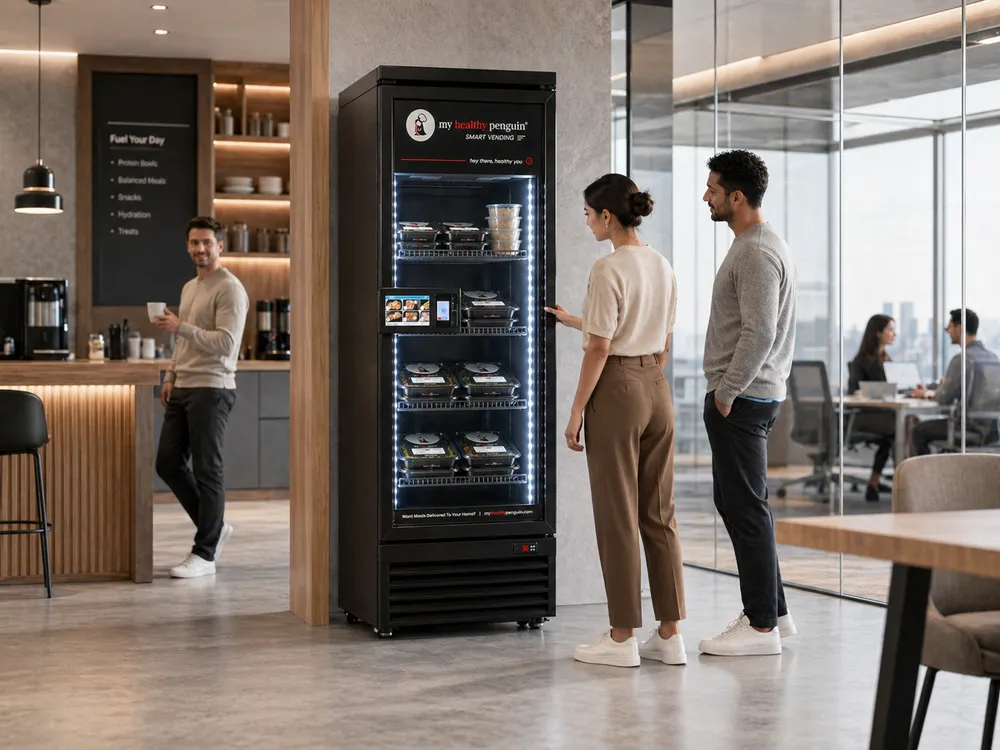
Smart Fridge in a multi-shift workplace break room
When the Smart Fridge fits

When the team needs a real meal.

The Smart Fridge is the model when the question is "how do night staff and weekend crews actually eat?" — not "how do they get a snack?" Warehouses, plants, hospitals, residential buildings, and 24/7 operations are the heaviest users. The fridge sits in the break room, restocks itself on cadence, and lets the team eat real food at hours when no cafeteria or restaurant is open.

Multi-shift or 24/7 workplaces. Sites where vending is the only current option. Offices too small for daily catering but big enough to need real food. Residential buildings looking for a real meal amenity. The fridge tucks into all of these.

See the Smart Fridge
Workplace break room where vending or micromarket is the right fit
When vending or a micromarket fits

When the need is snacks, not meals.

Some workplaces have a real cafeteria or a recurring catering program that already handles meals, and the gap is everything else — the afternoon snack, the morning coffee, the impulse purchase. That is what vending and micromarkets are built for. The two models often coexist — Smart Fridge for the meal, vending or micromarket for the snack.

If the existing cafeteria or recurring catering already handles meals, the need is snack and drink access, the break room has real estate for a micromarket, or the current vending operator is delivering value — that is the lane where they are the right answer. Still worth a 15-minute call to compare; sometimes the meal gap is bigger than it looks.

An honest moment

Where vending has a different model.

Comparison pages that only argue for the writer are not comparison pages. Here is where vending and micromarkets are the better answer, no spin.

1

Snack volume and impulse purchase.

If the actual demand is chips, granola bars, candy, and 30 sodas a day, vending was built for that. A Smart Fridge is the wrong tool for a snack problem.

2

Wide SKU count, dozens of options.

Micromarkets carry hundreds of SKUs — everything from yogurt to protein bars to ramen cups. If the workforce wants choice across many small purchases, that breadth is what the micromarket model delivers.

3

No employer cost on the snack side.

Operator-funded vending is free to the employer — employees pay at the machine. If the goal is pure access with zero P&L impact and the team is fine with snack-grade food, that route is hard to beat.

4

National coverage anywhere.

National vending operators show up everywhere. We are Southern California only. Outside SoCal, that geographic footprint is a real advantage.

Common questions.

Will the Smart Fridge replace our vending? +
Often partially. Sites with both report that meal-grade traffic shifts to the fridge and snack sales soften. Some employers pull the snack vending after a few months; others keep both. It depends on how heavy the snack culture was to start.
Who installs and maintains the Smart Fridge? +
We do — install, restock, maintenance, payment processing, all of it. The site needs a standard 110V outlet and roughly two square feet of floor space. No plumbing.
What does the Smart Fridge cost the employer? +
Three models. Pay-per-meal: employees pay at the unit and the employer pays nothing. Subsidized: employer covers a per-meal subsidy, employees pay the rest. Fully funded: employer covers meals as a benefit. We help you choose what fits the site economics.
Can we layer this on top of an existing vending contract? +
Yes. The Smart Fridge is a separate physical unit and operates independently. Most sites layer them — vending for snacks, fridge for meals — without conflict.
What about the micromarket route? +
Micromarkets are the bigger snack solution — more shelves, more SKUs, a self-checkout. They take more real estate and operate as a snack-and-packaged-item store. A Smart Fridge sits next to one cleanly when the need is real meals alongside the convenience inventory.
About this page

Written by the MHP Food Service team and reviewed by Christine, founder of MHP Food Service. Founded in 2015, MHP has been operating workplace food programs — daily catering, Smart Fridges, and weekly meal delivery — across Southern California ever since. AI is used to assist drafting; every page is reviewed and edited by a real person on our team before it ships.

Testimonials

Real teams, Real partners.

Real words from our partners we prepare for every week.

★★★★★
“Thank you for your assistance with this service! I continue to receive positive feedback every day about your services.”
Lt. Kristina CochranSanta Monica Police Department
★★★★★
“We're on our second agreement with MHP. The team adapts to our headcount changes, works with us on menu adjustments, and shows up consistently every week. One of the easier vendor relationships we've had.”
Diana De AlbaHuman Resources
★★★★★
“The fridge seems like a hit here! Everyone loves it and it's such a great option for staff to have a healthy meal on site.”
Spencer LovittFacilities Coordinator
Trusted by Southern California workplaces

Stuck with vending only?

Tell us your headcount, shifts, and current break-room setup. We will price a Smart Fridge program for your site and tell you honestly whether to keep the vending or pull it.

Price a Smart Fridge