Why a local SoCal operator works differently.
National workplace food contractors are built to operate at scale across dozens of states. A local Southern California operator is built for accountability inside one region. Both have a place. For most single-site and single-region employers under 1,000 on-site employees, the local model is the practical answer.











Local vs. national, in numbers
Where the two models differ
The same kitchen output, on paper. Different operations in practice.
| Local SoCal operator | National contractor | |
|---|---|---|
| Who answers when something goes wrong | The kitchen that prepared the food | Regional partner, then account team, then the kitchen |
| Response time on a service issue | Same business day, typically same hour | SLA-driven, often 24–72 hours |
| Contract length | Month-to-month or short pilot | Multi-year, with auto-renew |
| Menu changes | Direct conversation with the kitchen | Change request through account management |
| Sourcing | SoCal distributors, weekly | National GPO, lowest-cost bid |
| Pricing transparency | Quoted to your site | Embedded in contract overhead |
| Right fit at | Single site, 50–1,000 employees | Multi-state, 1,000+ per site |
| Food safety baseline | Same (CalCode, ServSafe, COI) | Same (CalCode, ServSafe, COI) |

One kitchen, one team, same number.
In a national contract, the food arrives from a kitchen the customer has never seen, run by people they will never meet. If the delivery is short, the path to a fix is through the account team. In a local model, the team that built the menu is in the kitchen that cooked it, and answers the call.
- One kitchen, same team every week
- One person to call when something needs to change
- Menu adjustments handled directly, not through an account team
- SoCal sourcing — produce, proteins, and dairy from regional distributors
When the national model fits better
This page is not an argument that local always wins. National contractors exist because some operations genuinely need their model.
Multi-state, multi-site employers
If a company is feeding 5,000 employees across 12 states, a national contractor's account structure, billing system, and multi-site coordination are real value.
Full on-premise kitchen management
For a campus or hospital running a full in-house cafeteria — not a drop-off catering or fridge program — the national contractor model is what the role calls for.
Sites over 1,000 daily traffic
At cafeteria-scale volume, the national contractor's overhead amortizes across enough meals to make sense. That math does not work below roughly 500 daily covers.
Sectors with national GPO requirements
Some healthcare systems and government agencies have GPO contracts that require national vendors. That is a procurement constraint, not a service-quality argument.
Same kitchen. Same SoCal.
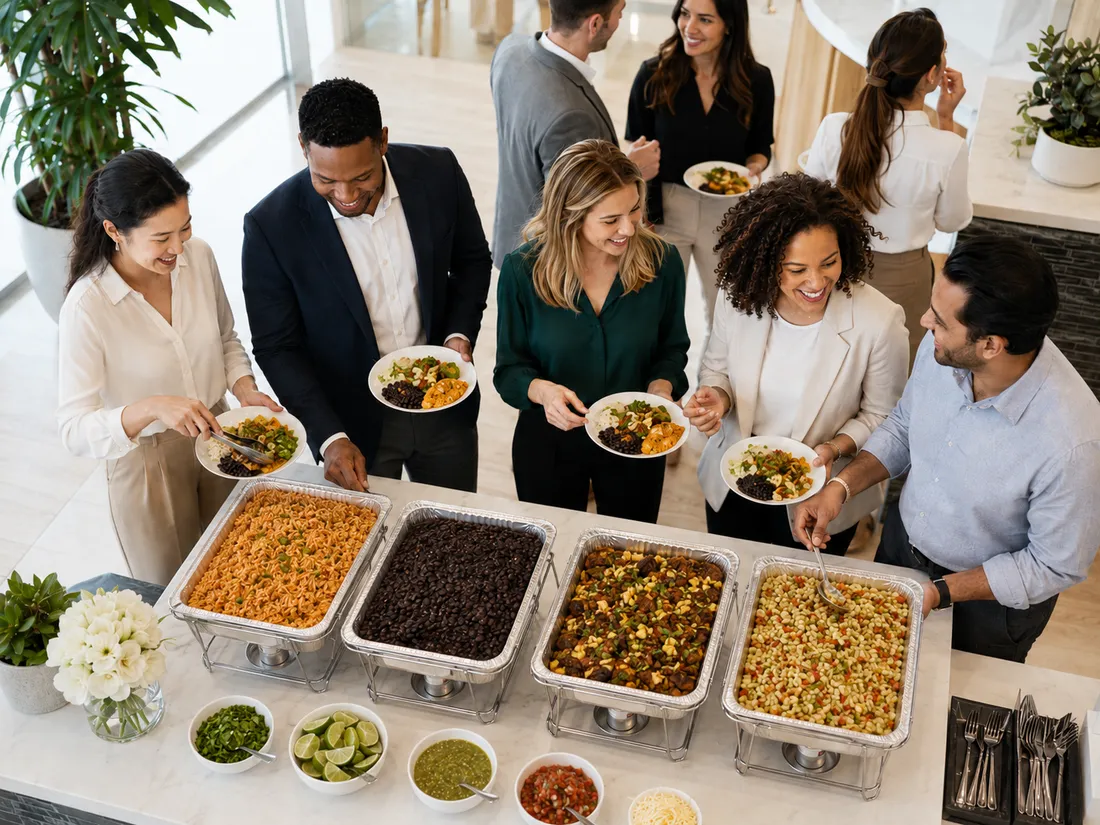
Every program we run, from a daily catering drop in Greater LA to a Smart Fridge restock in the Inland Empire to a weekly meal-prep delivery in Orange County, leaves out of the same kitchen on the same week. That is what makes a local operator local — geography, not just marketing copy.
- Greater Los Angeles, Inland Empire, Orange County
- One kitchen, one delivery footprint
- Menus built around a SoCal workforce
- Same week, every week
Why this matters for SoCal employers
Southern California is not one labor market. A workplace food operator that actually knows the region serves the team differently than one that doesn't.
Bilingual menus, not bilingual labels
A majority-Latino warehouse, plant, or care-staff floor does not need translated allergen icons. It needs menus that reflect what the team actually eats. Local operators build those by default.
Shift cadence that matches IE reality
The Inland Empire runs 24/7 logistics, manufacturing, and healthcare. A program built around the 9-to-5 cafeteria model misses 60% of the workforce.
Same-week service across the region
From Greater LA to Orange County to the IE, a local operator runs the same kitchen on the same week. A national vendor coordinates across regions, with longer turnaround on changes.
One COI, one invoice, one kitchen
For a procurement team buying workplace food once, the local model is simpler to set up, audit, and run.
Real teams, Real partners.
Real words from our partners we prepare for every week.
“Thank you for your assistance with this service! I continue to receive positive feedback every day about your services.”

“We're on our second agreement with MHP. The team adapts to our headcount changes, works with us on menu adjustments, and shows up consistently every week. One of the easier vendor relationships we've had.”
“The fridge seems like a hit here! Everyone loves it and it's such a great option for staff to have a healthy meal on site.”
Pricing a workplace program in Southern California?
Get a quote from a local kitchen. One conversation, one quote, one team. We will tell you if a national contractor is the better fit.
Talk to the kitchen ↗