Guides
Delivery apps vs. managed workplace food for Inland Empire teams
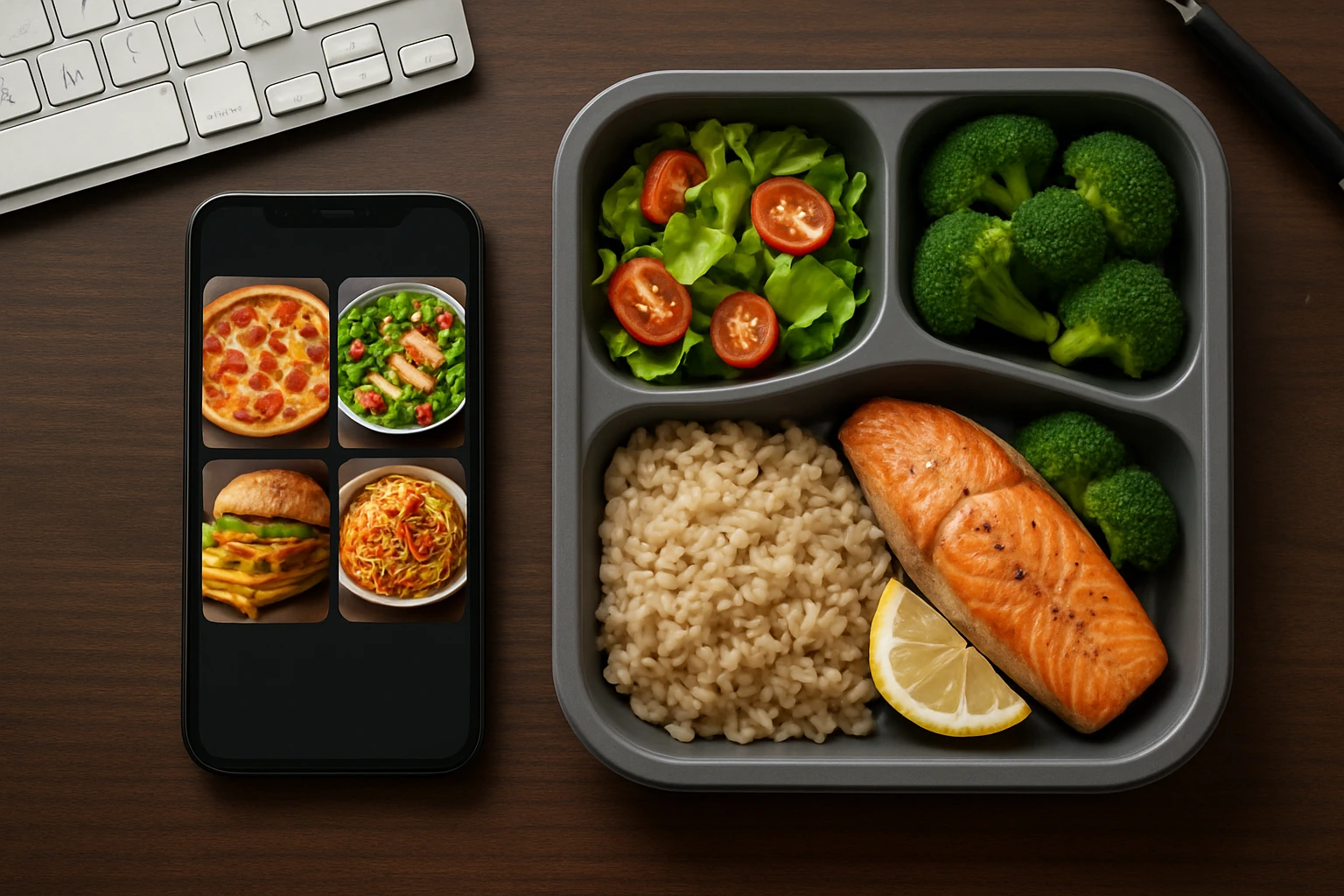
Delivery apps have become the default food benefit for a lot of Southern California employers, not because they work well, but because they are easy to set up. Give employees a monthly credit, point them to DoorDash or Uber Eats, and the food benefit box gets checked. This guide is for HR and Operations leaders in the Inland Empire who are starting to notice that the box is checked but the problem is not actually solved.
A delivery app stipend gives each employee a monthly credit, often $25 to $100, toward orders on DoorDash, Uber Eats, Grubhub, or a managed business account version like DoorDash for Business. The employer pays, the employee orders, and the vendor takes a cut. On paper it looks flexible and employee-friendly. In practice, it is one of the least efficient forms of food spend you can run.
The reason: delivery platform fees are built into every transaction. Third-party delivery apps charge restaurants 15% to 30% commission plus payment processing, and those costs pass through to order pricing, delivery fees, service fees, and minimum-order requirements (Rezku, Third-Party Delivery Fees in 2026). A $25 monthly stipend after delivery fees, service fees, and tips often covers one to two actual meals. The money leaks to platform fees before it reaches food.
For employers in Ontario, Rancho Cucamonga, Riverside, or any of the Inland Empire's suburban office corridors, delivery apps hit a second wall at lunchtime. When 80 people in one building all order between 11:50 and 12:15, the local restaurant capacity and driver supply cannot absorb that volume simultaneously. Orders arrive late, cold, or incomplete. The front desk is managing a stream of drivers. The experience degrades for everyone, on the day when everyone is hungriest and most likely to notice.
This problem is worse in office parks with limited nearby restaurant density. Delivery from downtown Riverside to an office on the I-10 corridor in Ontario can take 45 minutes on a busy day. That is not a 30-minute lunch break. It is a meal you ordered at noon and ate cold at 12:50.
For most Inland Empire industrial and logistics sites, delivery apps are not even a partial solution. A warehouse in Fontana or a distribution center in Moreno Valley does not have residential-density restaurant coverage within delivery range. Orders hit minimum fees or simply cannot be placed. Workers on a 30-minute break cannot wait for a driver. Night-shift workers after 10 p.m. find most nearby restaurants closed or drive-thru only. For these teams, which represent a significant share of the IE workforce, delivery apps are not a food benefit at all.
The data on night-shift nutrition backs this up. When on-site food options are limited to vending, night-shift workers default to packaged snacks and energy drinks, not because they prefer it but because there is no alternative (MDPI Nutrients, Shift Work and Dietary Choices, 2024). An app stipend does not solve the structural food access problem; it just moves the failure point from the vending machine to the smartphone.
A managed on-site food program eliminates the variables that make delivery apps unreliable. The food is already at your location, either delivered as part of a buffet setup, pre-portioned and in your break-room fridge, or accessible 24/7 through a stocked smart fridge. No driver dependencies, no peak-hour failures, no order minimums, and no fee leakage.
For teams of 100 or more eating a shared lunch, the Daily Drop-Off Lunch Buffet delivers hot food, sets up on-site, and breaks down without your team managing anything. For smaller groups or teams wanting individual grab-and-go, the Weekly Team Meal Delivery puts labeled, pre-portioned meals in your fridge every week. For 24/7 sites, the Smart Fridge is always stocked and accessible without ordering or waiting.
The comparison between delivery app stipends and a managed program is not just about per-meal cost. It is about the cost of the experience. A $50 monthly app stipend that delivers one or two usable meals per month and generates employee frustration is not a $50 benefit. It is a $50 spend with negative net impact. A managed program at a similar per-employee cost that reliably delivers multiple meals per week builds visible loyalty, drives participation in return-to-office days, and frees up the HR and admin time that app administration consumes.
Research consistently shows that food benefits with high visible utilization have stronger retention impact than benefits employees forget they have. A monthly app credit that disappears in fees and infrequent use is easy to forget. Hot food in the break room on Tuesday and Thursday is not.
Delivery apps are genuinely useful for remote workers who are never on-site and for ad hoc individual meal needs that fall outside a structured program. A remote employee in San Bernardino or Temecula who works from home three days a week is a reasonable use case for a delivery benefit, though our Remote Employee Meal Delivery program is a more reliable alternative for distributed teams who want real meals on a schedule, not a credit toward app chaos.
The point is not that delivery apps are useless. The point is that they are the wrong tool for on-site team feeding, and a lot of Inland Empire employers are using them as a substitute for a real program because a real program feels like more work. It is not, once it is set up. Talk to us and we will show you what it looks like for a team your size, at your location, on your schedule, from our kitchen in Rancho Cucamonga, no long-term contract required.
When 80 people at one office all order through DoorDash or Uber Eats between 11:50 and 12:15, the local restaurant capacity and driver supply cannot absorb that volume. Orders arrive late, cold, or incomplete. The front desk is overwhelmed with drivers. The experience degrades for everyone at the moment everyone is most hungry.
A delivery app stipend is a monthly per-employee credit toward DoorDash, Uber Eats, or a similar app. Employers use it because it is easy to administer. The problem is that it gives money without controlling the experience and much of the credit goes to platform fees, tips, and delivery charges rather than actual food.
Managed programs are generally more cost-efficient per usable meal. A $25 monthly app stipend often covers one or two actual meals after fees. A managed program at a similar per-employee cost delivers food reliably multiple times per week with zero administrative overhead.
Rarely. Most Inland Empire warehouses and factories are in industrial park locations where delivery coverage is thin, order minimums are high, and a 30-minute meal break does not leave room for app ordering and wait times. On-site food is the right answer for these sites.
MHP is a full replacement for delivery app stipends as a daily food benefit. Our programs deliver real meals on-site, no app required, no per-order fees, no driver reliability issues. We serve employers across the Inland Empire, Orange County, and greater Los Angeles.