Guides
Office park food deserts in the Inland Empire: the real impact on workers
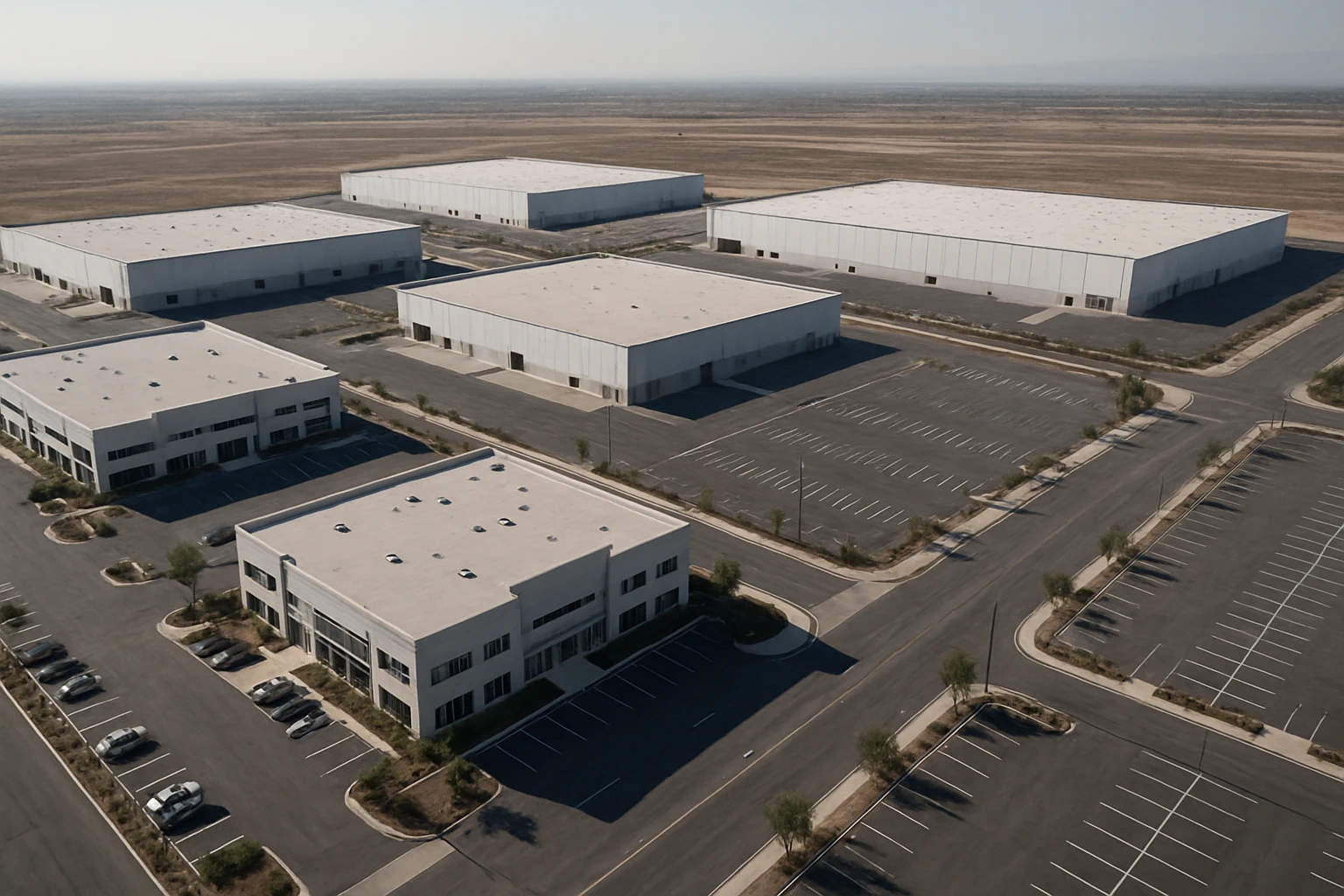
The Inland Empire holds roughly one billion square feet of industrial space, four thousand warehouses, and hundreds of corporate office parks and a significant portion of it sits in food deserts where workers cannot access quality food within a practical distance during a break. This is not a minor inconvenience. For the hundreds of thousands of workers in Ontario, Fontana, Rialto, Moreno Valley, San Bernardino, and the surrounding industrial corridors, the daily reality of feeding yourself at work is genuinely difficult. This piece explains the problem, why it matters to employers, and what you can do about it.
The academic definition of a food desert focuses on residential areas more than a mile from a supermarket. The worksite version is different but just as structural: it is a location where employees cannot access quality, affordable food within walking distance or a short drive during a 30-minute meal break. In the IE, this looks like a million-square-foot distribution center in Ontario surrounded by loading docks and parking lots, with the nearest sit-down food half a mile away. It looks like a corporate office park on Inland Empire Boulevard in Rancho Cucamonga, flanked by other office buildings and accessible only by car. It looks like a manufacturing plant on the south side of Fontana where the food options within a mile are two fast-food drive-thrus and a gas station.
The Food Empowerment Project notes that suburban patterns and limited public transit fuel food access gaps in working communities, with quality food often miles away from where people work (Food Empowerment Project, Food Deserts). Trade press for vending operators makes the same observation from a business angle: warehouses tend to be located in areas where there are few options for food if not packed and brought from home (VendingExchange, Vending for Warehouses).
California law requires a 30-minute unpaid meal break for shifts over five hours. What the law does not account for is the physical distance from workstation to break room, checkpoint re-entry, and the logistics of leaving and returning to a large facility. Research and worker accounts in the IE consistently show that a functional 30-minute break is more like 20 to 22 minutes of actual eating time once you factor in the walk to the break room, hand washing, finding a seat, and reversing the process.
That leaves no time to leave site for food. A round-trip to the nearest fast-food location, managing a large parking lot, waiting in a drive-thru line that is often backed up at 11:30 a.m. and noon, and getting back through security, takes 20 minutes minimum and realistically 30 or more. Workers who try it come back late. Workers who do not try it default to whatever is in the vending machine, whatever they brought from home, or nothing at all. None of those is a good outcome over the course of a 10-hour shift.
The rotation workers in IE industrial sites describe is narrow: cold food brought from home and eaten cold because the microwave line ate the break window, vending machine chips and energy drinks, fast food grabbed in a car during a rare window, and skipped meals. Night-shift workers have it worse: most surrounding restaurants are closed after 10 p.m., reducing options to vending, gas-station roller-grill items, and drive-thru windows that may or may not be open.
Peer-reviewed nutrition research on shift workers confirms the pattern: night-shift workers consistently score lower on diet quality measures and report less access to healthy food options than day-shift workers, with the gap widening in industrial locations with limited food infrastructure (MDPI Nutrients, Shift Work and Dietary Choices, 2024).
The connection from food access to employer outcomes runs through several documented pathways.
Safety. Night-shift injury rates run 30% higher than day-shift rates, and occupational health research links fatigue, impaired judgment, and slower reaction times to poor nutrition and inadequate food breaks (OH&S, Shadows and Sleep Deprivation, 2026). A worker running on energy drinks and chips in a 90-degree warehouse is a safety risk that shows up in OSHA recordables and workers' comp claims.
AB 701 compliance. California's warehouse quota law exists precisely because workers were being denied real meal breaks under production pressure. An employer who has no on-site food option is inadvertently pushing workers to skip the meal rather than spend their break on an impossible food run. Missed meal breaks cost one hour of premium pay per occurrence under California labor law, and a 2024 Inland Empire wage-theft settlement reached $1 million specifically over break violations (California DIR, 2024).
Retention. The Inland Empire labor market is competitive. Workers compare employers, and food access is a visible, discussable feature of the job. Glassdoor and Indeed reviews of IE industrial employers regularly mention food options as a factor in satisfaction scores. An employer who provides real food on-site differentiates from the one that does not and that difference shows up in time-to-fill and turnover rates.
The structural fix for a worksite food desert is bringing food to the workers, not expecting workers to solve the food access problem on their own. That means on-site food programs: a Smart Fridge stocked with fresh meals and accessible around the clock for any shift, a recurring Drop-Off Lunch Buffet for larger teams during a set window, or a Weekly Meal Delivery that puts pre-portioned individual meals in the break-room fridge on a set day each week.
Any of these eliminates the food desert for the people at that site. The food is there, it is real, it is labeled, and it does not require leaving the building or waiting in a drive-thru line. For warehouse and logistics employers across the IE, Ontario, Fontana, Rialto, Moreno Valley, San Bernardino. This is the most tangible worker-experience improvement available at reasonable cost.
MHP is based in Rancho Cucamonga and built specifically to serve the IE industrial and office corridor. We know which office parks are surrounded by food options and which are isolated, and we serve both. If your site is in a location where workers are visibly struggling to eat during their breaks, that is the conversation to start. Get in touch and we will look at your site, your headcount, and your shift pattern together and recommend the program that makes the most practical sense. No long-term contract required to start.
A worksite food desert is a location where employees cannot access quality, affordable food within a practical distance during their meal break. In the IE, this typically means industrial parks and office corridors where the nearest food options are fast-food drive-thrus a half-mile or more away, with nothing fresh or accessible on foot.
Industrial zones in Ontario, Fontana, Rialto, San Bernardino, Moreno Valley, and parts of Riverside consistently have the thinnest food options near worksites. The pattern follows the large industrial belt running from Pomona to San Bernardino, the same corridor that houses most of the IE's warehouse and manufacturing employment.
The most direct solution is an on-site food program: a smart fridge for 24/7 access, a weekly meal delivery for grab-and-go, or a recurring drop-off lunch buffet for larger teams. These bring food to the site rather than expecting workers to solve food access on their own during a 30-minute break.
Yes. Workers who consistently struggle to eat well during a shift are more likely to cite quality of life as a factor in leaving. In the competitive IE labor market, on-site food is an observable differentiator that shows up in Glassdoor reviews and word-of-mouth hiring.
Yes. MHP is based in Rancho Cucamonga and serves industrial, warehouse, and office locations across the IE, including Ontario, Fontana, Rialto, San Bernardino, Moreno Valley, and surrounding cities, where food access is structurally limited.