Guides
New-hire welcome meals: how to make a great first-week impression
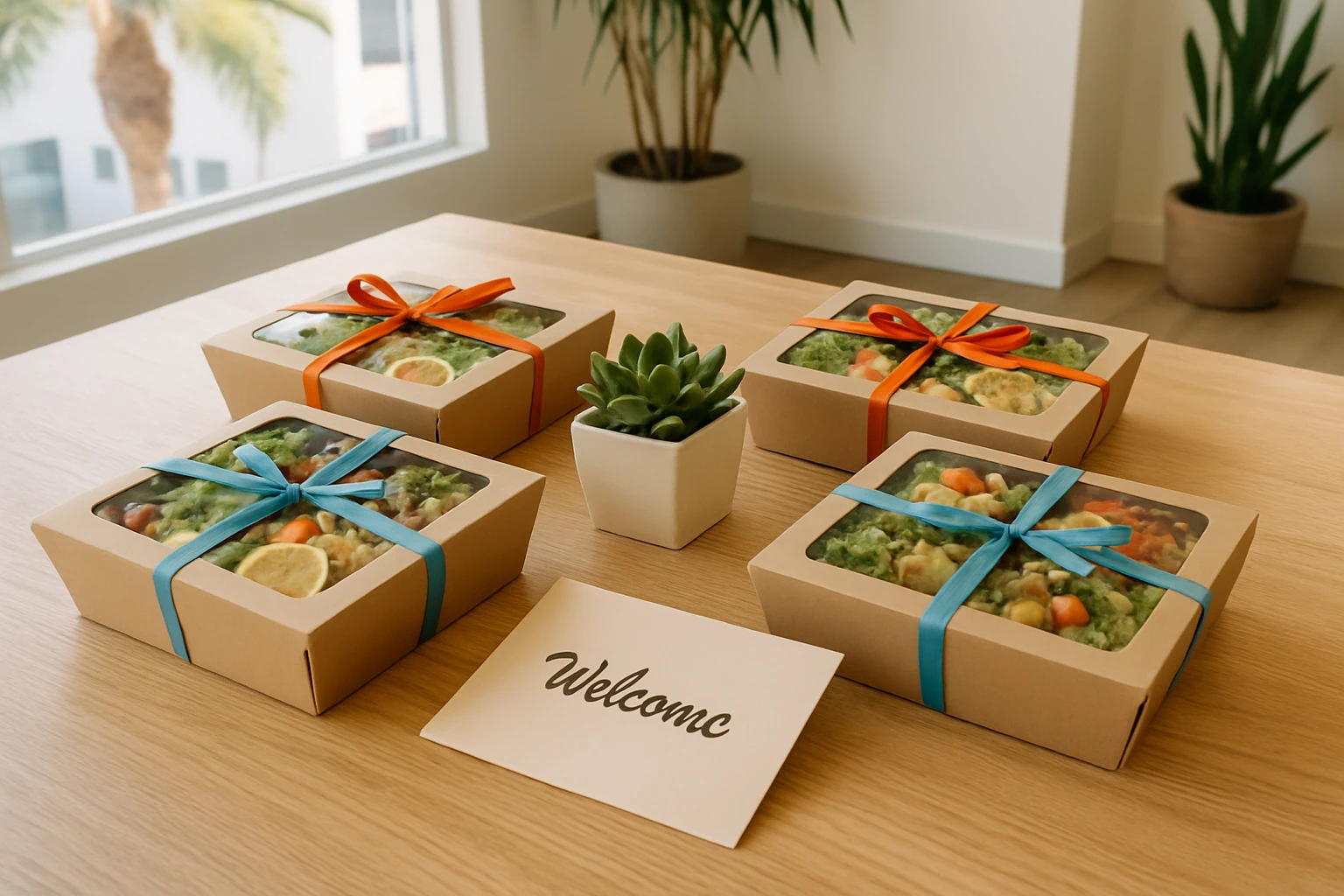
For many Southern California employers, the first week of employment is where retention is won or lost before it ever shows up in a retention metric. The 90-day attrition number is one of the most telling indicators of onboarding quality, and the first week, with its combination of administrative chaos, unfamiliar people, and logistical confusion, is often where the impression forms. A welcome meal is one of the lowest-cost, highest-visibility signals that an employer can send during that window. This guide covers why it matters and how to build it into your onboarding reliably.
SHRM research on onboarding consistently finds that organizations with strong onboarding programs improve new hire retention by up to 82% and productivity by over 70% (SHRM, Benefits and Compensation Research). The mechanism is not complicated: new employees form their assessment of the company quickly, and that assessment is shaped heavily by the signals of the first week. A disorganized first week, no workstation ready, no introduction to the team, no clear plan for the day, signals that the company does not run a tight ship. A well-organized first week signals the opposite.
Food is a particularly visible signal because it intersects directly with basic human needs. A new hire who arrives on their first day, navigates a full morning of paperwork and orientation, and then has to figure out independently where to eat lunch in an unfamiliar location has a small but real stress experience. A new hire who arrives to find that the company has a lunch program, that food is simply there, has a different first-week narrative. It is a minor detail that consistently comes up in new-hire surveys as a positive signal of employer attentiveness.
A welcome meal does not need to be elaborate. The point is reliable, quality food that removes one logistical burden from a day that is already full of them. The most practical formats for Southern California employers are:
The common thread is that the food is already arranged. The new hire does not have to ask where to eat. The manager does not have to make a reservation. It just happens, the same way on every onboarding day.
Replacing a warehouse worker, manufacturing associate, or customer service representative in the Inland Empire costs an employer roughly 16% to 20% of annual salary in recruitment, training, and productivity loss, $7,000 to $9,000 for a $45,000 role. For a professional in a corporate or healthcare role, replacement cost climbs to 50% to 80% of annual salary (Gallup via Turnozo, Employee Turnover Cost). If a company hires 50 people per year and loses 15% of them in the first 90 days, that is $52,000 to $67,500 in early attrition cost on a conservative estimate for $45K-average-salary roles, before accounting for the disruption to their teams.
A well-run first week does not eliminate early attrition by itself, but it contributes meaningfully to the impression that reduces it. The per-new-hire cost of a welcome meal, $15 to $25, is essentially invisible against the alternative.
The welcome meal is most powerful when it introduces a program that continues. A new hire who gets a great first-week meal, and then discovers on their second week that there is no food at all, gets a jarring whiplash. The better version is: the welcome meal is the first experience of a recurring food benefit. New hire arrives, gets a meal from the program they will continue to have access to, and leaves week one knowing that food is a consistent part of working here.
For companies building this out, the question is how to sequence it. If you have a weekly meal delivery program, new hires are automatically included. If you have a smart fridge, they get access from day one. If you do not have a recurring program, the welcome meal is a natural pilot: run it for 90 days on every onboarding week, survey new hires at 30 and 60 days, and use the data to make the case for the full program. See our guide to proposing a food program to your CFO for how to structure that proposal.
The welcome meal only works if it happens reliably without requiring manual coordination every time. The way to make that happen is to build it into the onboarding checklist as a standing order with your food vendor. At MHP, this means: when you notify us of a new-hire start date (which you can do by email or through your account), we include a labeled meal in that week's delivery. No special orders, no phone calls, no logistics for your HR team. The meal is simply there on the same schedule as everything else.
MHP serves employers across the Inland Empire, Rancho Cucamonga, Ontario, Riverside, San Bernardino, Fontana, Moreno Valley, as well as Orange County and greater Los Angeles. If you want to discuss building a welcome meal into your onboarding, get in touch and we will walk through what it looks like for your site and headcount.
The first week shapes a new hire's impression of the company in ways that persist for months. SHRM research shows companies with strong onboarding programs improve new hire retention by 82%. A welcome meal is a low-cost, high-visibility signal that the company cares about the employee as a person, one of the factors employees cite most in decisions to stay through the critical 90-day period.
For small cohorts of one to five new hires, a pre-portioned individual meal delivered on their first day is easiest to manage. For larger onboarding groups, a shared drop-off lunch on the first day or end of the first week works well. Consistency matters more than format.
Early attrition is often driven by a mismatch between what was sold during recruiting and what the job actually feels like. A warm, organized first week, including having food ready, signals that the company runs a professional, attentive operation and counters the disorganized-first-week feeling that is a common early-departure catalyst.
Yes. MHP's weekly meal delivery program scales down to small teams and individual deliveries. A standing arrangement where new hires receive a meal on their first day can be coordinated through your HR team with minimal ongoing administration.
Yes. We deliver across the IE, Rancho Cucamonga, Ontario, Riverside, San Bernardino, Fontana, Moreno Valley, and surrounding cities, as well as Orange County and greater Los Angeles.