Smart Fridge
Off-hours food for Temecula and Murrieta employers
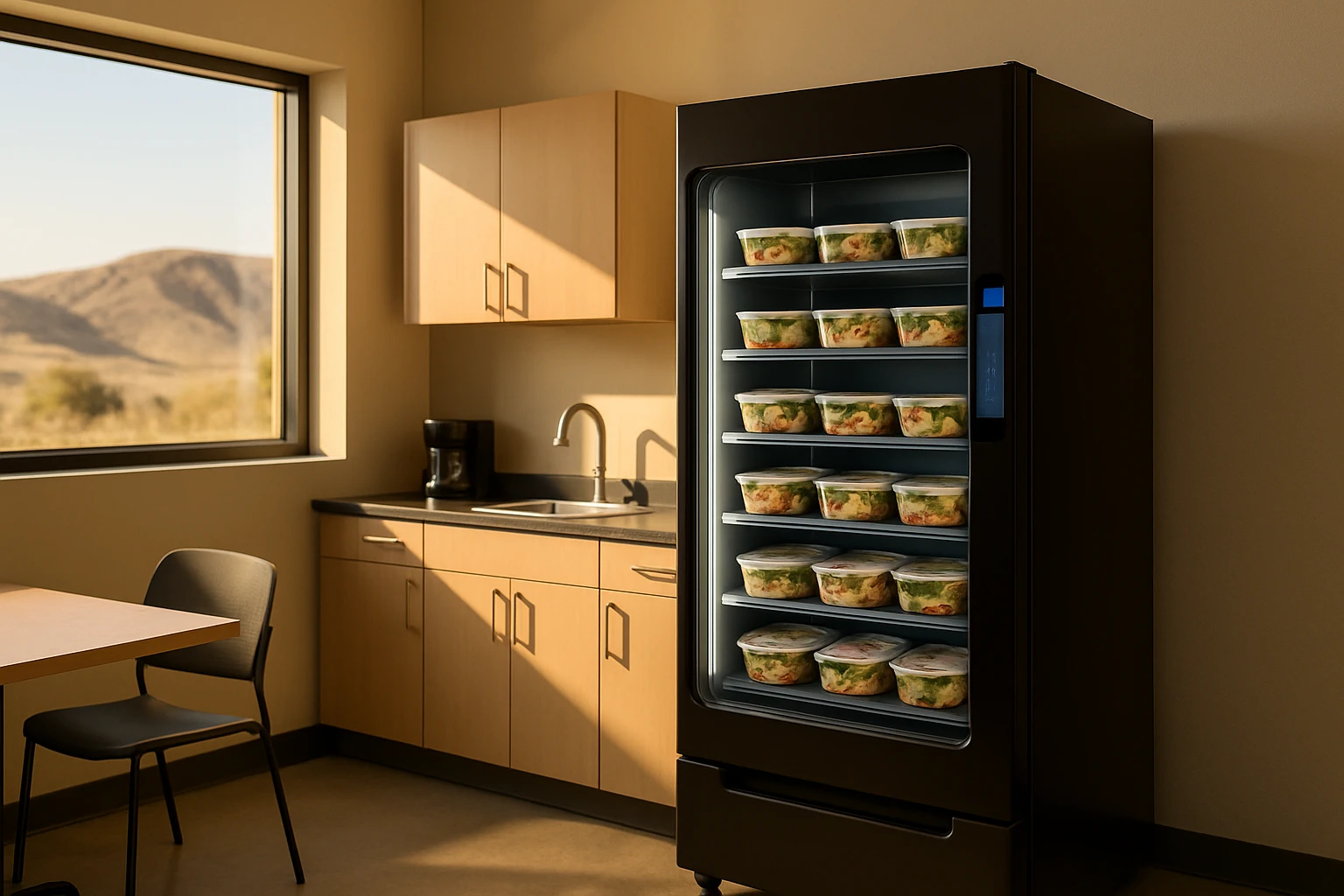
Temecula and Murrieta are not what most people picture when they think of the Inland Empire. They sit at the southern end of Riverside County, roughly equidistant from the IE's industrial core and the San Diego metro, with a character that blends the wine country lifestyle of the Temecula Valley with a fast-growing employment base that spans healthcare, biotech, distribution, and light manufacturing. The I-15 corridor through Southwest Riverside County is one of the most actively developing employment zones in Southern California and it has a food access problem that employers here are only beginning to address.
The employment mix in the Temecula-Murrieta corridor is more diverse than the region's wine country reputation suggests. Palomar Health's footprint in the area brings significant healthcare employment, including nurses, CNAs, imaging technicians, and clinical staff who work around the clock. The biotech and medical device sector has established a meaningful presence, with facilities that require skilled technical workers on multi-shift schedules. Distribution and logistics operations have expanded along the I-15 near French Valley and the 215 interchange, adding warehouse and logistics roles that run day and night shifts.
Beyond the commercial corridor, the winery and hospitality industry supports a workforce of early-morning logistics staff, maintenance crews, and guest services workers whose schedules do not align with normal restaurant hours. A winery logistics team loading refrigerated trucks at 5am or a hospitality crew prepping for a weekend event at 6am faces the same problem: there is almost nothing open, and whatever vending machine sits in the break room is their only option.
This is the off-hours food problem as it presents in Temecula and Murrieta: not the dramatic isolation of a remote desert facility, but the quieter food desert of a suburban employment corridor that shuts down its food options after 9pm and does not come back online until 7am. For workers on the edges of those hours, the gap is real.
The Temecula and Murrieta commercial corridor has plenty of food options during business hours. There are corporate park cafes, fast casual chains along Winchester Road and Murrieta Hot Springs Road, and a reasonable selection of sit-down restaurants. But after 9pm, options collapse to fast food at the freeway interchanges and whatever convenience store is still lit. For workers arriving at 4am for an early logistics shift, leaving at 11pm after an evening healthcare rotation, or working through the overnight at a 24-hour distribution center, those options are genuinely inadequate.
This is a structural feature of suburban employment corridors throughout California, and Temecula-Murrieta is not unusual in it. What makes the area distinctive is the rate of growth. Both cities have seen significant population and employment expansion over the past decade, driven in part by employees priced out of San Diego and coastal Orange County who are willing to commute or relocate for more affordable housing. The workforce is increasingly sophisticated about benefits and wellness expectations, people who were accustomed to San Diego-area employers competing on perks do not lower their expectations just because they moved to Murrieta.
Temecula and Murrieta employers occupy an interesting competitive position in the regional labor market. They are close enough to the IE's core employment corridor to compete for logistics and manufacturing workers who might otherwise work in Ontario, Fontana, or Perris. They are close enough to North San Diego County, particularly the Escondido, Vista, and San Marcos areas, to draw healthcare and biotech workers who might prefer a shorter commute than a drive to Carlsbad or Sorrento Valley. That means competing with employers in both directions for talent.
San Diego-area employers, particularly in healthcare and biotech, have often invested more heavily in employee benefits and workplace culture than IE employers at comparable size. A nurse or clinical tech considering a position at a Murrieta healthcare facility versus one in Oceanside is making a quality-of-life comparison that extends to workplace food. A food benefit, specifically a smart fridge that provides real meals around the clock, is one of the most concrete and daily-visible ways a Temecula or Murrieta employer can close that perceived gap.
For logistics and distribution employers competing with the IE's core, the dynamic is slightly different: the competition is more about wage and shift structure, but food benefits have emerged as a meaningful secondary factor in a market where turnover is high enough that any retention lever matters.
The smart fridge solves the off-hours food problem in a way that is particularly well-matched to the Temecula-Murrieta employment context. It is a 24/7 solution that requires no food service staff, no kitchen, and no scheduled meal window. It is stocked on a regular cycle by MHP and available whenever the break room is accessible, which, for an overnight logistics team or an overnight healthcare shift, is the key distinction from every alternative.
For employers in this corridor, the smart fridge also communicates something important about how the employer values employees who work the less desirable shifts. Night shift workers, early morning logistics crews, and weekend healthcare staff are routinely underserved by workplace food programs designed around the day shift. A smart fridge that is stocked and available at 3am sends a message that these employees were considered and that message registers.
Our guide to corporate catering alternatives in Temecula covers the full landscape of food options in the area for employers who want to compare formats. Our post on corporate lunch programs in Temecula covers the day-shift catering model for employers whose needs are primarily during business hours. The smart fridge is specifically the right tool for employers with off-hours crews. See the Smart Fridge program page for program details.
Yes. Temecula and Murrieta are within MHP's service area. Smart fridge restocking is scheduled based on the usage patterns at each site, and we calibrate frequency to keep the unit well-stocked without generating waste. The southern Riverside County corridor, including Temecula, Murrieta, and surrounding areas, is a regular part of our delivery route.
Healthcare and clinical facilities, logistics and distribution operations near the I-15 corridor, biotech and medical device employers, and winery or hospitality operations with early-morning logistics crews are the most common. The common thread is off-hours workers, employees whose shifts start or end outside of normal business hours when local food options are limited or closed.
Yes. A smart fridge is viable at smaller headcounts, particularly when the team works varied shifts and the usage is spread across the day rather than concentrated at a single lunch hour. For a 25-person team with day, swing, and overnight workers, the fridge serves each shift independently, the aggregate daily usage is sufficient to justify regular restocking. We discuss headcount and usage patterns during the initial site assessment.
In core IE cities like Ontario and Fontana, the density of fast food and convenience options is higher, so overnight workers often have a few choices within driving distance. In Temecula and Murrieta, the suburban corridor model means fewer late-night or early-morning options, particularly for workers who cannot leave the facility during a break. In that sense, the off-hours food gap is arguably more acute in Southwest Riverside County than in the denser IE core, which makes the smart fridge case even stronger.
Yes. MHP builds menus for diverse workforces and can weight the rotation toward dietary categories relevant to the site's workforce. Temecula and Murrieta have diverse employee demographics, and we take that into account when configuring the menu. Halal-certified options, plant-based proteins, and gluten-aware formats are all part of the standard rotation and can be prioritized based on workforce composition.
Tell us about your team and we will recommend the right program and a worksite-specific quote. No high-pressure sales.