Smart Fridge
Smart fridge for remote and satellite offices in SoCal
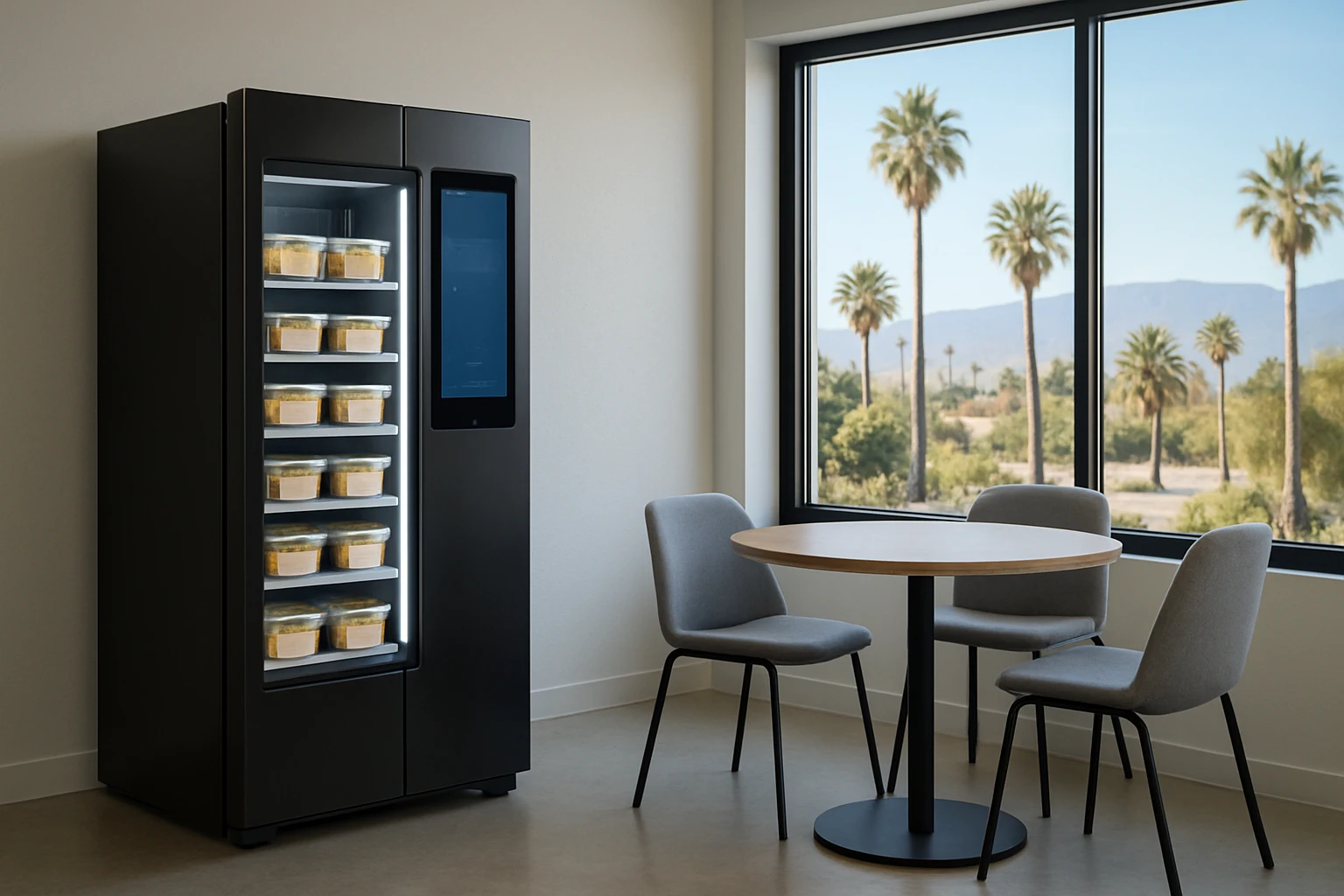
A company's headquarters might have a full catering program, a dining room, and a fleet of vending options. The 20-person satellite office in Chino Hills, the 15-person team in a Corona business park, the 25-person regional branch in Murrieta, those locations usually have a coffee maker and a vending machine that was installed in 2017 and still sells the same four items.
This is the satellite office food problem, and it is remarkably common across Southern California. Smaller offices exist in locations that do not make sense for a full food service program, but the people who work in them are not less hungry than their colleagues at headquarters. A smart fridge is purpose-built for this exact scenario: the right-sized solution for teams too small for a full program but too real to justify nothing.
Most corporate food service models are built around scale. A daily catered buffet makes economic sense when you are feeding 75 or more people, the per-head cost comes down, the logistics justify the trip, and the program has enough critical mass to run reliably. Below that threshold, the economics shift. A catered lunch for 20 people costs roughly the same per head as one for 100 people, but it is harder to justify to finance as a line item when the team is small and the location is remote from HQ.
Weekly meal delivery is a better fit for smaller teams, but it still requires advance ordering, distribution logistics, and some level of coordination, usually from whoever happens to be the informal "office manager" at the satellite location. For a 15-person office, that person is often already wearing six other hats and does not have the bandwidth to own a food program.
The smart fridge eliminates that coordination requirement entirely. It is there, it is stocked, and the only thing required from the satellite office is a break room with a standard outlet. No weekly ordering, no delivery coordination, no one to manage the program on-site.
There is an HR dimension to the satellite office food problem that gets overlooked in budget conversations. When headquarters employees have access to a catered lunch and satellite employees have a vending machine, it creates a visible, daily reminder that not everyone at the company is treated equally. This is not abstract. It is something satellite employees notice and talk about.
In 2026, when most companies are managing return-to-office expectations and trying to make the commute worth it for employees who have gotten comfortable working from home, the satellite office is at a particular disadvantage. These employees often chose their location specifically because it was closer to their home than the main office. When they come in, the in-office experience needs to be meaningfully better than the at-home experience. A vending machine does not clear that bar.
A smart fridge is a concrete signal that satellite employees are valued. It says: we know you are not at headquarters, and we made sure you have access to the same quality food program that our other locations have. That signal is disproportionate to the cost of the program. A smart fridge for a 20-person office is not expensive. The goodwill it generates with a team that might otherwise feel forgotten is significant.
A 15-person team in Corona. The office is in a business park off the 15 freeway, surrounded by logistics buildings. The nearest restaurant is a fast food drive-through 10 minutes away. Workers who want a real lunch drive out and come back late, or they eat from the vending machine in the lobby. A smart fridge stocked twice weekly with MHP meals gives the team 12 to 15 different meal options at any given time, enough variety that nobody is eating the same thing twice in a week.
A 25-person team in Murrieta. The office is in a suburban business park in the Temecula Valley. There are restaurants in the area, but peak-hour traffic on Jefferson Avenue makes a round trip during a 30-minute lunch break impractical. Several team members are eating at their desks because leaving feels like too much overhead. A smart fridge makes eating at break time a 90-second task: walk to the break room, tap access, grab a meal, microwave, eat. No car required.
A 20-person office in Chino Hills. The team is a mix of sales, operations, and support staff who are in the office three to four days per week on a hybrid schedule. The challenge is that the in-office days feel less appealing than home because there are fewer amenities. A smart fridge changes that calculation, employees know that when they come in, they have access to a real meal that they do not have to prepare or order. It becomes a small but genuine incentive to choose the office.
The smart fridge is the right format for satellite offices with as few as 10 to 15 on-site employees. Below that threshold, consumption may be too low to justify the restocking frequency. Above 40 or 50 employees, a weekly meal delivery or a daily buffet program may offer better value per head. The sweet spot for a single smart fridge is a satellite team in the 15 to 40 person range, large enough to generate consistent usage, small enough that a larger food program does not make economic sense.
For satellite offices on the larger end, two fridges or a combination of a fridge and a weekly meal delivery can bridge the gap. MHP will make a specific program recommendation based on your headcount and any shift or schedule considerations.
One of the most practical advantages of the smart fridge for satellite offices is that it requires no local coordinator. The HR business partner at headquarters does not need to manage a vendor relationship for each satellite location. The office manager at the satellite site does not need to manage food. MHP handles everything: restocking schedule, food safety, payment processing, and any service issues. The only thing the satellite location needs to do is provide building access for MHP's restock team on the days they visit.
This is meaningful for organizations with multiple satellite locations, a network of small offices across Southern California can all run the same smart fridge program through a single MHP account, with consolidated billing and consistent service across every location.
See our Smart Fridge program page and Weekly Team Meal Delivery for the larger satellite office alternative. Our corporate offices page covers the broader range of program types for office environments. And our Rancho Cucamonga employee lunch guide covers adjacent market context for IE satellite office teams.
In most cases, a satellite office with 12 to 15 on-site employees on a given day can support a smart fridge program with two restocks per week. Below 10 regular on-site employees, consumption may be too low to keep the fridge fresh and fully utilized. MHP will assess your team size and in-office frequency and make a specific recommendation.
Yes. MHP manages multi-location programs under a single account with consolidated billing. Many SoCal employers with a network of satellite offices use this model, one agreement, one point of contact, service at all locations. Restocking schedules are set independently per location based on each site's usage patterns.
No. That is one of the core advantages of the smart fridge for satellite offices. Once the fridge is installed and access is configured, the satellite location has no ongoing management responsibilities. MHP handles restocking, food safety, and any service issues autonomously. Your headquarters HR team manages the account; the satellite team simply uses the fridge.
MHP monitors consumption remotely on connected units and can adjust the restock schedule if usage is higher than anticipated. For satellite offices with more variable attendance, due to hybrid schedules or seasonal fluctuations, MHP calibrates the restock frequency over the first few weeks of operation based on real usage data. If the fridge unexpectedly runs low, the site contact can notify MHP for an off-schedule restock.
Yes. Subsidy levels can be configured per location. An employer might choose to fully subsidize meals at a satellite office as a parity measure, matching the value of a catered lunch at headquarters, while running a different model at the main campus. This flexibility is built into MHP's program structure and managed through the same account dashboard.
Tell us about your team and we will recommend the right program and a worksite-specific quote. No high-pressure sales.