Smart Fridge
Smart fridge for senior living facilities in SoCal
There is a particular irony in how senior living facilities treat their staff's food access. These facilities spend enormous energy on resident nutrition, detailed dietary plans, trained culinary staff, meal programs designed around the health and dignity of older adults. The food served to residents is often thoughtfully planned and carefully prepared. And then, in the staff break room, there is a vending machine.
The nurses aides, CNAs, caregivers, housekeeping staff, and kitchen workers who spend 12 hours ensuring that residents are fed, bathed, medicated, and cared for often have no access to real food for themselves during those same 12 hours, unless they bring their own. The facility cafeteria, when it exists, is designed and scheduled for residents. The kitchen staff has no time to prepare staff meals outside of resident service windows. And the overnight shift, which covers 11pm to 7am in a facility that never closes, has essentially no options beyond whatever snacks are in the vending machine and whatever someone remembered to bring from home.
Senior living facilities employ a wide range of roles on schedules that span every hour of the day. CNAs and caregivers work 8- or 12-hour shifts, often rotating between day (7am–7pm), evening (3pm–11pm), and overnight (11pm–7am) rotations. Nursing staff follows similar shift patterns. Housekeeping runs early morning deep-clean shifts and evening turndown rounds. Kitchen staff works pre-dawn prep shifts starting at 5am and post-dinner cleanup shifts running to 9pm. Activity coordinators and social workers generally work day shifts, but memory care and behavioral units often require evening coverage from specialized staff.
What all of these roles have in common is that they are bounded by the facility, staff cannot leave during a shift except on a break, and the break duration in a fast-paced senior care environment is rarely more than 20 to 30 minutes. That break window is not enough time to drive to a restaurant, eat, and return. It is barely enough time to heat something in a microwave if there is something worth heating.
For overnight staff, who make up a meaningful portion of the workforce at any 24-hour senior living facility, the break-time food problem is even more acute. At 2am, the only food option at most facilities is whatever is in the vending machine. The nearest open restaurant may be a fast food drive-through 10 minutes away. If the employee drove to work, that is a 20-minute round trip for a meal that is unlikely to be nutritious. If the employee took transit or was dropped off, there is no option at all.
Senior living is one of the highest-turnover industries in the American economy. CNA and caregiver turnover rates in assisted living and skilled nursing facilities routinely exceed 50 percent annually, and many facilities experience turnover rates well above that. The reasons are well-documented: physically and emotionally demanding work, relatively modest wages, irregular shift schedules, and the cumulative emotional weight of caring for people who are often in decline. Burnout is endemic.
Into this context, an employer's choices about how to treat staff, what benefits they provide, how they invest in staff wellness, whether they communicate that they see staff as more than labor hours, carry outsized weight. In an industry where turnover is so high that experienced CNAs and caregivers are genuinely scarce, the marginal retention effect of meaningful benefits is significant. Facilities in Southern California's senior living market are competing for the same pool of experienced caregivers, and the difference between a 60 percent turnover rate and a 50 percent turnover rate represents real operational stability and real cost savings.
Food access is not the whole answer to senior care turnover. But it is one of the most tangible and daily-visible investments an operator can make. A staff member who works an overnight shift and has access to a hot, real meal during their break, not a bag of chips, not whatever they packed five hours ago, feels different about their employer than a staff member who ate the same vending machine snack every overnight shift for months. The signal is clear: this facility thought about us.
Many senior living facilities have a staff kitchen or break room separate from the resident dining area. In well-resourced facilities, this space has a microwave and a refrigerator where staff can store packed lunches. In less well-resourced facilities, it may be a table, a coffee maker, and a vending machine. In either case, the food available is whatever the staff brought, which, for an overnight caregiver who commuted an hour, may be a sandwich that is no longer appetizing at 3am, or nothing at all.
The facility's kitchen is not a resource for staff food. The food service team is there to serve residents on a schedule defined by resident meal times. Staff who wander into the kitchen looking for food outside of resident service windows are a liability and an operational problem, not a welcome presence. The institutional boundary between resident food and staff food is firm and appropriate. But it leaves staff without a real alternative.
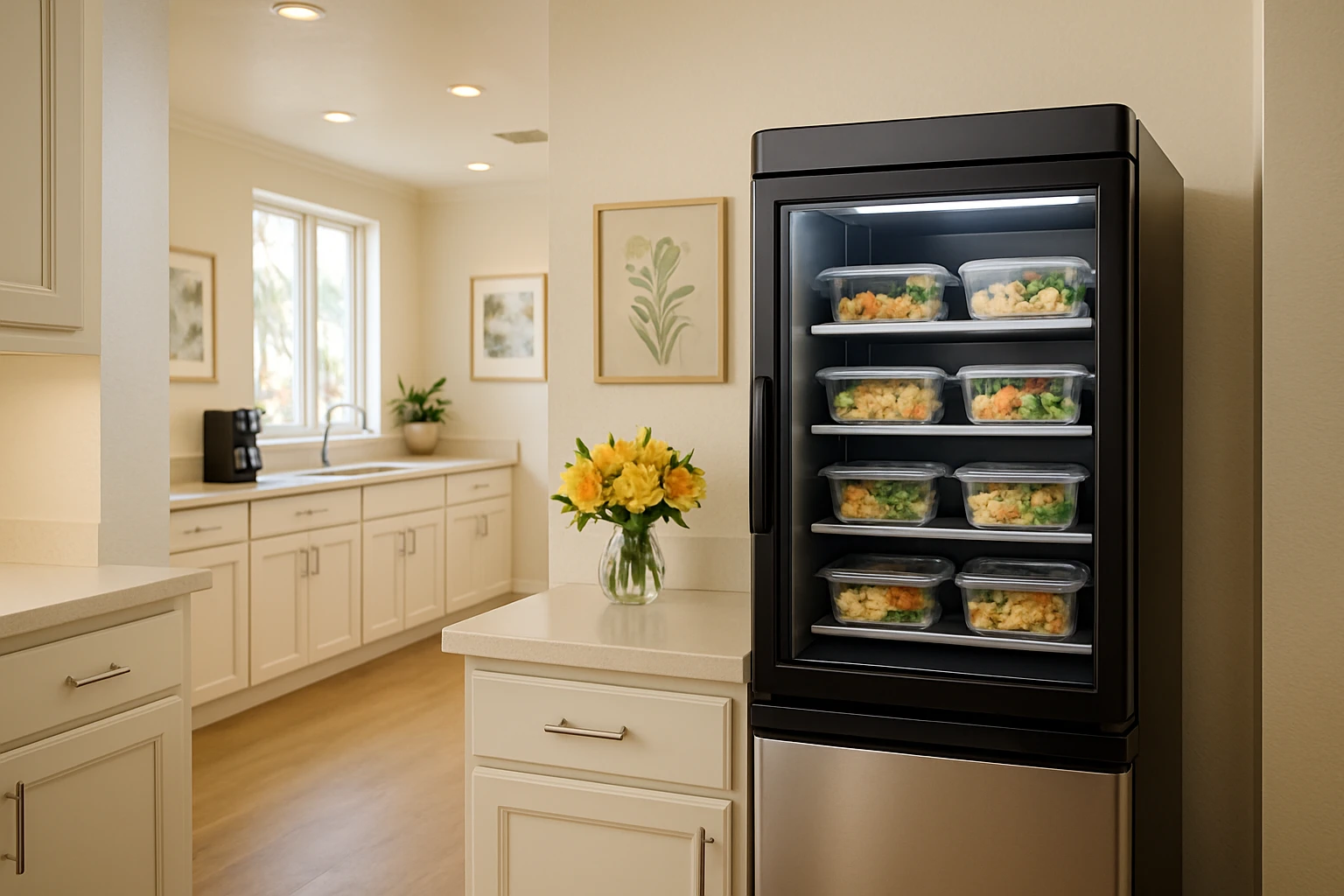
A smart fridge in the staff break room solves this without creating any operational complexity for the facility's food service team. MHP manages the unit independently, stocking it, rotating items, handling quality control, without any involvement from the facility kitchen. The staff break room has real food 24 hours a day, seven days a week, without the facility having to operate a separate food service for staff. The overnight CNA who finishes patient rounds at 2am can grab a grain bowl or a protein-forward wrap, heat it in 90 seconds, and eat something that actually nourishes them before the next round.
Senior living operators talk a great deal about staff wellness, particularly in the context of reducing burnout and improving retention. A smart fridge stocked with real food is one of the most concrete wellness investments available. It is not a wellness app. It is not a gym membership that most overnight caregivers never have time to use. It is food, actual nutrition, available when the work actually demands it.
The irony noted at the start of this post is worth dwelling on: the people whose professional identity is built around caring for others' nutritional and health needs are often the least well-served by their own employer when it comes to food access. That is a solvable problem, and a smart fridge is one of the cleanest solutions available at the cost and complexity that senior living operators can actually execute.
See the Smart Fridge program page for full program details. Our senior living industry page covers how MHP serves the sector more broadly. We have also written about drop-off lunch formats for senior living staff in our post on senior living staff lunch programs in the Inland Empire.
Yes, and this is the standard configuration for senior living facilities. The smart fridge is placed in a staff break room, staff kitchen, or other employee-only area that is not accessible to residents. This maintains the appropriate boundary between staff and resident food service, ensures food safety (the fridge is stocked with meals intended for adults without the dietary restrictions of the resident population), and keeps the benefit focused on staff. Access is controlled by the facility's normal building access protocols, the fridge itself does not require additional security beyond its standard payment/access system.
Yes. MHP's restock schedule is calibrated to usage patterns, including overnight usage. For senior living facilities where overnight staff are a significant proportion of the total workforce, we schedule restocks to ensure the unit is well-stocked before the overnight shift begins. Overnight staff access the same fridge as day and evening staff, the unit does not run out of its highest-demand items before it is restocked because the schedule accounts for total daily throughput across all shifts.
Both configurations exist. Some facilities fully or partially subsidize meals as a staff wellness benefit, particularly in markets where they are competing aggressively for experienced CNAs and caregivers. Others operate the fridge as a fully employee-paid convenience with no subsidy. The retention and wellness signal of having the fridge available at all is meaningful even without subsidy, because the alternative for overnight staff is genuinely nothing. For facilities considering subsidy, the ROI calculation against turnover costs is typically favorable, particularly at the CNA level where replacement costs are significant.
Yes. Senior living workforce demographics in Southern California often reflect significant dietary diversity, and MHP's menu rotation is built to accommodate this. Halal-certified options, plant-based entrées, and gluten-aware formats are standard parts of the rotation and can be weighted based on the specific workforce composition of the facility. Dietary-inclusive food access is particularly important in a context where the benefit needs to work for every staff member, a caregiver who cannot eat from the fridge because nothing meets their halal requirement has not been benefited.
The smart fridge operates as an independent unit with no connection to the facility's licensed food service operation. MHP maintains food safety compliance for the meals it produces and stocks, each item is produced in a licensed commercial kitchen, packaged with appropriate labeling and use-by dating, and rotated on a schedule that ensures nothing approaches expiration while still on the shelf. The facility is not responsible for the food service compliance of the smart fridge; that responsibility sits entirely with MHP. This is distinct from any food prepared or served in the facility's kitchen, which remains under the facility's food service license.
Tell us about your team and we will recommend the right program and a worksite-specific quote. No high-pressure sales.