Guides
Workplace food programs in Los Angeles: what employers need to know
Los Angeles employers face a workplace food problem that is both familiar and specific to the region. The market is saturated with delivery apps, the traffic makes drive-out lunches a 45-minute project, and a growing number of HR leaders are being asked to make return-to-office stick without turning it into a mandate that costs them top performers. This guide is for HR, Operations, and Facilities leaders at LA County employers, companies in Pasadena, Long Beach, Glendale, Burbank, El Segundo, Torrance, and the rest of the county, who want a clear picture of what a managed workplace food program actually looks like, what it costs, and whether it is the right move for their team.
Three forces are colliding at once. Return-to-office pressure is real: Founder Reports tracked 37% of companies enforcing in-office attendance in 2025, up from 17% in 2024, with the average required in-office days rising from 2.6 to 3.9 per week. At the same time, CNBC reports that five days in the office is the least popular schedule among workers, and TalentLMS finds 64% of employees would consider job-searching if forced full-time. That gap, mandate versus acceptance, is exactly where food benefits earn their keep. ezCater's 2025 research found 75% of hybrid employees would work on-site more often if employers provided lunch.
Meanwhile, delivery-app costs have become a visible line item in LA offices. Platform fees, service charges, markups, and tips routinely push a $13 entree to $26 or more delivered and peak-hour congestion means food arrives cold and late when the whole team orders at noon. Finance leaders are asking whether the company should simply provide food instead of reimbursing the chaos.
Managed workplace food is not one thing. Four distinct formats serve different team sizes and shift patterns:
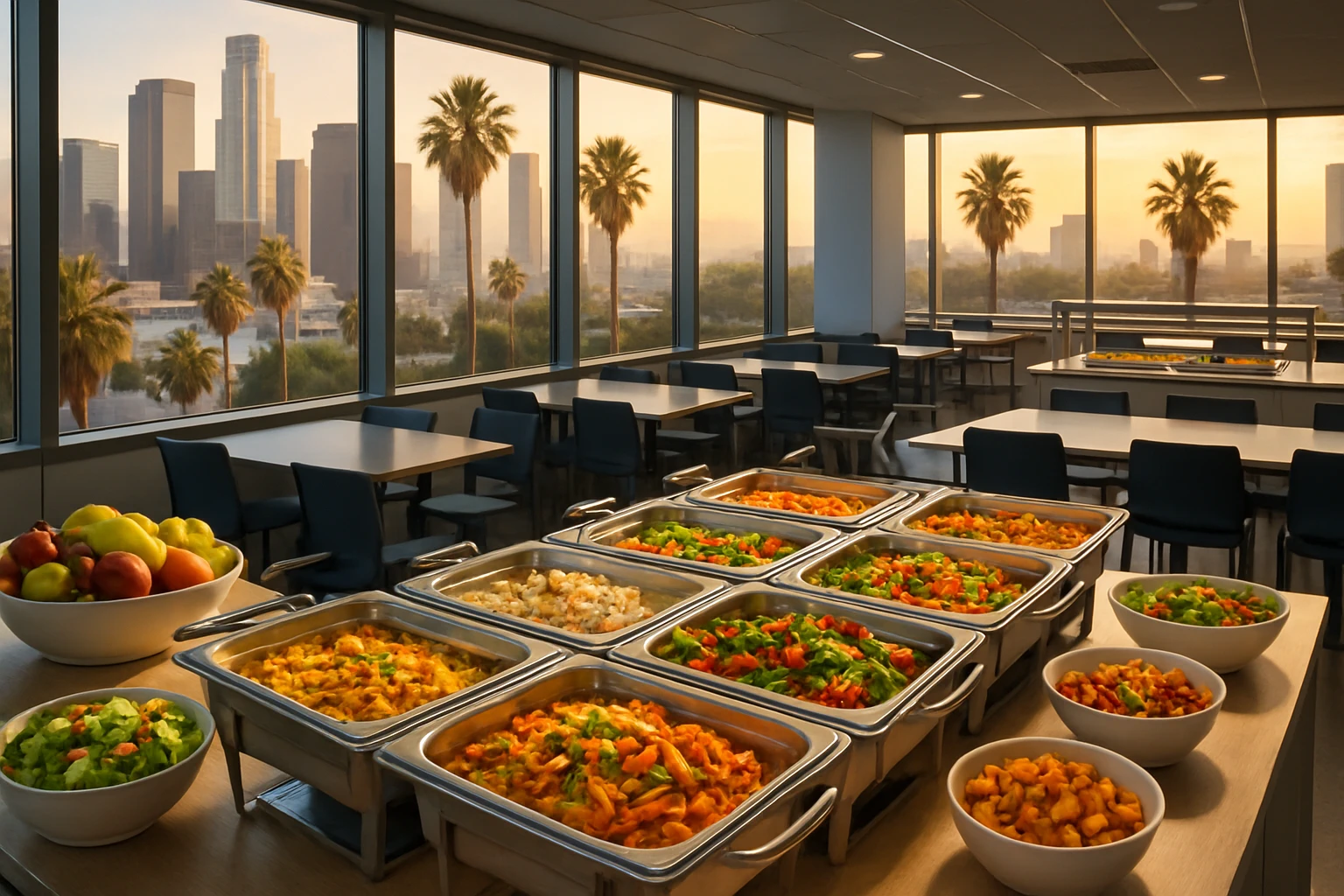
A hot buffet is delivered, set up, and broken down by our team on a recurring schedule, no cafeteria staff required on your end. It is the right fit for teams of 100 or more who are largely on-site during a predictable lunch window. In LA County this model works well for manufacturing campuses in Torrance and El Segundo, logistics operations in Commerce and the City of Industry, and corporate headquarters in Pasadena and Long Beach where headcount is large and concentrated. See the Drop-and-Go Lunch Buffet page for the full picture.
A tap-to-pay smart fridge of fresh, chef-prepared meals available around the clock. This is the right call when your team runs mixed or non-standard shifts, when your headcount is in the 30–100 range, or when your building has no good nearby options. For Glendale biotech offices, Burbank production and media facilities, or any LA County site where not everyone eats between 11:30 and 1:00, a smart fridge covers every shift without requiring anyone to coordinate. Learn more on the Smart Fridge page.
Pre-portioned chef meals delivered once or twice a week, refrigerated and ready to grab. This format fits satellite offices and smaller teams, a 20-person satellite in Santa Monica, a 40-person department at a Glendale office park, that want a real food benefit without the logistics of a daily program. Details on the Weekly Meals page.
For LA employers managing hybrid teams where part of the workforce never comes in, Remote Employee Meal Delivery ships chef-prepared meals directly to employees' homes. It keeps remote workers feeling like part of the team and avoids the equity problem of feeding everyone in the office while remote staff get nothing.
Several things are specific to LA County that affect how you structure a food program:
Pricing for workplace food programs varies by format and volume. For a managed daily buffet, expect per-person costs in the $12–$18 range for teams of 100 or more, with the price per head decreasing as team size grows. Smart fridge meals typically run $9–$14 per item depending on the menu. Weekly drop-off sits in the $10–$16 per meal range. Remote delivery pricing depends on shipping zone and order frequency.
The more useful comparison is not the sticker price but the total cost versus your current approach. If 80 employees are each spending $22–$26 on delivery apps four days a week, that is roughly $350,000 to $430,000 in annual food spend, most of it going to app fees, driver tips, and platform markups rather than actual food. A managed program at $15 per head for the same team runs closer to $250,000. That gap funds the program and still saves money.
If you are still in early research mode, the RFP checklist for workplace food vendors covers the questions to ask any vendor before you sign. If your team is smaller or you want to start cautiously, the program comparison guide helps you pick the format that fits. And if you are trying to build the business case internally, the guide to writing a food program proposal for your CFO is the right next read.
Our kitchen in Rancho Cucamonga is roughly 45–60 minutes from most of LA County, and we serve employers across the full range of industries represented there: logistics and distribution in Commerce, City of Industry, and Cerritos; manufacturing in Torrance, El Segundo, and Long Beach; corporate and professional offices in Pasadena, Glendale, and Burbank; healthcare and medical organizations throughout LA County; and auto dealerships across the South Bay and San Gabriel Valley. The relevant industry pages, Corporate Offices, Warehouse & Logistics, and Healthcare & Hospitals, have sector-specific context.
The fastest path is a 20-minute call where we look at your team size, shifts, location, and what you are currently spending. From there we can recommend the right program, walk through pricing, and, if you want to test before committing, structure a short pilot at your site. No long-term contract is required to start. Get in touch and we will take it from there.
LA employers can choose from a managed hot buffet drop-off (best for on-site), smart fridges (24/7 access for mixed shifts), weekly meal delivery (smaller teams or satellite offices), and remote meal delivery for hybrid or fully remote workers.
A managed lunch buffet typically runs $12–$18 per person per day for teams of 100 or more. Smart fridge meals usually run $9–$14 per item. Weekly drop-off ranges from $10–$16 per meal depending on volume. The right comparison is your total current food spend versus a managed program cost.
Yes. ezCater's 2025 research found 75% of hybrid employees would work on-site more often if their employer provided lunch, and 88% of business leaders say corporate meal programs boost in-office attendance. Food is consistently the highest-yield RTO lever that does not generate resentment.
Yes. We deliver across Southern California including Pasadena, Long Beach, Glendale, Burbank, El Segundo, Torrance, Commerce, City of Industry, and Downtown LA. Our kitchen is in Rancho Cucamonga, roughly 45–60 minutes from most of LA County.
Not with MHP. We do not require long-term contracts to start. You can pilot the program, measure participation, and decide to continue or adjust before making a longer commitment.
Tell us about your team and we will recommend the right program and a worksite-specific quote. No high-pressure sales.