Guides
On-site lunch, smart fridge, or weekly drop-off: which fits your team?
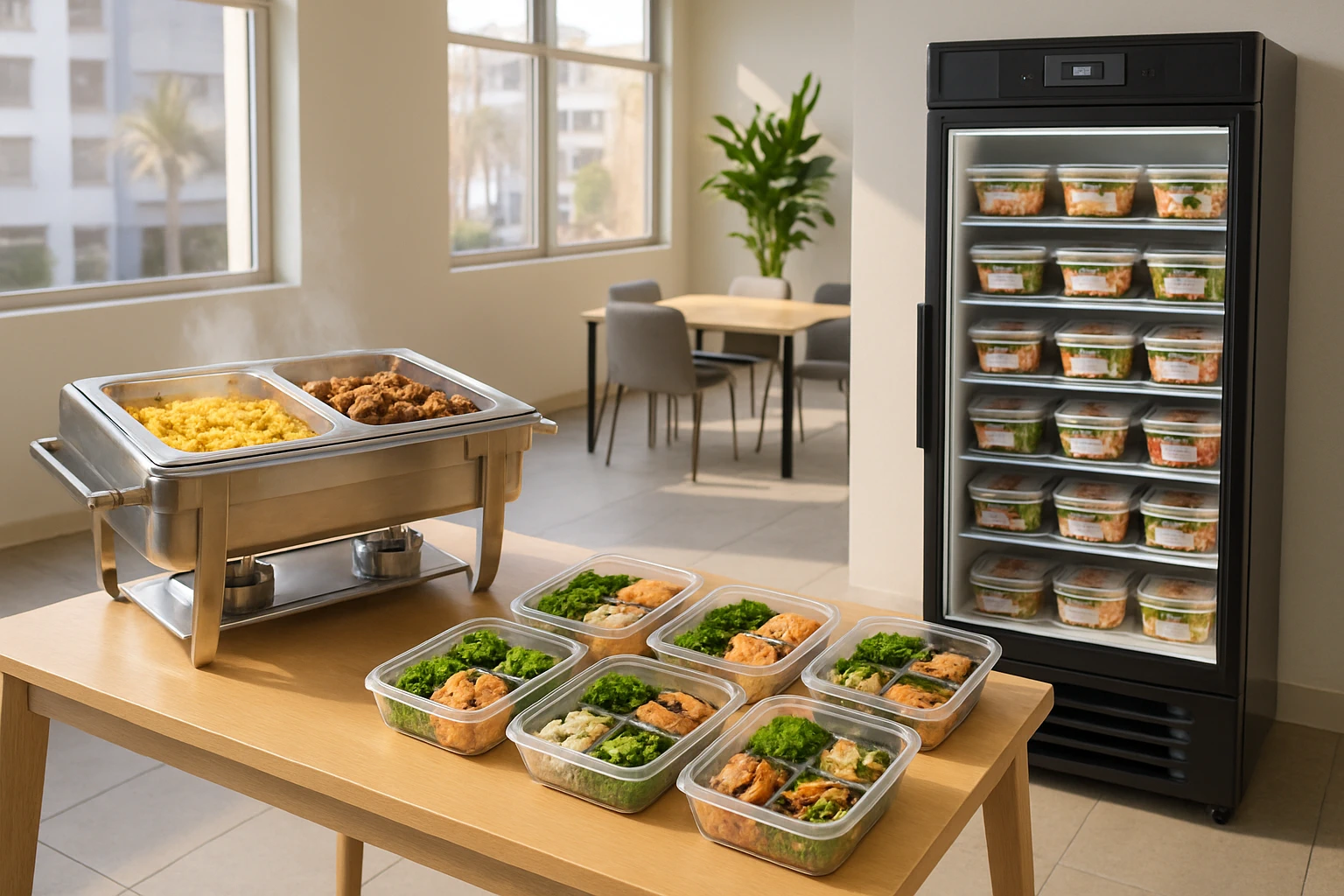
There is no single right way to feed a workplace. The best fit depends on how many people are on-site, when they eat, how much space you have, and how much coordination you are willing to take on. That is exactly why we run three programs instead of one. This guide walks through all three, the factors that should drive your decision, and a simple framework for landing on the right answer. By the end you should know whether a hot buffet, a smart fridge, or weekly meal drop-off fits your team, or whether a combination makes the most sense.
At a high level, on-site workplace food comes in three shapes. A hot buffet is a recurring, drop-and-go lunch served from chafing pans during a set window. A smart fridge is a stocked, self-serve fridge of fresh meals available around the clock. Weekly meal drop-off delivers pre-portioned individual meals on a schedule for people to grab and go. Each solves a different version of the same goal, which is getting good food to your team without you running a kitchen. The trick is matching the shape to how your workplace actually operates.
A drop-and-go hot buffet is the flagship for a reason. It works best for larger teams, roughly 100 or more on-site, who eat during a predictable lunch window. We bring hot pans on a recurring schedule, set up the buffet in about ten minutes, and your team serves themselves while we handle delivery, setup, and breakdown. It feels like having a cafeteria without the cost and headache of running one. The buffet shines when most of your people are in the building at the same time and you want a shared, sit-down-together moment in the middle of the day. It is less ideal when your team is small, spread across shifts, or rarely all present at once, because a buffet assumes a crowd at a set hour. You can read the full breakdown on the Drop-and-Go Lunch page.
If your people work mixed shifts, overnights, or weekends, a buffet at noon misses most of them. A smart fridge stays stocked around the clock, so a fresh meal is available whenever a break actually happens. Employees tap a card or badge, grab a meal, and go, with no app and no ordering. It also fits smaller sites where a full buffet would simply be too much food, and sites with no good options within walking distance. The fridge is the great equalizer for a workforce where not everyone works nine to five, because the night crew and the weekend team get the same access as the day shift. Our guide to feeding a 24/7 workforce goes deep on this, and the Smart Fridge page covers how it is installed and managed.
Some teams want the same fresh, chef-prepared meals without a buffet setup at all. Weekly meal drop-off delivers pre-portioned individual meals once or twice a week, which suits smaller teams, departments, and satellite offices that want grab-and-go convenience without daily coordination. It is the lightest footprint of the three: no serving line, no chafing pans, just labeled meals ready in the fridge. It runs on the same kitchen and standards we have honed over more than a decade of meal-prep service. Weekly drop-off is the right call when your headcount is in the 25 to 100 range, when you do not have room or appetite for a buffet, or when you want to offer a food benefit at a satellite location that is too small for the flagship program. See the Weekly Meals page for details.
Five variables decide which program fits, and it helps to score your site against each before you choose:
If you want a shortcut, start here. Large team, predictable lunch hour, everyone in at once: start with the hot buffet. Mixed shifts, overnight or weekend coverage, or no nearby options: start with the smart fridge. Smaller team, satellite site, or you simply want pre-portioned grab-and-go: start with weekly meal drop-off. These are starting points, not hard rules, and the right partner will pressure-test your choice against the realities of your site rather than just taking the order.
The options are not mutually exclusive, and some of the best setups use more than one. A company might run a hot buffet for the day shift in its main office and place a smart fridge in the warehouse for the overnight crew. A growing business might start with weekly drop-off at a satellite site and add a buffet at headquarters as it scales. Because all three come from one kitchen, one contact, and one invoice, combining them does not multiply the administrative work. It simply lets you cover every shift and every site with the format that fits each one.
A few patterns trip up first-time buyers. The most common is buying a buffet for a workforce that is rarely all present at once, which leads to waste and low participation. The second is trying to patch off-hours hunger with vending machines or app stipends, which never feels like a real benefit. The third is over-engineering the launch, committing to five days a week across every site before proving demand. The fix for all three is the same: match the format to how your team actually works, start small, and expand on real participation.
The right program today is not always the right program in a year, and a good setup leaves room to grow. A startup that begins with weekly drop-off at one office can graduate to a hot buffet as headcount crosses one hundred. A company opening a second location can extend the same menu and the same single point of contact to the new site without rebuilding anything. Because all three programs share one kitchen and one invoice, scaling up is a conversation, not a new procurement project. Plan for the team you are becoming, not just the team you have, and choose a partner who can flex with you.
Still not sure? That is the most common starting point, and it is exactly the conversation we are built for. We will look at your headcount, shifts, space, and budget, recommend the program or combination that fits, and put together a worksite-specific quote. There is no long-term contract to start, so you can pilot the choice and adjust. Book a short call and we will help you choose. If you would rather read first, the guide to starting a lunch program without adding work for HR is a good next step.
General research on workplace food programs and benefits: SHRM and ezCater / SeatGeek.
There is a usable format at almost every team size. Weekly Team Meal Delivery works for teams as small as 25 to 30 people because the delivery footprint stays light. A Daily Drop-Off Lunch Buffet is most cost-effective at roughly 100 or more on-site, since the labor and food volume only pencil out when a crowd uses the serving window. A Smart Fridge is the most size-flexible option and runs well from about 30 people upward, especially when you have off-hours staff. If your headcount is under 25, weekly meal drop-off is usually still the right starting point.
The deciding factor is whether your team eats at the same time. If most of the staff is on-site during a predictable lunch window and you want a shared midday moment, the Daily Drop-Off Lunch Buffet is the better fit. If your team is spread across shifts, takes breaks at staggered times, or works any nights and weekends, a Smart Fridge will reach more people because it stays stocked around the clock. Some sites run both: a buffet for the day shift and a fridge for everyone outside that window. The two are complementary, not competitors.
A Daily Drop-Off Lunch Buffet needs a serving area roughly the size of a long conference table for the chafing pans, plus room for a short line during the lunch window. A Smart Fridge needs a standard 110V outlet and about two square feet of floor space, with no plumbing or buildout required. Weekly Team Meal Delivery needs only existing fridge space to hold pre-portioned meals until staff grab them. None of the three programs require any kitchen equipment on your end, and we install the fridge ourselves so facilities is not on the hook for delivery or setup.
Yes, and it is one of the most common setups for multi-site or mixed-shift employers. A company with a 120-person headquarters in Irvine and a 40-person warehouse in Rancho Cucamonga might run a Daily Drop-Off Lunch Buffet at HQ and Weekly Team Meal Delivery at the warehouse. A 24/7 distribution center might layer a Smart Fridge for off-hours staff on top of a buffet for the day crew. Because all three programs come from the same kitchen, one contact, and one invoice, combining them does not multiply the administrative work or the vendor relationships.
Pick the format your headcount and shift pattern point to, run it on the schedule you would actually use, and measure for four to six weeks. Week one is novelty and not predictive. By week three you have a real participation rate, employee feedback, and an honest read on operational friction. If you are torn between two formats, pilot the one with the lower commitment first: Weekly Team Meal Delivery is the easiest to start and stop, a Smart Fridge is flexible to add or remove, and a Daily Drop-Off Lunch Buffet typically wants a longer runway because the per-meal economics improve as participation builds.
Tell us about your team and we will recommend the right program and a worksite-specific quote. No high-pressure sales.