Guides
How to choose a workplace food service provider
Choosing a workplace food service provider is one of those decisions that looks simple until you are three vendor calls deep and every quote is structured differently. This guide is for the HR and operations leaders who own that decision. It walks through what actually matters, the questions that separate a real partner from a reseller, and the red flags worth walking away from, so you can sign with confidence instead of crossing your fingers.
The best corporate food service setup depends less on the food and more on your people. A single day-shift office of 150 has very different needs than a warehouse running three shifts. Before you compare providers, get clear on headcount on-site, the hours people are actually there, and whether you want a daily hot lunch, grab-and-go all day, or pre-portioned meals people take with them. Walk the floor at the times people eat. The realities of your site, not a brochure, should drive the conversation, and a provider worth hiring will ask these questions before they quote anything.
Once you know your pattern, these questions tell you most of what you need to know:
The answers reveal whether you are hiring an operator who owns the outcome or a middleman who forwards your order to someone else.
It is easy to get pulled into delivery windows and invoicing and forget the obvious: people have to want to eat it. Ask to see a recent menu and how often it rotates. A strong provider runs a four to six week rotation covering familiar comfort food, lighter options, higher-protein plates, and vegetarian choices, so most of your team is covered without custom per-person ordering. Ask where the food is cooked and how long it sits before your team eats. Fresh, chef-prepared meals from a local kitchen beat reheated restaurant takeout for a daily program, both in quality and in how the benefit is perceived by the people relying on it.
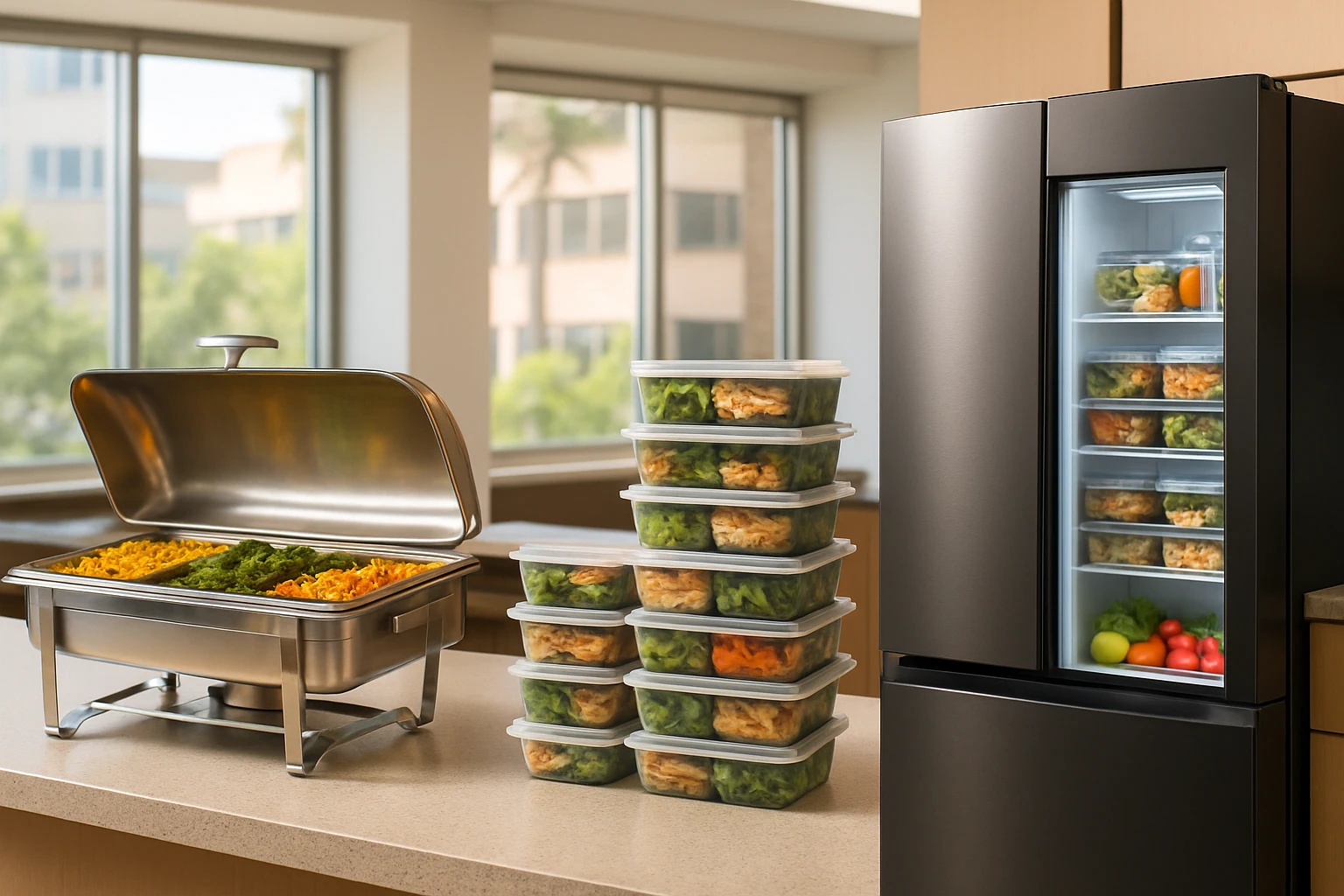
Most providers push one format. A better fit usually comes from matching the program to the worksite. A recurring hot buffet works for larger day-shift teams. A smart fridge covers mixed shifts and 24/7 sites where a noon buffet misses half the staff. Weekly meal drop-off fits smaller teams and satellite offices. Our Drop-and-Go Lunch, Smart Fridge, and Weekly Meals programs each map to one of those patterns, and our guide to choosing a program compares them in detail. The right provider helps you pick, rather than selling you the only thing they offer.
A program that looks cheap per head can cost more once you add delivery fees, app surcharges, wasted food from over-ordering, and the staff hours spent coordinating it. Ask each provider to walk through a full month, including the line items that do not show up on the headline quote, so you are comparing the real number. Real pricing depends on your location, headcount, and frequency, so expect a worksite-specific quote rather than a flat figure pulled from the air. What you should insist on is predictability: a clear monthly number you can budget against without surprises.
The best signal of a reliable partner is a client who has stayed. Ask how long their typical account has been with them and whether they can share a reference in a similar industry or of a similar size. A provider who shows up consistently every week, adapts to headcount changes, and is easy to reach will have clients happy to vouch for them. Be cautious of anyone who can only speak in the abstract. A real workplace food partner has a track record of recurring, satisfied accounts and is comfortable connecting you with one of them.
The whole point of outsourcing food is to take work off your plate. Look for a single point of contact instead of a call center, a schedule you set once, and a program that runs without daily babysitting. If a provider needs you to collect orders or chase headcounts every week, that is not hands-off, no matter what the sales deck says. The goal is a program your team barely has to think about once it is running.
Starting a program should feel low-risk. Look for a short discovery call to confirm fit, a simple first month rather than an annual commitment, and weekly pre-pay so you are never locked into something that is not working. A 30-day pilot lets you see real participation and gather honest feedback before you scale to more days or more sites. If a provider pushes a long contract before you have served a single meal, treat that as a flag. The right partner earns the next month by getting this one right.
A few signals should give you pause: a flat per-head price quoted before anyone understands your site, pressure to sign a long contract up front, vague answers about where the food is cooked, no willingness to share a reference, and a setup that quietly leaves the weekly coordination on you. Any one of these is a reason to keep looking. A food program is a recurring, visible part of your week, and the cost of choosing the wrong partner is paid every single day in low participation and extra work.
One question separates providers who understand workplaces from those who just deliver food: what happens to the people who do not work nine to five? If part of your team works nights, weekends, or rotating shifts, a noon buffet quietly excludes them, and an exclusion like that does more harm to morale than no program at all. A provider worth hiring will ask about your shift pattern early and propose a setup that reaches everyone, whether that is an always-stocked fridge for off-hours staff, a buffet for the day shift, or a combination across sites. Fairness across shifts is not a detail to sort out later. It is part of choosing the right provider in the first place, because the cost of a benefit only some of your team can use is paid in resentment from the ones who cannot.
MHP Food Service cooks every meal in our Rancho Cucamonga kitchen and serves workplace catering across the Inland Empire. We run the kind of fresh, fully managed, no-lock-in program described here. If you want help matching a program to your site, book a 20-minute call and we will send a worksite-specific quote within one business day.
General research on workplace meal benefits and food programs: SHRM and the ezCater / SeatGeek case study.
Six questions tend to separate operators from middlemen. Where is the food actually cooked and how fresh is it on arrival. Who handles delivery, setup, and breakdown on-site. How are allergens and dietary needs labeled every week. What does it take to change the schedule, pause a week, or scale up. Is pricing one predictable invoice or per-order fees that swing month to month. Are we locked into a long-term contract or can we start with a pilot. A provider who answers these confidently and specifically is hiring out their own kitchen; a provider who hedges or routes through a partner is reselling someone else's program.
Pilot first. A 30-day to 60-day pilot lets you see real participation, gather honest feedback, and confirm the format fits your site before you commit to anything longer. Any provider who pushes a multi-year contract before serving a single meal is asking you to take on the risk that should sit with them. MHP Food Service operates without long-term contracts so you can adjust or exit based on actual program performance. The right provider earns the next month by delivering well this month, not by locking you into a paper agreement that obscures whether the program is actually working.
Five signals should give you pause. A flat per-head price quoted before anyone understands your site, shifts, or space. Pressure to sign a long contract before a pilot. Vague answers about where the food is cooked or how recently it was prepared. No willingness to share a reference of similar size or industry. A setup that quietly leaves the weekly coordination on your team, such as collecting individual orders or reconciling delivery app receipts. Any single one of these is reason to keep looking. A workplace food program is a daily, visible part of how your team experiences the company, and the cost of choosing the wrong partner shows up in low participation and extra work for HR.
A locally-cooked program reaches your site fresher and is logistically easier to support. We cook in Rancho Cucamonga and serve Inland Empire, Orange County, LA County, and Temecula workplaces, which means a hot Daily Drop-Off Lunch Buffet arrives within a sensible drive time rather than a multi-hour route. Local also matters for service: schedule changes, headcount adjustments, and one-off requests are easier to handle when the kitchen and the operations team are on the same time zone and the same freeway system. A national reseller can technically deliver food, but the responsiveness gap usually shows up around week three.
Insist on a full monthly number that includes every line item, not just a per-head price. Ask each provider to model your actual site, with your headcount, your delivery frequency, and any setup, breakdown, delivery, or service fees included. App-based platforms in particular tend to quote a low per-meal rate and then layer on service charges, delivery fees, and tipping that double the real cost. The fair comparison is monthly out-the-door spend for the same schedule and participation assumption. A provider who walks through that math with you is showing you their cost structure; one who avoids it is hoping you do not ask.
Tell us about your team and we will recommend the right program and a worksite-specific quote. No high-pressure sales.