Smart Fridge
Night shift meals in San Bernardino: what actually works
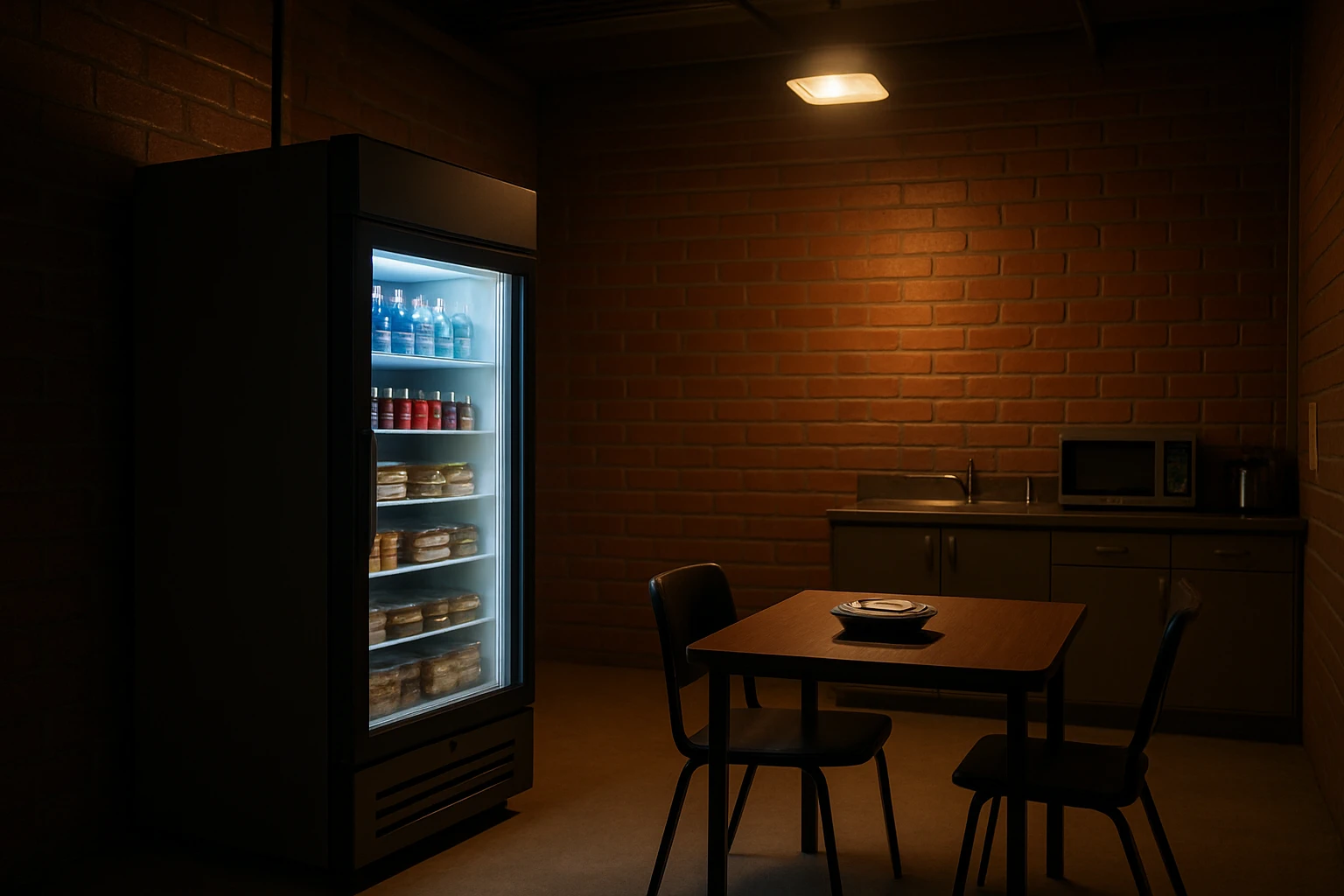
San Bernardino is one of the most important employment centers in the Inland Empire, and its workforce does not keep banker's hours. The city's industrial and logistics base, its healthcare system, its public safety operations, and its manufacturing corridor all run around the clock. For the employers managing those overnight crews, the question of what workers eat between 10pm and 6am is a real operational problem and most of the answers people try first do not hold up.
This post is an honest assessment of the options. We are not going to oversell the smart fridge solution before explaining why everything else fails. The reason the smart fridge is the right answer will be clearer after you understand why the alternatives are not.
San Bernardino is the county seat of the largest county in the contiguous United States by area, and it punches well above its population in industrial employment. The city's logistics and warehousing sector has expanded considerably along the I-215 corridor and in the industrial parks east of downtown. Manufacturing, particularly food processing, metal fabrication, and building materials, has a long presence here. The healthcare sector is anchored by Arrowhead Regional Medical Center, a large county hospital that runs 24-hour operations with hundreds of clinical and support staff on shift at any given time. Public safety operations, county sheriff, city police, fire, and emergency dispatch, maintain round-the-clock staffing. The California Department of Corrections and Rehabilitation has major facilities nearby.
The common thread across all of these industries is overnight staffing. San Bernardino is not a city where most workers go home at 5pm. A meaningful fraction of the total workforce is on site past midnight, every night.
At 2am in San Bernardino, a worker on a break has the following options if their employer has not provided food:
Fast food: A few 24-hour drive-throughs exist, primarily on the larger commercial arterials. Getting to one during a 30-minute break requires driving, ordering, waiting, and returning, which is often physically impossible within the break window. Even if the timing works, the nutritional profile of fast food eaten at 2am is not optimal for someone who needs to work four more hours and drive home safely.
Convenience stores: Gas station food, packaged snacks, energy drinks, processed sandwiches, is accessible but nutritionally poor. It is also expensive on a per-calorie basis for the quality delivered. A worker spending $6 on chips and a Red Bull has not eaten a meal.
Vending machines: The default option at most facilities. The problems are well documented: limited variety, overwhelmingly snack- and sugar-based, cash-heavy systems that workers find inconvenient, and no fresh food. Vending satisfies the immediate sensation of eating without providing the sustained nutrition a physical worker actually needs.
Delivery apps: DoorDash, Uber Eats, and their competitors do not serve most industrial areas in San Bernardino reliably after 10pm. The restaurant supply collapses, most places stop taking delivery orders, and the remaining options are fast food that would be faster to drive to. For someone without a car in the break room, delivery app access is even more constrained. The apps were not designed for overnight industrial workers.
Bringing food from home: This is the most nutritionally controllable option, but it requires workers to plan, prepare, and remember to bring food before every overnight shift. In practice, it is inconsistent. Workers forget. They run out of time to prepare. They get called in for an unexpected shift and have nothing packed. For a manager trying to ensure the whole crew is fed, relying on workers to self-provision is not a reliable plan.
The National Institute for Occupational Safety and Health has published extensively on the health impacts of shift work. Night shift workers experience circadian rhythm disruption that affects metabolism, digestion, and hunger signaling. The body's insulin response is less efficient during overnight hours, which means workers are more susceptible to blood sugar volatility from sugary or high-glycemic foods, precisely the foods available in vending machines and convenience stores.
NIOSH recommends that employers with overnight workers provide access to food that is high in protein and complex carbohydrates, low in simple sugars, and available at consistent intervals aligned with break schedules. The reasoning is both metabolic and safety-related: well-nourished workers on overnight shifts maintain cognitive performance and alertness better than those who have eaten poorly or not at all. In industries where cognitive performance has safety consequences, operating machinery, monitoring systems, making clinical decisions. This is not an academic point.
MHP's approach to overnight shift nutrition is built on a specific principle: avoid the foods that cause energy spikes and crashes, and stock the foods that provide sustained output for workers who need to stay alert and physically capable for hours.
In practical terms, this means the smart fridge at a San Bernardino night-shift facility will be stocked with protein-forward meals, chicken, beef, fish, legumes, paired with complex carbohydrates like brown rice, roasted sweet potatoes, or whole grain bases. Fresh vegetables are included as sides. The menu avoids white rice-heavy dishes where possible, minimizes added sugar, and keeps the overall glycemic load of each meal moderate.
This is not a restriction, the food is genuinely good. MHP's menu is California cuisine in sensibility: fresh ingredients, real flavors, rotating options. The protein-forward bias is a design choice informed by what the science says about night shift worker nutrition, not by an intent to limit options. Workers eat more consistently from a fridge that stocks food they actually want and workers want food that tastes good.
For San Bernardino facilities with diverse teams, the menu rotation also includes vegetarian options, halal-compatible preparations, and allergen-labeled items so that workers with different dietary requirements can all find something every shift.
The fundamental advantage of a smart fridge over every other night shift food option is that it does not depend on human scheduling, driver availability, restaurant hours, or worker preparation. It is stocked and accessible when the break room opens at 11pm, at 2am, and at 5am. It operates the same way on a Tuesday as on a Saturday. It does not call in sick or get stuck in traffic.
For a San Bernardino employer managing overnight crews, that reliability is the core value proposition. The food access problem is solved once, with a stocked fridge, and it stays solved as long as MHP is maintaining the restock schedule. The employer does not need to manage it, coordinate it, or think about it shift by shift.
See our Smart Fridge program page for the full overview of how the program works. For the warehouse and logistics context specifically, our warehouse and logistics industry page covers the sector in detail. We have also written about the broader overnight shift food problem and about feeding government and municipal workers in San Bernardino, which covers the daytime food access context for public sector employers in the same city.
Yes. San Bernardino is within MHP's core service area. Our Rancho Cucamonga kitchen is approximately 15 to 20 minutes from most San Bernardino industrial and commercial locations, which allows for frequent restocking including multiple visits per week for high-usage facilities. Contact us with your location and headcount and we will confirm coverage and provide a quote.
MHP typically looks for facilities with at least 30 to 40 workers using the fridge regularly. For overnight-specific access, the relevant headcount is the overnight crew size, a facility with 200 day workers and 40 overnight workers qualifies based on the overnight headcount for a dedicated overnight-accessible unit. Smaller teams may qualify for a shared fridge if the total usage across shifts reaches the threshold.
Yes. Employer subsidy structures are common and straightforward to set up. The employer covers a fixed amount per transaction, and workers pay any overage. Full subsidy (no worker cost) is also an option. Billing goes directly to the employer account. Many San Bernardino employers with overnight crews fully subsidize the night shift access as a specific acknowledgment of how limited other options are at that hour.
The smart fridge maintains temperature between 34 and 40 degrees Fahrenheit continuously. All MHP items are dated with expiration labels, and items past their freshness date are removed during restocking. The fridge does not stock items that have exceeded their safe consumption window. This is managed through the inventory system, not manual checking by facility staff.
Workers on 12-hour shifts typically get two break windows, a shorter mid-shift break and a longer meal break. The smart fridge supports multiple transactions per worker per shift without any per-shift limit. Workers can access it during their first break and their second break. If subsidy is configured, the subsidy typically applies per transaction up to a daily cap rather than limiting access to a single meal.
Tell us about your team and we will recommend the right program and a worksite-specific quote. No high-pressure sales.