Smart Fridge
How a smart fridge solves the overnight shift food problem
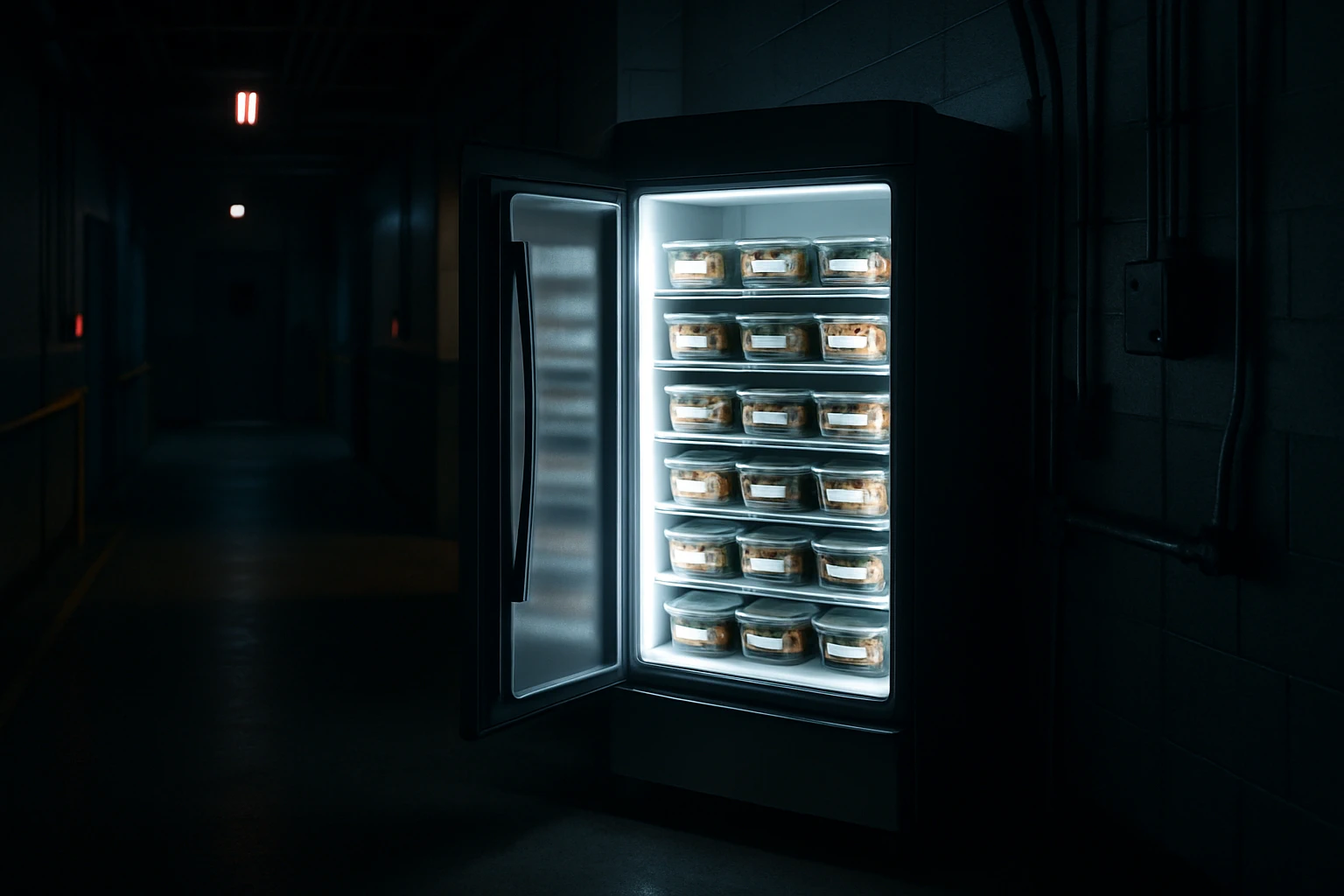
For every employer who runs a day shift, there is a reasonable set of food options: delivery apps, nearby restaurants, a daily buffet program, meal stipends that workers can actually use. The problem is solvable for people who work 8am to 5pm. For every employer who runs an overnight shift and in Southern California, that is most industrial employers, the food problem becomes genuinely hard, and the standard answers stop working.
Delivery apps wind down after midnight. Restaurants near most industrial areas close by 10pm. The break room has vending machines. And so, at 3am, the person who has been picking orders, moving product, monitoring machines, or providing patient care for the last five hours has to choose between a bag of chips, a candy bar, and going hungry.
This is not a niche edge case. It is the daily reality for hundreds of thousands of workers in Southern California alone. And a smart fridge is the only food solution that actually addresses it.
The food infrastructure of modern life is built around daytime business hours. Grocery stores, restaurants, delivery services, and cafeterias all peak during lunch and dinner and shut down or dramatically reduce availability from midnight onward. This is a reasonable response to demand, most people are not trying to eat at 3am.
But overnight workers are not most people. They are working during the hours when food access is worst, and the physical demands of their work mean they need real nutrition just as much as a day shift worker. In fact, NIOSH research on shift work and metabolic health suggests that overnight workers may have a higher caloric need on shift due to the physiological stress of working against their circadian rhythm. Their bodies are fighting to stay alert at a time when every biological signal says to sleep, and that fight has a metabolic cost.
The CDC's National Center for Health Statistics has documented that night shift workers have higher rates of obesity, hypertension, and metabolic syndrome than their day-shift counterparts. A significant contributor is the food environment: limited access to healthy options during work hours, combined with the disruption of normal hunger and meal timing patterns, leads to worse eating outcomes over time.
Vending machines are the default answer in most overnight workplaces, and they are a particularly bad fit for the situation they are meant to solve.
A standard vending machine selection, chips, candy, crackers, pastries, sodas, is high in simple sugar and refined carbohydrates, low in protein, and low in fiber. That nutritional profile produces a specific physiological response: a quick blood sugar spike followed by a steep crash. For a worker at hour five of an overnight shift who is already fighting circadian fatigue, that crash is not just uncomfortable. It is dangerous. Reduced alertness, slower reaction times, difficulty sustaining focus, these are the conditions that precede accidents and errors.
A worker operating a forklift at 3am who just ate a bag of chips and a can of soda is not adequately fueled for the task. The calories exist but they are the wrong kind, the kind that produce a short burst followed by a deficit. A grilled chicken and rice bowl from a smart fridge produces something entirely different: stable blood glucose, sustained energy, actual macros that support the physical and cognitive demands of warehouse or production work.
The difference between these two outcomes is not theoretical. NIOSH documentation on occupational fatigue and nutrition explicitly links caloric quality during overnight work to accident and incident rates. Employers who care about safety records should care about what their overnight workers are eating.
The reason a smart fridge solves the overnight problem where other solutions fail is that it operates like infrastructure, not like a program. It does not require a caterer to show up at midnight. It does not require a restaurant to be open nearby. It does not require workers to have a car to get somewhere. It does not require an app, an order, or a delivery window.
It is just there, stocked, lit, accessible at whatever time a break happens to fall. A worker at 3am walks to the break room, taps a badge or card, grabs a meal, and eats. The transaction takes thirty seconds. The break time goes to eating, not logistics.
MHP manages every aspect of the fridge: stocking, restocking, food safety, payment processing. The employer installs the unit and provides an outlet. After that, the food infrastructure manages itself. This is the correct model for overnight operations, because overnight supervisors should not be managing food vendors, and HR staff who left the building at 6pm cannot coordinate a delivery for a midnight break.
Overnight shifts in Southern California span a wide range of industries, and the smart fridge applies across most of them:
Warehouses and distribution centers: The Inland Empire's massive logistics corridor runs 24/7. Fontana, Rialto, Ontario, Moreno Valley, and Chino collectively house hundreds of DCs where overnight picking, packing, and shipping operations require hundreds of workers per facility through the night. Our warehouse and logistics page covers the full picture.
Hospitals and healthcare facilities: Clinical staff work 12-hour shifts that routinely span midnight. Nurses, techs, CNAs, respiratory therapists, and overnight house supervisors are working when hospital cafeterias are closed and delivery apps have nothing to offer. Healthcare is arguably the industry where worker nutrition matters most, the people providing care must be alert, focused, and physically functioning. More on this in our healthcare page.
Public safety: Police precincts, fire stations, and emergency dispatch centers operate around the clock. First responders on overnight shifts face the same food desert. A smart fridge in a station or a precinct break room provides the same infrastructure solution.
Hotels and hospitality: Overnight front desk staff, kitchen prep crews, and housekeeping teams at larger hotels work through the night. Most hotel food service is designed for guests, not for the workers keeping the building running at 2am.
Manufacturing and production: Plants running three shifts cover overnight hours where no catering vendor operates and no supervisor wants to coordinate food delivery mid-shift. A fridge in the break room handles it without any coordination at all.
The menu in an MHP smart fridge is built around real food, not shelf-stable products, not frozen meals that require fifteen minutes in a microwave, but fresh chef-prepared meals that were cooked in our Rancho Cucamonga kitchen and delivered to the fridge during the day.
For overnight workers specifically, the menu design prioritizes:
Everything is labeled with ingredients and nutrition information. Workers can see exactly what they are eating, which matters for the significant portion of any blue-collar Southern California workforce that is managing health conditions like diabetes, hypertension, or high cholesterol.
The process is straightforward. MHP handles installation, a standard 120V outlet and break room floor space are all that is required. Setup is typically complete in under two hours. No construction, no plumbing, no permits.
After installation, the program is hands-off for the employer. MHP sets the restocking schedule based on your overnight crew size and usage patterns. For a facility with 50 overnight workers, a fridge might be restocked every other day. For a facility with 200 overnight workers, daily restocking is more typical. The fridge logs transactions automatically, so MHP knows how usage is trending and adjusts stock and restocking frequency accordingly.
If you want workers to access meals at no cost, a common choice for employers who want a genuine benefit, not just a convenience, that is a configuration option. If you want a partial subsidy or full employee-pay model, both work within the same system. See our 24/7 workforce feeding guide for more on how employers structure the benefit.
Adding a smart fridge for overnight workers is not a charity expense. It is an investment with measurable returns. Employers who have deployed overnight-accessible fridges report:
These are not guarantees, every worksite is different. But they reflect what happens when you treat overnight workers' nutrition as something worth solving rather than something to patch with a vending machine. Talk to MHP about installing a smart fridge at your overnight operation.
A smart fridge is the most effective option because it requires no vendor presence, no ordering, no delivery logistics, and no open restaurants nearby. It is stocked with fresh chef-prepared meals and accessible 24/7 via tap-to-pay. All other solutions, delivery apps, nearby restaurants, vending machines, break down in some significant way at 2 or 3am.
NIOSH and CDC research indicates that overnight workers face elevated metabolic stress from working against their circadian rhythm. Proper nutrition during overnight shifts, adequate protein, complex carbohydrates, controlled sugar intake, is associated with better sustained alertness and lower fatigue-related incident rates. Vending machine snacks with high simple-sugar content produce short energy spikes followed by crashes that worsen already-elevated fatigue.
No. MHP handles all restocking, food safety, and payment processing. The smart fridge operates autonomously overnight. There is no coordination required from HR, facilities, or overnight supervision. The employer's involvement after installation is essentially zero on an ongoing basis.
Warehouses and distribution centers, hospitals and healthcare facilities, public safety operations, manufacturing plants, and hotels all run overnight shifts where workers have limited or no real food access. The Inland Empire's logistics corridor and Southern California's healthcare system together represent a very large overnight workforce with inadequate food infrastructure.
Yes. Larger facilities often deploy multiple units, one per major break room, or one per shift zone, to ensure workers do not have to travel far during a short break. MHP manages all units under a single service agreement. Multiple units can be stocked and restocked on the same visit schedule.
Tell us about your team and we will recommend the right program and a worksite-specific quote. No high-pressure sales.