Smart Fridge
Smart fridges for auto dealerships in the Inland Empire
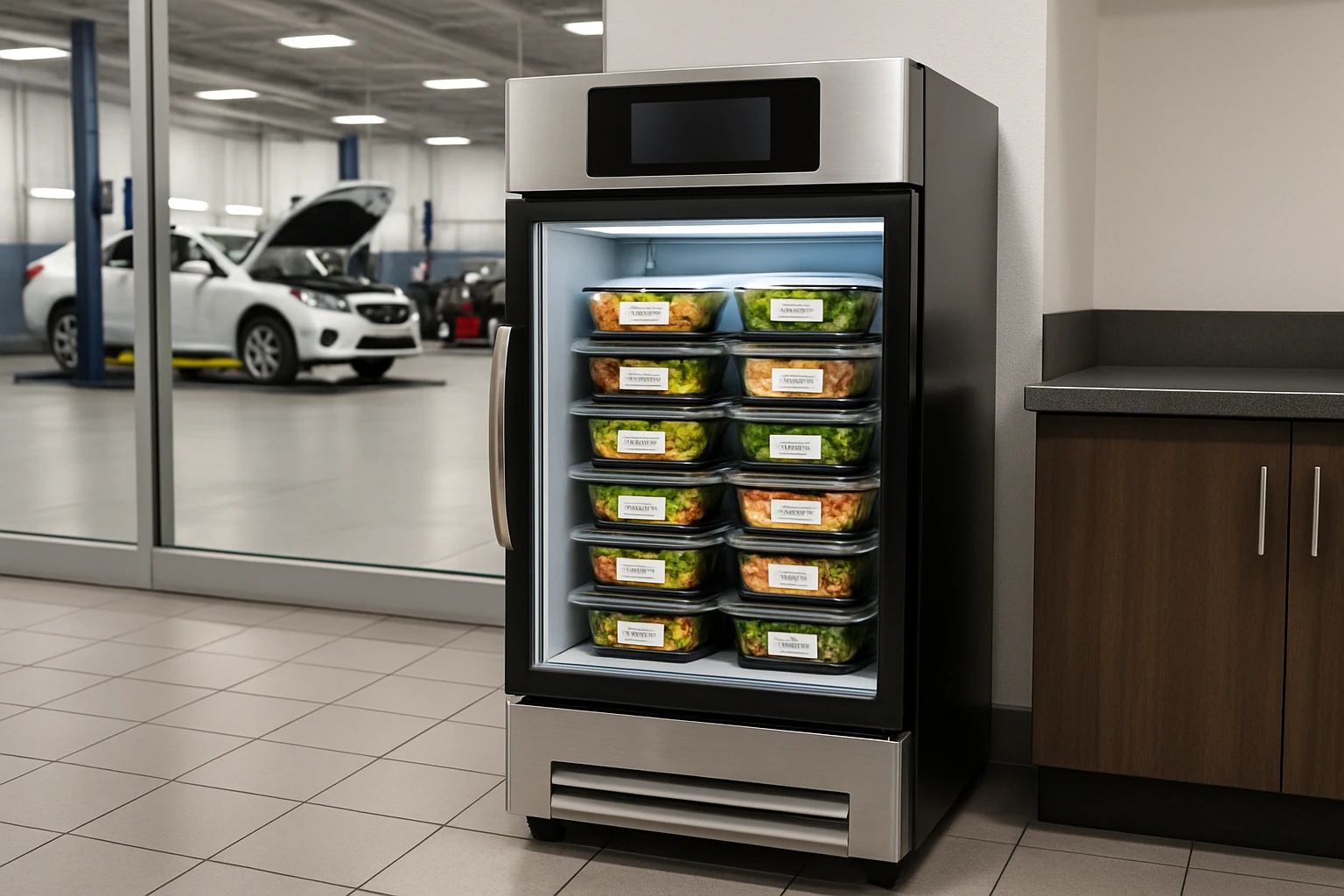
Auto dealerships are one of the most physically and mentally demanding work environments in retail and among the most consistently underserved when it comes to food access. Service technicians start early, work in uncomfortable positions under vehicles for hours at a stretch, and often eat whatever they can find before the shop gets slammed. Service advisors skip lunch when the appointment board fills up. And most Inland Empire dealerships are located along auto mall corridors, like Auto Center Drive in Ontario, or along the 60 and 215 in Riverside, that are not walkable to a single quality food option.
The smart fridge solves the dealership food problem in a way that every other program type fails to match. Here is why the problem is as specific as it is, and why the fridge fits so naturally into the service department break room.
Dealership service departments typically open before 7am and close after 7pm. The first technicians arrive at 6:30 or 7am to stage cars and get the bay ready. The last techs close out ROs and clean up around 6 or 7pm. That is a 12-hour operational window, one that makes a standard noon-hour catered lunch serve only a fraction of the day's team.
Service advisors have an even less predictable schedule. When a slow morning turns busy at 11am, the advisors who were going to grab lunch at noon are now buried with walk-ins, dispatch calls, and customer handoffs. They may not eat until 2 or 3pm, or they may skip the meal entirely and eat a bag of chips from the vending machine in the lounge. This is not an unusual day. For many dealership advisors, it is the typical day during peak season.
A smart fridge does not have a service window. It is open at 6:45am for the early tech who wants a real breakfast before the bays open. It is open at 1pm for the advisor who finally got a break between appointment rushes. It is open at 6:30pm for the closer finishing up the last vehicle of the day. Nobody coordinates with nobody. The food is simply there.
Service technicians do work that combines physical labor with precision cognitive tasks in a way that most industries do not. A technician diagnosing a complex electrical fault is performing detailed diagnostic analysis, tracing circuits, interpreting live data, ruling out failure modes, while simultaneously working in a physically demanding environment: crouching under vehicles, reaching into tight spaces, lifting components. The cognitive load is high and the physical stress is real.
That combination makes nutrition especially important. A tech who skipped breakfast and ate a vending machine pastry at 10am is operating on a caloric and nutritional deficit by noon. By 2pm, they may be fighting fatigue, struggling with concentration, and more prone to the kind of small mistakes, a torque spec off by a few foot-pounds, a step skipped in a complex procedure, that create comebacks and warranty claims. None of this is a character issue. It is the predictable consequence of a body running low on fuel during high-demand work.
Protein-forward meals with balanced macros, the kind MHP stocks in its smart fridges, support sustained cognitive and physical performance across a long shift. A tech who eats a real meal at noon is performing measurably better at 3pm than one who ate from the vending machine. This is not an abstract wellness claim. It is documented in occupational health research on nutrition and performance in physically demanding roles.
Service advisor turnover is one of the most expensive recurring costs for auto dealerships. A good advisor takes 6 to 12 months to develop and costs a dealership many times their salary to replace when you account for lost CSI, comebacks that go unresolved, and the productivity gap during the learning curve of a new hire. The market for experienced advisors is competitive. They know their value and they leave for small differences in total compensation and working conditions.
A smart fridge is a visible, daily-use benefit that experienced advisors notice and appreciate. It is not a once-a-year bonus or a health insurance plan they rarely think about. It is something they interact with on their worst days, when the board is packed, they have not had five minutes to themselves, and they are hungry. In that moment, a well-stocked fridge with real food is worth more in goodwill than many benefits of comparable cost.
Dealership GMs and service managers who have added smart fridges consistently report that the reaction from long-tenured advisors is disproportionately positive. The message it sends, we notice that you work hard and we are doing something about it, lands in exactly the way that institutional benefits often do not.
Most dealership break rooms in the Inland Empire have a microwave, a coffee maker, a vending machine, and a table. The vending machine sells chips, candy, and sodas. The coffee is reheated all morning. Workers who plan ahead bring food from home. But that requires planning at the end of a long previous day, and it does not always happen. Workers who do not plan eat from the vending machine or drive out to a fast food option during lunch, which takes 20 to 30 minutes round-trip and often means coming back with a food coma.
None of this supports the kind of sustained, focused performance that a high-volume service department needs. A smart fridge with fresh, labeled, microwave-ready meals changes the break room from a vending machine stop into a place where a tech can actually refuel.
Most dealership break rooms have exactly what a smart fridge needs: a standard outlet, a few square feet of floor space, and a door that locks at night. MHP handles site assessment, placement, initial stocking, and ongoing restocking. The service manager or HR coordinator does not manage inventory, coordinate deliveries, or handle any ongoing food service tasks. MHP owns all of it.
Many dealerships opt to partially or fully subsidize fridge meals as a tech and advisor benefit, often under $10 per employee per day, which is modest relative to the cost of a single advisor departure or a comeback that had to be re-done on warranty. For dealerships interested in testing before committing, a short pilot with employee-paid access is easy to arrange and typically generates enough positive feedback to justify a full program.
See our Smart Fridge program page and our auto dealerships industry page. Our post on dealership lunch programs in the Inland Empire covers the buffet-format alternative for dealerships with larger teams or a preference for a midday catered model.
Dealership hours stretch from early morning to late evening, and the busiest periods are unpredictable. A catered lunch arrives at noon and is gone by 1pm, which means it serves only the workers who happen to be free in that window. A smart fridge is available from open to close, so the early tech, the midday advisor, and the late closer all have access to a real meal on their schedule.
Protein-forward meals: grain bowls, wraps, rice and protein dishes, salads with substantial protein, and seasonal options from the MHP rotation. The menu changes regularly so the same workers are not eating the same item week after week. The food is designed for people doing physical and cognitively demanding work, adequate portions, clean ingredients, real meals rather than snacks.
Yes. MHP serves dealerships across Southern California, including markets in Riverside, San Bernardino, Ontario, Fontana, Temecula, and greater Los Angeles. If your dealership is in our service area, we can discuss a program regardless of your specific location on the auto corridor.
There are several models: employer-subsidized (the dealership pays for all meals as a staff benefit), partially subsidized (employer covers a portion and the employee pays the remainder), or employee-paid at a fixed per-meal price. Access is managed via badge tap, card, or a phone-based access code depending on the fridge model deployed.
Yes. MHP offers trial arrangements that let a dealership test the program for a defined period, typically 30 to 60 days, before committing to a longer service agreement. This is common for dealerships evaluating whether participation rates justify the investment. In most cases, feedback from the trial is strongly positive and the dealership moves to a full program.
Tell us about your team and we will recommend the right program and a worksite-specific quote. No high-pressure sales.