Smart Fridge
Smart fridge for Chino and Chino Hills industrial sites
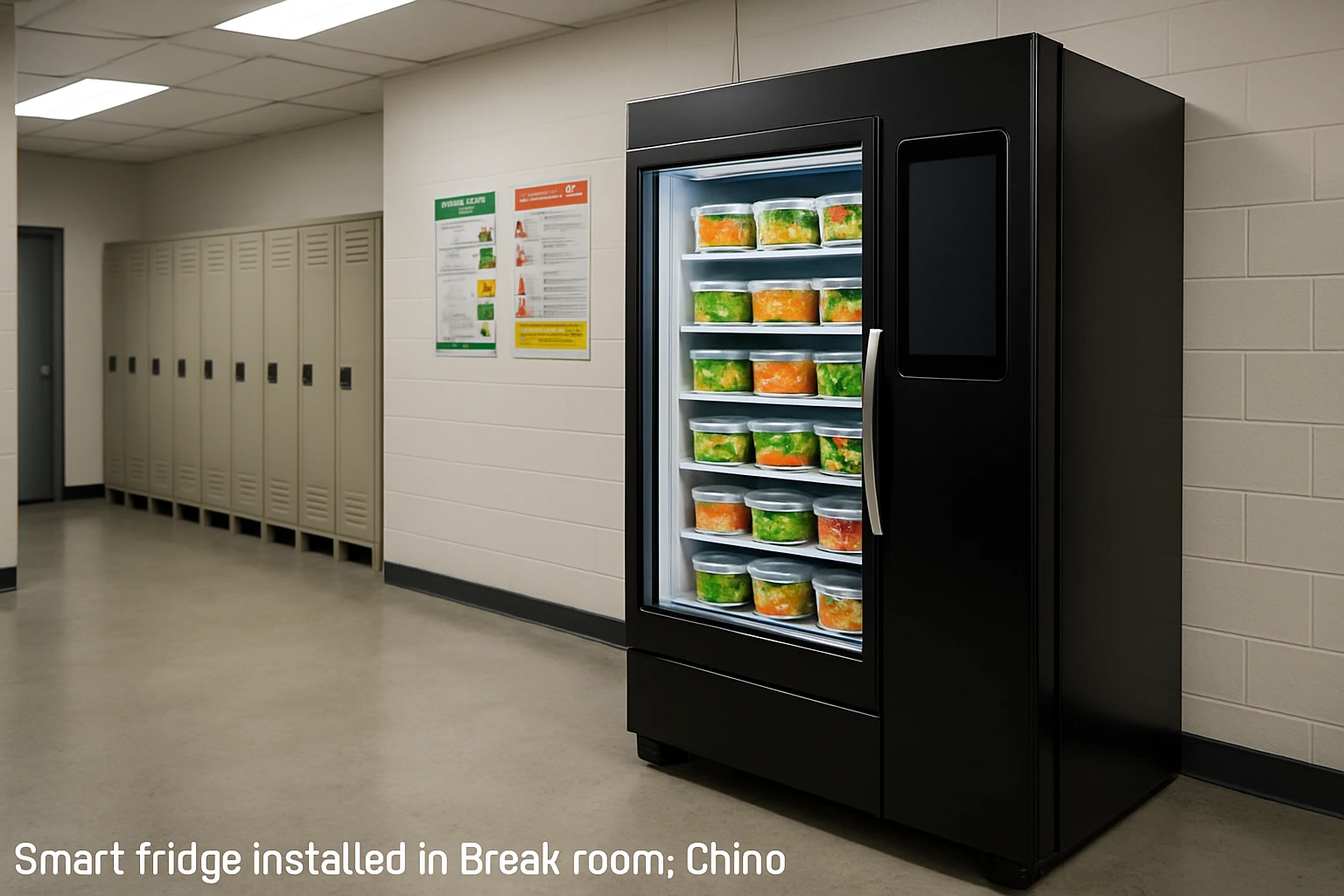
Chino and Chino Hills occupy the western edge of the Inland Empire, sitting at the junction of San Bernardino County and the broader Los Angeles Basin. The area is one of the most industrially dense zones in the IE, a tight concentration of logistics operations, food processing facilities, light manufacturing, and corporate parks that sits within reach of Ontario International Airport to the east and the 60, 71, and 91 freeways to the north and west. For employers here, the proximity to major transportation infrastructure is the whole point. For workers, it means shift schedules designed around cargo and production cycles, not mealtimes.
Chino is primarily industrial. The city's zoning reflects decades of evolution from dairy and agricultural land to distribution centers and manufacturing facilities that serve the broader IE economy. Large-footprint warehouse and logistics operations dominate the corridors along Kimball Avenue, Riverside Drive, and the industrial zones south of the 60. Food processing and cold storage facilities are a significant segment. Light manufacturing, plastics, packaging, consumer goods, fills the remaining industrial parks.
Chino Hills is different in character. It is primarily a residential and commercial city with a suburban layout that includes corporate office parks, retail corridors along Grand Avenue and Peyton Drive, and some light industrial. The workforce at Chino Hills employers tends to be more office-based: professional services, healthcare, retail management, and some tech-adjacent corporate roles. The two cities share a border and a regional labor market, but they represent distinct workplace types that the smart fridge serves in different ways.
In Chino's industrial facilities, the smart fridge serves warehouse crews and production workers on 10- and 12-hour shifts who cannot leave the facility during breaks and whose break windows are defined by operational cadence rather than personal preference. In Chino Hills' corporate parks and healthcare facilities, the smart fridge serves employees on more flexible schedules who have more off-site options but appreciate having quality food without the commute to a restaurant.
One of the most interesting use cases in the Chino market is facilities that house both industrial and office employees in the same building or campus. A distribution center with an attached corporate office, a manufacturing facility with an administrative wing, or a food processing operation with a quality and compliance team, these mixed-workforce facilities have employees with very different daily realities sharing the same break room.
The warehouse worker on a 6am to 4pm shift cannot leave the building during the 30-minute break that California law provides. The administrator in the office wing can theoretically drive to a restaurant nearby, but in Chino's industrial corridors, "nearby" often means a 10-minute drive each way on a street grid designed for trucks, not quick lunch runs. In practice, both groups of employees end up in the same break room, and the food options available to them are the same.
This is where the smart fridge creates genuine value for the whole workforce rather than just one segment. A single unit in the shared break room serves the warehouse crew on their mandatory break and the office worker who decided not to leave the building. The meal options, grain bowls, wraps, protein-forward entrées, work equally well for a production worker who needs caloric fuel for a physical shift and an office worker who wants a lunch that does not make them slow for the afternoon.
Wellness equity is the right frame for this: giving every worker at a site, regardless of whether their job is in the warehouse or behind a desk, the same access to real food is a concrete expression of the idea that all employees deserve the same consideration. A break room with a vending machine and a microwave implicitly says the opposite. The food available to hourly warehouse workers should not be categorically worse than what salaried employees can access.
Chino's position adjacent to Ontario and just west of Ontario International Airport, means that many logistics operations in the area are directly connected to the airport's air cargo and fulfillment ecosystem. Workers in these facilities often operate on shift schedules driven by flight arrivals and fulfillment windows that have nothing to do with conventional meal timing. A shipment that lands at 2am generates a processing wave at 3am. A fulfillment push for a next-day delivery window creates demand spikes at hours when nothing outside the facility is open.
For these operations, the smart fridge is not a nice-to-have. It is the only viable solution for employee nutrition at the hours when the work happens. See our related post on smart fridges for Ontario warehouses for more on how logistics operators in this cluster handle employee food access.
For industrial employers in Chino, the core value is operational simplicity and genuine nutritional access for shift workers. MHP handles stocking, rotation, and quality control. The fridge is available whenever the break room is accessible. Employees get real food, not vending machine snacks, regardless of what shift they work. For employers competing for reliable hourly labor in a tight West IE market, this is a real differentiator.
For corporate and office employers in Chino Hills, the value is slightly different: convenience, quality, and the cultural signal that the employer invests in employee wellness. A smart fridge in a Chino Hills corporate park break room replaces the choice between a mediocre nearby restaurant and a bag of chips, with a real meal, available immediately, that someone actually wants to eat.
See the Smart Fridge program page for full program details. Our manufacturing and production industry page covers how MHP serves production facilities across the IE in more detail.
Yes. Chino and Chino Hills are within MHP's West IE service area. Both cities are on our regular restock routes, and program setup for sites in either city follows the same process as any other IE location, a site visit, an assessment of break room layout and access, and a restock schedule calibrated to the workforce size and shift pattern.
Yes, and it is one of the most effective use cases for the format. A single unit in a shared break room serves both workforce segments. The menu is designed to be broadly appealing, not targeted at one type of worker and the 24/7 availability means both the warehouse crew on a fixed break schedule and the office worker on a flexible schedule can access it when they need it.
The unit requires approximately 24 to 30 inches of width, standard depth, and a 120V electrical outlet nearby. Most industrial break rooms in the Chino area have adequate space. We assess the specific location during the pre-installation site visit and confirm fit before committing to the installation. If space is a constraint, we discuss placement options, including hallway or common area placement where break room size is limited.
Yes. MHP's menu is protein-forward, with entrées typically providing 30 to 40 grams of protein and meaningful caloric content, designed for workers who are expending real physical energy during their shifts. Grain bowls, wraps with substantial protein components, and high-protein salads are standard rotation items. For facilities with physically demanding work, we can weight the rotation toward higher-calorie, higher-protein options that better match the energy demands of the job.
For a facility in the 40 to 150 employee range, a smart fridge is typically the better fit. It requires less floor space, less infrastructure, and less management overhead than a micro-market. The food quality is also typically higher, MHP's fresh meals are a different category from the shelf-stable snacks and beverages that make up most of a micro-market's inventory. For very large facilities (200+ employees), a micro-market may make sense as a supplement, but the smart fridge is the right primary format for most Chino and Chino Hills employers.
Tell us about your team and we will recommend the right program and a worksite-specific quote. No high-pressure sales.