Smart Fridge
Smart fridges for Ontario warehouses: what to expect
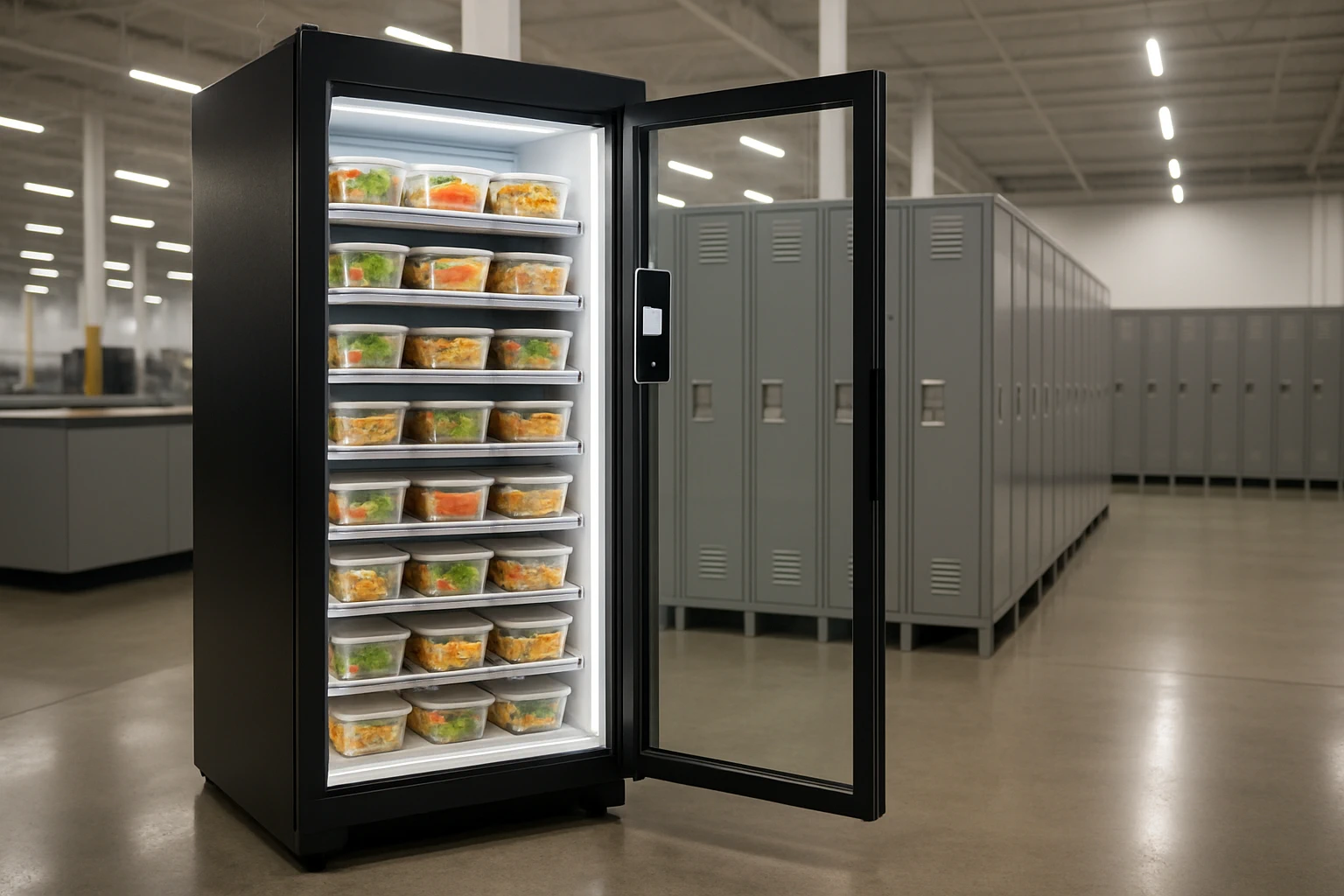
Ontario, California is one of the most significant warehouse and logistics hubs in the United States. The Ontario International Airport cargo complex, the Jurupa Valley and Airport Drive corridors, and the sprawling industrial parks off the 15 and 60 freeways put millions of square feet of active warehouse space within a few miles of each other. Those buildings run around the clock. And every shift that starts, whether it is 6am, 2pm, or 10pm, starts the same way: workers walking into a building where there is nothing good to eat nearby and nothing to eat inside except whatever a vending machine offers.
A workplace smart fridge is the most practical solution to that problem for Ontario warehouse operators. This guide explains what one actually looks like in practice, how it is set up, what goes inside, who accesses it and when, and what it costs. If you are an HR director, operations manager, or facilities lead at an Ontario warehouse, this is the information you need to decide whether a smart fridge fits your site.
Ontario's warehouse facilities are physically large, 200,000 to 500,000 square feet is common, with some exceeding a million square feet. They typically employ 100 to 600 workers per shift, operate across two or three shifts, and run on tight break schedules driven by labor law and production targets. Workers get a 30-minute lunch break. That is not enough time to drive to a restaurant, wait, eat, and return. Driving off-site is also a fatigue and safety concern, sending a worker who has been on their feet for four hours out onto the 60 or the 15 during a 30-minute window is not ideal for anyone.
The industrial nature of the Ontario corridor compounds the problem. The areas around most large warehouses have very limited retail food infrastructure. There is no food court, no cafeteria row, and delivery apps operating at 2am are not filling that gap reliably. For day shifts, a motivated worker can find something within a mile. For swing shift workers and overnight teams, the realistic options collapse to vending machines and whatever they brought from home.
This is not just a convenience issue. Warehouse and logistics work is physically demanding, associates are lifting, walking, operating equipment, and managing inventory for eight to ten consecutive hours. The average active warehouse worker burns significantly more calories per shift than a sedentary office worker. Research consistently places the caloric demand for moderate to heavy physical labor at 2,500 to 3,000 calories per day for an average adult male, with a meaningful portion of that demand concentrated in the work window itself.
When workers skip meals or replace them with vending machine snacks, high-sodium chips, candy, and caffeinated drinks. They do not actually solve their hunger. They produce a short spike followed by an energy crash in the second half of the shift. OSHA's guidance on fatigue-related incidents in warehousing and logistics identifies nutritional inadequacy as a contributing factor in worker fatigue, which in turn is one of the leading precursors to on-the-job accidents. A forklift operator whose blood sugar has crashed two hours into their second half of a shift is less alert, has slower reaction times, and makes worse decisions. This is measurable and documented.
A smart fridge stocked with real food, protein, complex carbohydrates, vegetables, provides the nutritional foundation that keeps workers performing safely across a full shift. This is not a wellness perk; it is an operational risk management input.
A smart fridge is a temperature-controlled refrigeration unit, roughly the size of a standard upright fridge, stocked with fresh, labeled meal containers. Employees access it by tapping a badge, card, or mobile device on a reader mounted to the unit. The transaction is recorded automatically. Meals are charged either to the employee directly (at the point of access) or to the employer under a subsidy arrangement. There is no staff member required to operate it, no service window, and no app to download.
MHP Food Service stocks its smart fridges with meals cooked fresh in our Rancho Cucamonga kitchen and delivered on a restocking schedule matched to your site's consumption. Every container is labeled with the contents, ingredients, and allergen information. The menu rotates, grain bowls, grilled proteins, salads, wraps, hot entrees, so workers are not eating the same thing every day. The food is the same quality as what MHP delivers to its buffet clients; it is portioned for an individual and presented for grab-and-go access rather than a serving line.
Getting a smart fridge running at an Ontario warehouse is a straightforward process. The unit requires approximately two square feet of floor space in your break room and a standard 110V outlet. There is no plumbing, no special electrical work, and no structural modification. Installation takes less than an hour. MHP handles delivery, positioning, and connection. Your facilities team does not need to be involved beyond clearing the space and confirming the outlet location.
Once installed, MHP programs the unit with your site's access credentials, whether that is employee badge numbers, key fobs, or another system, so only your workers can open it. The employer decides whether access is tied to a subsidy or whether employees are paying individually. Either way, the setup is done before the fridge is ever stocked. When the first delivery of meals arrives, the fridge is ready to go.
Most Ontario warehouse sites are up and running within a week of the initial conversation. There is no long-term contract required to start, which means you can pilot the program on one shift or one building and expand from there based on actual participation.
MHP restocks on a schedule determined by your headcount and consumption. Most warehouse sites in the Ontario area are serviced two to three times per week. On restock days, an MHP driver arrives, loads fresh meals, removes any items approaching their use-by date, and wipes down the interior. The whole visit takes about 15 minutes. Your team does not need to be involved.
If consumption spikes, say, a new shift starts or headcount increases, MHP adjusts the restock frequency. If the program is being underutilized on a particular shift, we will work with you to identify whether it is a menu issue, an access issue, or a communication issue, and adjust accordingly. The goal is a fridge that is neither consistently empty nor consistently wasting food, and MHP monitors inventory data to keep it that way.
There is no single right answer on who pays, and MHP supports all three common models. In a fully employer-subsidized arrangement, the company pays a per-meal rate for every meal consumed. Employees access the fridge at no charge. This model is common among larger Ontario operators who view the food benefit as a retention and safety investment and want to remove any barrier to use. In a fully employee-pays model, workers tap their card and are charged the meal price at the point of access. The employer pays nothing beyond a nominal placement fee. In a split model, the employer subsidizes a portion, say, half the meal cost and workers pay the remainder. All three are simple to administer and can be adjusted as your program evolves.
For employers weighing the ROI: turnover in warehouse logistics is high, and the cost of replacing a trained associate, recruiting, onboarding, productivity loss, is significant. A food benefit that costs a few dollars per person per day competes directly with the factors that drive voluntary turnover. Many Ontario operators find the math persuasive. See how MHP approaches warehouse and logistics programs for more context on the business case.
The alternatives, vending machines, delivery app stipends, and employer-run cafeterias, each have significant limitations in the Ontario warehouse context. Vending machines provide access around the clock but stock processed, low-nutrition food that does not support physical performance. Delivery app stipends work in theory but fail in practice at 2am in an industrial park and require workers to manage an app, wait for delivery, and hope the window aligns with their break. Employer-run cafeterias require staff, equipment, permits, and a sustained management commitment that most warehouse operators are not in a position to take on.
A hot buffet is another option MHP offers, and it works well for Ontario warehouses with 100 or more employees eating during a defined lunch window on the day shift. But a buffet inherently serves one window and one shift. For facilities running two or three shifts, which describes most large Ontario warehouses, a smart fridge covers the gaps the buffet cannot. Our guide to feeding a 24/7 workforce goes into more depth on how to think about the combination.
A standard smart fridge unit requires approximately two square feet of floor space and a standard 110V outlet. There is no special electrical work, no plumbing, and no structural modification required. Installation takes less than an hour and your break room setup does not need to change.
Restocking frequency is set based on your headcount and consumption patterns. Most Ontario warehouse sites are restocked two to three times per week. MHP monitors inventory levels and adjusts the schedule to ensure the fridge is never empty going into a shift.
Yes, that is precisely what the smart fridge is designed for. The fridge operates 24/7. Employees tap their badge or a card to unlock and access meals at any hour. There is no window, no service counter, and no requirement for a staff member to be present. Overnight and weekend workers have the same access as the day shift.
That is up to the employer. MHP supports three models: fully employer-subsidized (the company pays per meal), fully employee-pays (workers pay at the point of access via tap), or a split subsidy where the employer covers a portion and employees pay the remainder. All three are common in Ontario warehouse settings.
MHP generally works best with sites that have at least 30 to 40 employees across all shifts. Smaller sites may be a fit depending on specifics, contact MHP with your headcount and shift structure and we will let you know whether a fridge or a different program format makes more sense.
Ontario is one of the hardest markets in the country for worker food access, massive facilities, 24/7 operations, and surrounding infrastructure that was never designed for lunch. A smart fridge is the most practical answer: low footprint, no staffing requirement, available on every shift, and stocked with real food that supports physical performance. The workers who need it most, the overnight crew, the weekend shift, the people whose breaks do not fall at a convenient hour, benefit most.
If you run a warehouse in Ontario and want to talk through whether a smart fridge is the right fit, reach out to MHP Food Service here. We will look at your headcount, shift structure, and break room space and give you a straight answer on whether it makes sense and what it would cost.
OSHA guidance on fatigue in warehousing: osha.gov/worker-fatigue. CDC resources on shift work and nutrition: cdc.gov/niosh.
Tell us about your team and we will recommend the right program and a worksite-specific quote. No high-pressure sales.
Hot buffet lunches, a 24/7 smart fridge, or weekly meal drops — cooked in our Rancho Cucamonga kitchen and run as one simple program.