Smart Fridge
Smart fridge for public safety: fire stations, police departments, and dispatch centers
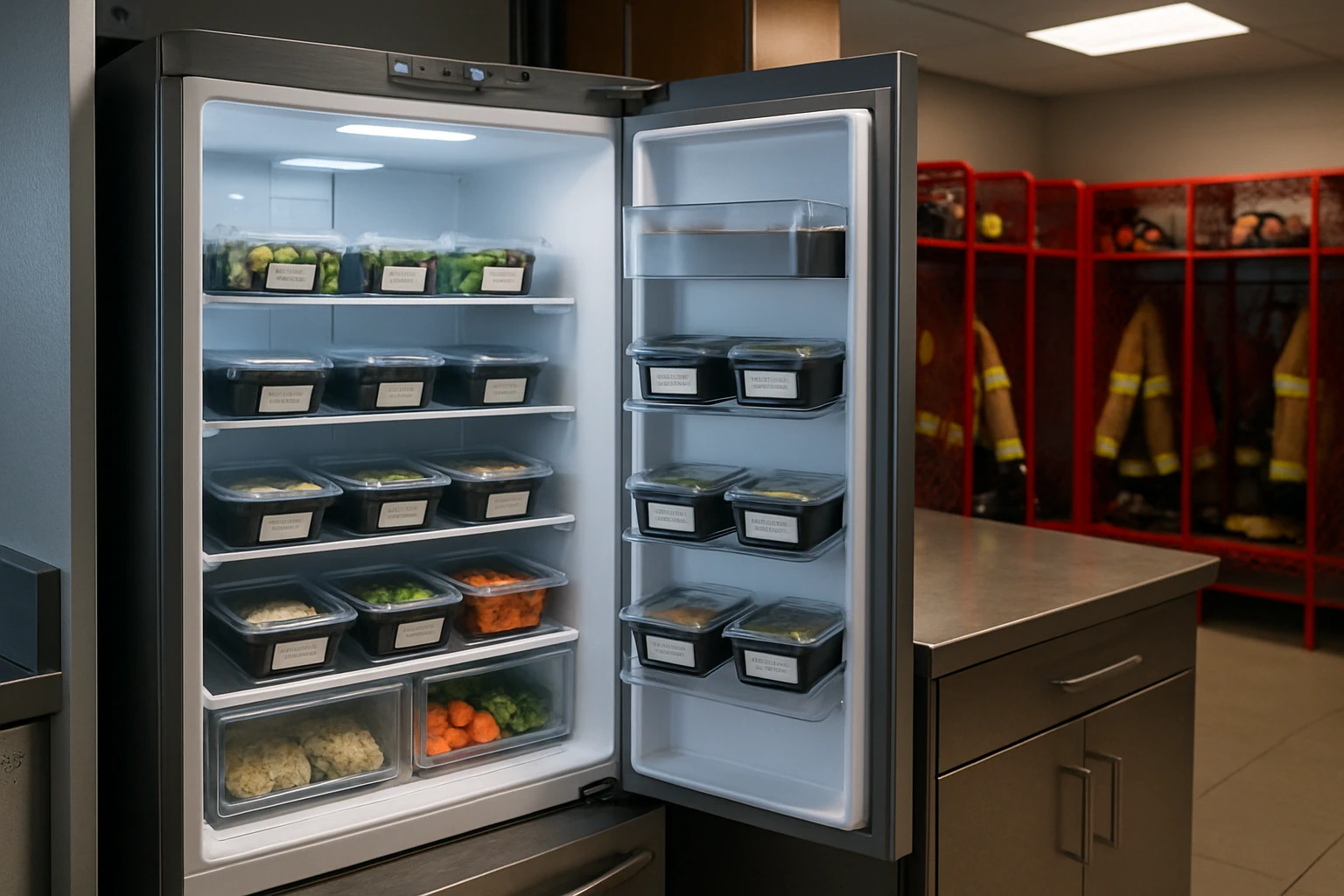
Most workplaces have a lunch problem. Public safety agencies have a different version of it, one that is considerably harder to solve with the standard answers.
A corporate office employee who is unsatisfied with their break-room options can walk to a nearby restaurant, order delivery, or leave for 45 minutes without consequences. A firefighter on a 24-hour shift cannot. A police officer mid-patrol cannot. A dispatcher covering the overnight watch at an emergency communications center cannot. The facility is the worksite, the shift doesn't pause for hunger, and the break window, when it comes at all, is short, unpredictable, and subject to instant interruption.
This is the defining food access challenge in public safety work: the people whose jobs demand the most from their bodies and minds have the least reliable access to food during the hours they need it most. A smart fridge, stocked with real food and available around the clock, is one of the cleanest solutions to this problem that currently exists at a cost and operational complexity that municipal and county agencies can actually execute.
Public safety operations in Southern California are structured around shift models that bear little resemblance to standard business hours. Fire departments in large IE and OC jurisdictions, Riverside Fire, San Bernardino City Fire, Anaheim Fire & Rescue, Ontario Fire, Santa Ana Fire, run their engine and truck companies on 24-hour on / 48-hour off rotation. Crews report at 7am and don't leave until 7am the next day. During that 24-hour period, they sleep at the station, train at the station, and eat at the station, when calls allow.
Police departments run a different model. Patrol shifts typically run 10 or 12 hours. Large departments, Riverside PD, San Bernardino PD, Anaheim PD, Ontario PD, the San Bernardino County Sheriff's Department, run three overlapping shifts covering the full 24 hours. Officers on patrol can theoretically stop for food, but in practice this is constrained by call volume, partner schedules, and the practical difficulty of leaving a beat in a busy jurisdiction to eat a real meal. In many departments, officers end up eating in their vehicles from fast food drive-throughs or skipping meals entirely on high-activity shifts.
Dispatch and emergency communications centers are arguably the most constrained of all. Dispatchers are console-bound by the nature of the work. They cannot leave their station mid-shift without coverage, and coverage requires either a supervisor stepping in or another dispatcher cutting short their own break. The Centers for Disease Control and Prevention has documented that dispatcher work is among the highest-stress occupations tracked, with significant cardiovascular and metabolic health implications, including those related to chronic irregular eating patterns and shift-work disruption of normal meal timing.
Physical demand and cognitive demand are both elevated in public safety work compared to most civilian occupations. A firefighter responding to a structure fire is performing sustained high-intensity physical work under high heat stress while wearing 50 or more pounds of gear. A patrol officer conducting a felony stop or responding to a violent incident requires rapid reaction time and clear decision-making under acute stress. A dispatcher managing multiple simultaneous active incidents requires sustained focus and the ability to process information under high cognitive load.
Research from the National Institute for Occupational Safety and Health (NIOSH) has repeatedly documented that first responders, particularly firefighters, suffer significantly elevated rates of cardiovascular disease, obesity, and metabolic syndrome compared to the general working population. The International Association of Fire Fighters (IAFF) has noted that cardiovascular events now account for more line-of-duty deaths annually than traumatic incidents in many years, a reversal of the pattern from earlier decades. Poor nutrition is a documented contributing factor.
This is not an abstract policy concern. It is an operational concern for department leadership. A crew that eats well performs better and stays healthier over a career. For HR directors and chiefs who are watching pension costs, workers' compensation claims, and early medical retirements, the nutritional environment at the station or the precinct is a direct operational input, not a soft benefit.
The two food options that exist in most public safety facilities are the station kitchen and the vending machine. Both fail in characteristic ways.
The station kitchen has genuine value in fire departments, cooking together is a cultural tradition with real morale benefits, and fire crews that cook and eat together tend to function better as units. But the station kitchen only works when the crew has time to cook, which is not guaranteed on high-call shifts. A busy engine company in a high-demand urban territory may run 15 or more calls in a 24-hour period. When calls are clustered in the evening hours, which is statistically common, the crew may return from their last call at 10pm or later without having had a real meal since mid-afternoon. The station kitchen at that hour requires someone to cook, which requires energy no one has after a long call run.
Police precincts and dispatch centers usually don't have the station kitchen tradition at all. The break room has a microwave and a vending machine. Officers who bring meals from home have to remember to bring them, keep them refrigerated, and heat them in a short window. Officers who rely on the vending machine are eating chips, candy, and processed snack items that do not support sustained physical and cognitive performance. The fast food stop, the default for patrol officers, involves leaving the beat, waiting in a drive-through line, and eating in a vehicle, often while still monitoring radio traffic.
A smart fridge stocked by MHP in a fire station, police facility, or dispatch center changes the food access equation in a few specific ways that align with how these facilities actually operate.
First, availability. The fridge is accessible at any hour, including 2am, 4am, and any other time a crew member is hungry after a call run. There is no prep time required, no cooking required, and no decision fatigue, the meals are there, labeled, ready to heat in 90 seconds or eat cold.
Second, quality. MHP stocks protein-forward meals designed to support physical and cognitive performance, not vending machine calories. High-protein entrées, complex-carbohydrate grain bowls, and balanced wraps are standard in the rotation. For first responders who are doing physical work and need to recover quickly, the quality difference between a smart fridge meal and a vending machine option is significant and measurable in energy levels and satiety.
Third, consistency. The fridge is restocked on a regular schedule, which means there is always something real to eat. This removes the dependency on individual crew members to plan and execute cooking, which is inconsistent on high-demand shifts.
Fourth, independence from the facility kitchen. For police and dispatch facilities that don't have a kitchen culture, the smart fridge provides a complete standalone food solution. For fire stations that do have a kitchen culture, the fridge supplements it, it's there when the crew has time to cook, and it's the backup when they don't.
Southern California has some of the largest municipal public safety operations in the United States. The cities and jurisdictions relevant to MHP's service area represent a substantial installed base of potential locations:
Riverside: Riverside Fire Department and Riverside Police Department serve one of the Inland Empire's largest cities, with multiple stations and precincts across a geographically dispersed territory. Large shift workforces on 24-hour and 12-hour rotations.
San Bernardino: San Bernardino City Fire and San Bernardino Police Department, plus the county-level San Bernardino County Fire Protection District and San Bernardino County Sheriff, one of the largest sheriff's departments in the country, with stations and substations spread across the largest county by land area in the continental United States.
Anaheim: Anaheim Fire & Rescue and Anaheim Police Department serve Orange County's largest city, with significant call volumes driven by the entertainment corridor.
Santa Ana: Santa Ana is one of the densest cities in the United States, and its fire and police departments reflect that, high call volumes and large shift workforces.
Ontario: Ontario Fire Department and Ontario Police Department serve one of the IE's largest logistics and industrial hubs, with call patterns that include both residential and commercial/industrial incidents.
Beyond city departments, county dispatch centers, including the Riverside County Sheriff's dispatch, San Bernardino County emergency communications centers, and Orange County Sheriff-Coroner dispatch, are facilities where dispatchers work long shifts in exactly the kind of console-bound environment where a smart fridge provides the most differentiated value.
For HR directors and department administrators evaluating a smart fridge program for a public safety facility, the relevant framing is less about food as a perk and more about food as an operational wellness investment. The distinction matters in public sector budget conversations.
The cost of a smart fridge program, typically structured as a low or no-cost installation with individual employees paying for meals, or a subsidized arrangement where the department covers some or all of the per-meal cost, is modest relative to the operational costs of addressing the downstream consequences of poor first-responder nutrition. Cardiovascular disease in firefighters, for instance, generates workers' compensation costs, disability costs, and early-retirement pension costs that dwarf any reasonable food program budget.
Departments that choose to subsidize meals can frame this as a health and wellness benefit, comparable to gym memberships and wellness programs that many departments already offer. The smart fridge has the practical advantage of near-100% utilization: every crew member eats during every shift, so the benefit actually reaches every employee rather than the subset who opt into a wellness program.
See our Smart Fridge program page for program details and how to get started. Our public safety industry page covers the broader context of how MHP works with first responder agencies. We've also written about drop-off lunch formats for public safety crews in our post on public safety lunch programs in the Inland Empire.
Yes, and the two work well together rather than competing. The station kitchen tradition in fire departments has real cultural and morale value, cooking and eating together as a crew is a meaningful part of the job. The smart fridge supplements that tradition rather than replacing it. On shifts where the crew has time to cook, they cook. On shifts where calls run through the dinner window and everyone returns at 10pm exhausted, the fridge is there with real food that doesn't require anyone to start a pot of something. Many fire department clients treat the fridge as the backup plan that takes pressure off the cooking rotation, which actually makes the cooking tradition more sustainable.
MHP coordinates access protocols with facility management before installation. For most fire stations and police facilities, the fridge is placed in the designated break room or kitchen area that existing staff access through normal building protocols. MHP service staff, who restock and maintain the unit, are scheduled during hours that work for the facility's security and operational requirements. Credentialing and access arrangements are handled as part of the setup process. The unit itself uses a standard payment or access system (tap-to-pay or account-based) that doesn't require additional facility security infrastructure.
MHP's menu for public safety facilities is weighted toward high-protein, calorie-appropriate entrées that support physical work and shift recovery. Typical items include protein-forward grain bowls (grilled chicken, turkey, beef over rice or farro), high-protein wraps, hearty stews and braised proteins with complex carbohydrate sides, and salads with substantial protein components. The rotation also includes lighter options for crew members who are not coming off heavy physical work, not everyone on a shift is on the engine company. Items are labeled with macronutrient information, heating instructions, and use-by dates. Dietary variety (halal, plant-based, gluten-aware) is maintained in the rotation to serve diverse department workforces.
Yes, and dispatch centers are in some ways the ideal placement for a smart fridge. Dispatchers are among the most constrained workers in terms of their ability to leave their station for food. They are console-bound, coverage-dependent, and often working in facilities that have no food service infrastructure at all beyond a vending machine. The smart fridge fills that gap completely without any coordination burden on the facility. The dispatch environment also tends toward overnight and irregular-hour shifts, which are exactly the hours where vending machines are the only alternative. MHP's restock schedule is calibrated to overnight usage patterns, ensuring the unit is well-stocked before night shifts begin.
Yes. MHP works with public safety agencies on both fully employee-paid arrangements (where the fridge is provided as a convenience service and crew members pay individually per item) and subsidized arrangements (where the department or a wellness budget covers some or all of the per-meal cost). For departments that want to position the program as a wellness benefit, particularly those trying to address first-responder health outcomes proactively, the subsidized model is worth evaluating. The cost per subsidized meal is typically modest relative to the per-employee cost of other wellness benefits, and utilization is nearly universal because the benefit activates at the point of need (hunger) rather than requiring employees to opt in to an abstract program.
Tell us about your team and we will recommend the right program and a worksite-specific quote. No high-pressure sales.