Wholesale
Wholesale meal labeling, packaging, and cold-chain logistics for SoCal operators
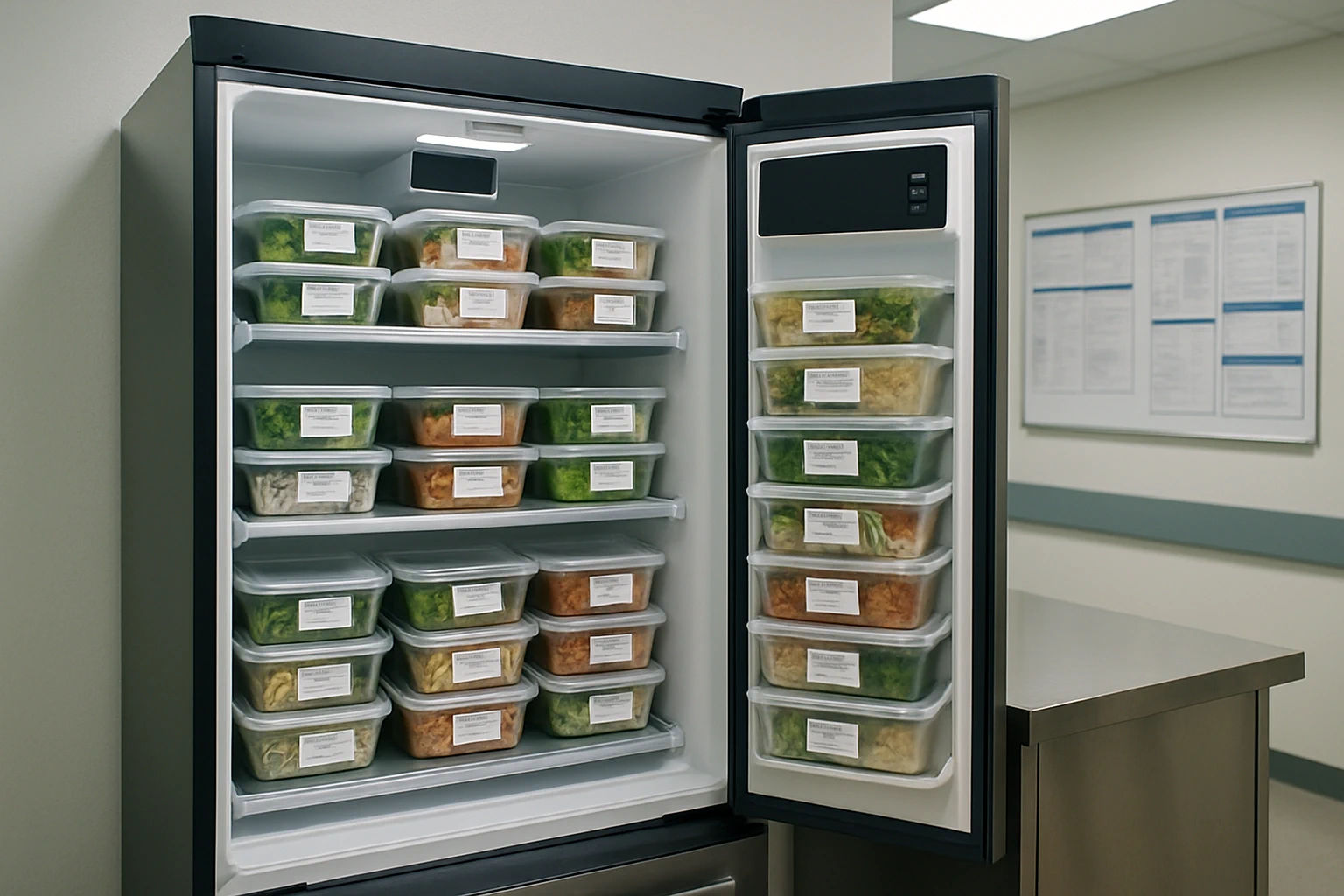
Operators new to the wholesale fresh-meal category often underestimate the operational rigor required to keep meals safe, labeled, and saleable across a multi-day code-date window. This guide explains what to expect from a wholesale supplier on labeling, packaging, and cold-chain logistics, and what compliance requirements California operators have to meet on the retail side.
California state law and federal food safety requirements set a clear minimum bar for the labeling on every packaged prepared meal sold through unattended retail. Every container needs:
A complete ingredient list, in descending order by weight, including any sub-ingredients in compound ingredients. A line item that says "sauce" without breaking down what is in the sauce is not compliant.
Allergen declarations for the eight major allergens: milk, eggs, fish, shellfish, tree nuts, peanuts, wheat, soybeans. Sesame was added as the ninth major allergen by federal law in 2023. The declaration needs to be visible and unambiguous.
The producer name and address, so a customer can identify and contact the responsible business. For a wholesale operator reselling meals from a co-packer or kitchen, the producing kitchen's name and address goes on the label, not the operator's.
The net weight of the contents, in both metric and US units.
A clearly visible date code. Most prepared-meal suppliers use a code-date system showing the date by which the food should be consumed. Some use a production date and let the operator track shelf life.
For chain retail operators above the size threshold, calorie disclosure on every menu item is also required under federal law. Most wholesale suppliers print calorie counts on the label as a standard practice even when the operator is below the chain threshold, because it reduces friction at the point of sale.
The container has three jobs: hold temperature in the cold chain, hold up to handling without crushing, and produce a clean visual presentation in the retail case.
Temperature holding is the technical requirement. The packaging has to maintain the food at 40 degrees Fahrenheit or below from the supplier's kitchen through delivery through restocking through the customer's eventual purchase. Most chef-prepared wholesale meals delivered in SoCal use sealed plastic containers with MAP (modified atmosphere packaging) or vacuum sealing. The gas mix or vacuum slows bacterial growth, which is what extends the code-date life from 3 days (unsealed) to 7 to 10 days (MAP).
Handling durability matters because the meals get loaded into a truck, driven to the location, unloaded, stocked in a case, and sold. A container that looks great in the kitchen but cracks on the truck produces shrinkage and customer complaints. Wholesale suppliers serving operators at scale have container choices that solve for transport durability.
Visual presentation matters because the meal is the product. Workers buying from a smart fridge or micromarket see the container before they see the food inside. Clean labels, consistent positioning, and the ability to read the contents through the lid all affect purchase rates. Suppliers who treat the container as part of the product design produce higher-velocity SKUs at retail.
The cold chain is the temperature-controlled pathway from production to point of sale. For most SoCal operators, the wholesale supplier handles the cold chain through the delivery, and the operator handles the cold chain at the location.
On the supplier side, the path is kitchen production at 40 degrees, blast-chill to drop product temperature, refrigerated storage at the kitchen, refrigerated truck for delivery, and delivery to the operator at temperature. Suppliers worth working with use refrigerated trucks with temperature monitoring and can provide delivery temperature records if requested.
On the operator side, the path is delivery acceptance at the location, refrigerated case stocking, customer purchase, and operator pull-and-shrinkage for expired units. The operator's case has to maintain temperature reliably across the week, which means a real refrigerated case rather than a passive cooler.
The temperature handoff at delivery is the most common failure point. A supplier delivery that sits in a hallway for an hour before being stocked is a cold-chain break. Operators who run high-velocity locations usually have someone on-site at the delivery window to stock immediately. Operators with off-hours delivery have to coordinate with the building to ensure delivery acceptance and immediate stocking.
MHP labels every wholesale meal container with the complete ingredient list, allergen declarations, producer name and address, net weight, calorie count, and code date in a standard layout. The layout is consistent across every SKU, so operators building smart fridge backends or micromarket inventory systems can rely on the same placement and format every time.
Packaging is MAP-sealed plastic containers engineered for the SoCal cold chain. Code-date life is 7 to 10 days from production, with most meals delivered to operators within 24 hours of cook time. Refrigerated delivery trucks maintain product temperature from kitchen to location, with delivery temperature records available on request.
For operators with specific labeling or packaging requirements (state-of-California-specific compliance, smart fridge backend integration, branded retail packaging), MHP works with the operator to customize the standard layout. The starting point is industry-standard compliant labeling, and the customization conversation happens after the standard is in place.
The supplier handles labeling and cold-chain delivery. The operator handles four things:
First, the refrigerated case at the location has to be calibrated and monitored. A case running warm is a code-date acceleration problem and a food safety risk.
Second, restocking has to follow first-in-first-out rotation. The oldest code-date units go to the front of the case. Newer units go behind. Restocking labor that does not enforce FIFO produces avoidable shrinkage.
Third, the operator has to pull and shrink any unit within 24 hours of code-date expiry. The wholesale supplier's code date is the operator's deadline. Selling a unit on the expiry date is technically fine. Selling one a day past is not.
Fourth, the operator has to track shrinkage as a percentage of stocked units and adjust stocking pace accordingly. A location running 12 percent code-date shrinkage is being overstocked. A location running 3 percent is being understocked and losing sales. The target band is usually 4 to 8 percent.
The labeling and cold-chain conversation with MHP is part of the standard wholesale onboarding. We walk operators through the labeling layout, the packaging spec, and the delivery temperature monitoring as part of setting up the wholesale relationship. From there the operator runs their side of the cold chain at the location, and the supply chain works.
Food labeling requirements for prepared meals are defined by the FDA (Food and Drug Administration), the USDA (US Department of Agriculture for meat and poultry components), and the California Retail Food Code. MAP packaging best practices for fresh prepared meals are documented by the IFT (Institute of Food Technologists).
MAP stands for modified atmosphere packaging. The container is sealed with a specific gas mix that slows bacterial growth and extends shelf life without preservatives. Most chef-prepared wholesale meals delivered in SoCal use some form of MAP or vacuum packaging. The result is longer code-date life and lower shrinkage for the operator without compromising the freshness of the food.
Tell us your locations and the volume you move, and we’ll come back within one business day with wholesale terms for your route.