Wholesale
How wholesale meal pricing actually works (per-location minimums explained)
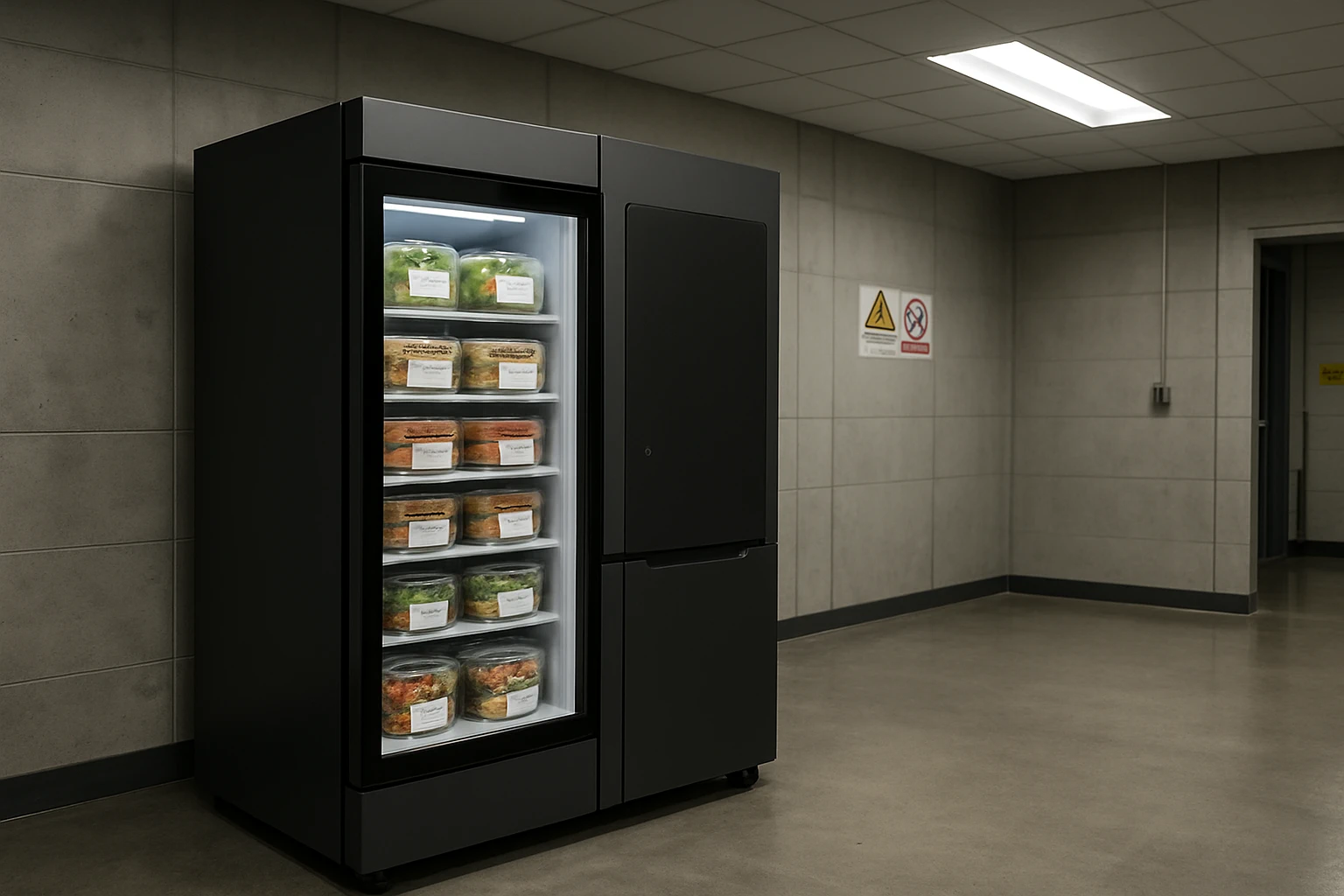
Wholesale meal pricing confuses operators new to the category because the math is not the same as wholesale dry goods or beverages. The per-meal cost depends on per-location minimums, route logistics, and weekly volume per stop. This guide explains why pricing is structured this way and how operators should model their economics before signing a wholesale agreement.
The cost of getting a meal from a kitchen to a workplace fridge breaks into three buckets: ingredient and labor cost to cook it, packaging and labeling cost, and delivery cost per stop. The first two buckets scale with meal count. The third bucket is mostly fixed per stop regardless of how many meals are dropped.
A delivery truck running a SoCal route makes a finite number of stops per day. Each stop carries roughly the same cost in driver time, fuel, refrigeration draw, and route logistics. A stop that drops 200 meals absorbs that cost easily. A stop that drops 20 meals absorbs the same cost across one-tenth the meal count, and the per-meal cost balloons.
Per-location minimums are how wholesale suppliers price for this reality. A 50-meal weekly minimum location is priced to make sense for the operator and the supplier. Below that, the math does not work for either side. Above that, the per-meal cost can come down as volume scales because the stop cost is already absorbed.
The right mental model is not per-meal cost in isolation. It is per-meal cost at the actual volume the location runs. A small location running 30 meals a week at a $7 per-meal wholesale price is paying for the inefficiency of the stop. A larger location running 150 meals a week at the same $7 is getting a fair price.
For operators with a mix of small and large locations, the practical question is whether the small locations are worth running at all. Some operators decide that a small location at high per-meal cost is still worth it because the account is strategic or the location is on the way to a bigger drop. Others consolidate small locations into a single drop point and let employees travel a short distance to pick up.
The pricing conversation with a wholesale supplier should always be account-specific, not catalog-specific. A supplier who quotes a flat per-meal price without asking about your locations and weekly volumes is either overpricing the small accounts or losing money on them.
MHP prices wholesale meals on a per-location-minimum model. The per-location minimums are set in conversation with the operator based on the actual weekly velocity at each site. Per-meal pricing scales transparently with the per-location minimum and total weekly volume.
A small SoCal micromarket location running 30 meals a week will see different pricing than a 200-meal warehouse site, and both prices will be visible to the operator before they sign. Multi-location operators see consolidated pricing that reflects the route efficiency of dropping multiple sites in a single delivery run.
What MHP does not do is quote a single per-meal number out of context. The number depends on the account, the volume, and the route. Operators who want a flat answer can get one, but it is the worst-case-priced answer, and the real number for most accounts is better than the flat quote.
Wholesale meal cost includes a cold-chain component that does not exist in dry goods. The food has to stay at temperature from production through delivery through restocking. The truck has refrigeration. The packaging is engineered to hold temperature during the drop. Each container is labeled with a production date and a code date.
For most SoCal operators, the cold-chain cost is bundled into the per-meal price and does not show up as a separate line. What the operator sees is a per-meal cost that already covers the temperature control and labeling. The supplier handles the operational complexity of keeping the food cold and getting it to the location on time.
The operator should ask one specific question about cold chain: what is the production-to-delivery timeline, and what is the standard code date on a delivered meal? A 7-day code date with same-week delivery gives the operator a full week of retail life. A 10-day code date with mid-week delivery gives the operator more flexibility on velocity. Both work for different account types.
Operators running multiple locations across SoCal have a specific lever that single-location operators do not: route consolidation. A supplier delivering to five operator locations on a single route gets stop-cost efficiency that improves the per-meal price for the operator at every stop.
The operator who runs five accounts in the Inland Empire alone will see better wholesale pricing than five separate single-location operators each running one account, even at identical per-location volume. The supplier is dropping more meals per route, and the per-meal cost reflects it.
This is one of the structural reasons multi-location operators have a competitive advantage in the micromarket category. Wholesale pricing rewards route consolidation, and consolidated routes lower the operator's blended cost.
Operators usually price retail at 1.6 to 2.2 times the wholesale cost. A $7 wholesale meal lands at the micromarket or smart fridge at $11 to $14. The upper end of that range is where customers start to reach for delivery apps instead, so operators rarely go above 2.2 unless the location has no nearby food alternatives.
Below 1.6 the operator margin gets thin once restocking labor, shrinkage, and cold-chain compliance are factored in. Most successful operators sit at 1.8 to 2.0, which produces a meaningful margin and keeps retail prices competitive with delivery apps after delivery fees.
The pricing conversation with MHP starts with a short call about your locations, weekly volumes, and route mix. From there we send a per-location-minimum quote that you can model against your retail markup, and the math is transparent on both sides.
Wholesale food distribution cost structures and per-stop economics are documented by NAMA, the Society for Foodservice Management, and the IFMA (International Foodservice Manufacturers Association).
Most operators price retail at 1.6 to 2.2 times wholesale. A $7 wholesale meal sells for $11 to $14 at the micromarket or smart fridge. Above that, customers reach for delivery apps. Below that, the operator margin gets thin once cold-chain, restocking labor, and shrinkage are factored in.
Tell us your locations and the volume you move, and we’ll come back within one business day with wholesale terms for your route.