Workplace Lunch
Office lunch in Torrance and El Segundo: what South Bay employers need
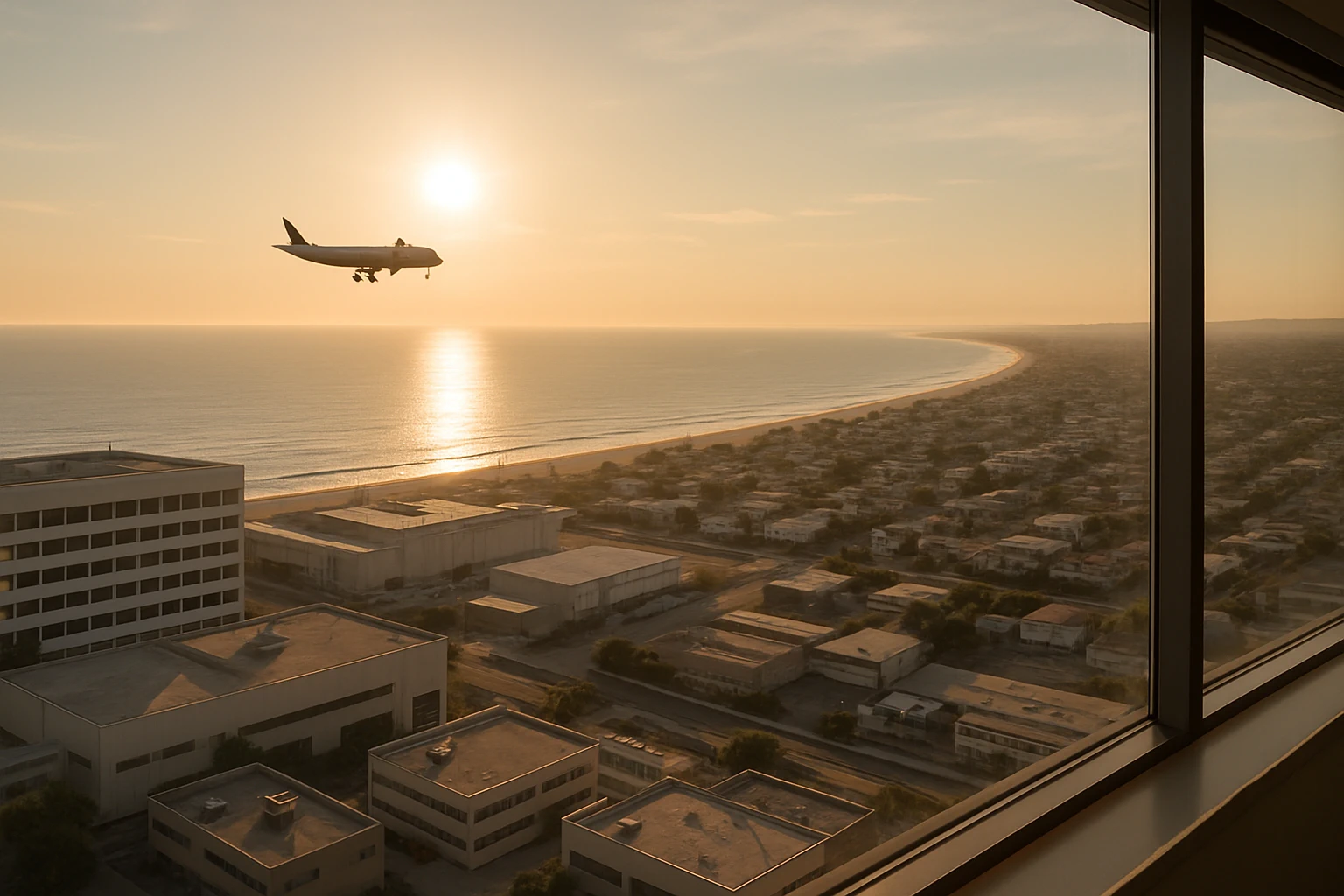
Torrance and El Segundo sit in one of Southern California's densest corporate corridors, aerospace primes, defense contractors, oil majors, tech companies, and regional headquarters stacked along a strip of coastline between LAX and the Palos Verdes Peninsula. For HR and Facilities teams in those buildings, feeding the workforce is a genuine operational problem, not an easy perk. The commute is brutal, the delivery infrastructure is overwhelmed at noon, and most of the teams in this corridor run shifts that don't align neatly with a 12-to-1 lunch window. This guide covers what actually works and why the South Bay's specific characteristics push toward managed, on-site food programs rather than delivery app stipends or catering one-offs.
The Torrance and El Segundo corridor is dominated by a handful of industries that share a common trait: they run complex, security-conscious operations that don't mesh well with delivery chaos. Boeing, Northrop Grumman, Raytheon, and their supplier networks fill industrial campuses where a lobby full of delivery drivers is a practical and sometimes contractual problem. Chevron's South Bay operations, the tech and media companies around the LAX technology cluster, and the regional headquarters that anchor both cities all face the same friction: too many people trying to eat at the same time, with limited walk-up options and an overloaded delivery ecosystem.
The 405 is the axis of pain. Employees commuting from the South Bay's own residential neighborhoods, Redondo Beach, Hawthorne, Lawndale, Gardena and from further inland spend significant time in traffic just to reach a desk, and then face the same congestion if they try to leave for lunch. A 30-minute lunch break is effectively useless if the nearest restaurant involves a parking lot search and a five-minute drive each way. That reality shapes the market: workers who commute don't want to leave the building during their break. They want food to come to them.
According to a 2025 study reported by StudyFinds, 55% of office workers skip lunch on hectic days, and 51% skip at least once a week. In a dense corporate corridor like the South Bay, where anchor-day density spikes on Tuesdays, Wednesdays, and Thursdays under most hybrid schedules, those skip rates track directly with afternoon productivity drops. The same research notes that up to 75% of office workers experience a significant energy dip between 1 and 4 p.m., the window that also happens to cover most South Bay employers' critical afternoon hours.
Delivery app stipends are popular with HR teams because they feel like a benefit without the operational complexity of running a food program. In practice, they create a different set of problems. At noon in El Segundo or Torrance, every delivery platform is operating at peak load. Orders are late. Orders are wrong. Drivers navigate security checkpoints and unfamiliar campus layouts. Front desks become staging areas for bags from six different restaurants. For facilities teams at aerospace and defense sites, that's not just inconvenient, it's a liability that some sites have moved to explicitly restrict.
Beyond the logistics, per-meal delivery costs are significant. The effective fees charged by DoorDash and Uber Eats run 30% to 40% of menu price when commissions, marketing fees, and payment processing are included and those costs come back to the end user as markups, delivery fees, service fees, and tips. A $13 entree becomes $24 to $28 fully loaded. For an employer running a per-meal stipend at $15 per person, the actual coverage value is less than it looks on paper, and the experience is still poor.
A managed on-site lunch program sidesteps most of that. One delivery window. One drop-off point. No driver congestion. For South Bay sites with security requirements, a single, known vendor with a consistent drop schedule is dramatically easier to manage than 80 individual delivery orders arriving in a 45-minute window. Fooda's 2025 research found that 88% of business leaders report corporate meal programs boost in-office attendance, an important data point for South Bay HR teams managing return-to-office mandates where food is one of the few concrete levers available.
The right format depends on your headcount, your shift pattern, and how much break room or lobby space you have available. Here's how the options map to South Bay realities:
For teams of 100 or more with a defined in-office population on anchor days, a recurring drop-off hot buffet is typically the highest-impact choice. A rotating weekly menu of chef-prepared hot entrees, sides, and salad arrives at a set time, gets set up in a designated area, and your team self-serves. There's no kitchen staff, no prep work, and no post-service cleanup beyond breaking down the serving setup. For aerospace primes or corporate headquarters with predictable Tuesday-through-Thursday in-office density, this is the format that turns a lunch break into an actual benefit.
For smaller teams, technology startups, satellite offices, regional sales teams, the weekly meal delivery format is a better fit. Pre-portioned chef-prepared meals arrive once or twice a week, go into the break room refrigerator, and employees grab them when their schedule allows. There's no daily coordination, no minimum headcount, and no fixed delivery window to staff for. It's the cleanest option for South Bay offices in the 25-to-100-person range where a daily hot buffet would generate too much food but a delivery stipend still produces the same chaos.
Aerospace and defense sites run first, second, and sometimes third shifts. A smart fridge stocked with fresh, labeled meals available around the clock solves the overnight-and-weekend food problem that a hot buffet can't address. Employees tap a badge or card to unlock the door, take a meal, and go. There's no app to download, no pre-ordering, and no time window that conflicts with a rotating shift schedule. For a site with swing or graveyard operations, the fridge is the only format that actually feeds everyone.
Most South Bay corporate offices settled into a Tuesday-Wednesday-Thursday in-office pattern through 2025. That creates a specific pressure: on anchor days, the office needs to feel worth the commute. Data from ezCater's 2025 Food for Work report, covered by HR.com, found 75% of hybrid employees would come into the office more often if their employer provided lunch, a number that jumped to 69% among Millennials and 60% among Gen Z specifically. For South Bay employers spending real money on office leases and RTO programming, a lunch program is one of the cheapest lines on the budget and one of the most visible to employees who are being asked to commute.
The anchor-day spike also exposes the problem with delivery apps. On a Tuesday when 80% of the workforce is on-site simultaneously, a delivery infrastructure designed for average load fails visibly. A managed program that's sized for anchor-day headcount sidesteps that failure entirely.
The South Bay workforce is diverse, engineering teams that include international talent from throughout Asia and Latin America, administrative support staff from the South Bay's residential communities, and executive populations with varied dietary preferences. A one-size-fits-all lunch doesn't work. Rotating menus with clearly tagged dietary options, vegetarian, gluten-aware, halal-friendly, higher-protein for workers on GLP-1 protocols, drive higher participation and fewer complaints than a menu that covers the average and misses the outliers. The guide to dietary-inclusive workplace menus covers how to think about variety across a diverse team.
South Bay corporate lunch benchmarks align closely with the LA market broadly. A managed hot buffet for 100 employees runs roughly $15 to $18 per person per service day. Weekly meal delivery at the pre-portioned format runs in a similar per-meal range with lower per-day frequency. On a three-day anchor schedule, a 100-person program costs roughly $4,500 to $5,400 per week all-in, or about $1,500 to $1,800 per employee per year. CaterCow's 2025 corporate catering benchmark puts the average corporate lunch at $20 per person, which means a well-managed program can actually come in below what an ad hoc delivery budget spends per meal when delivery fees are included.
Employers typically fund the program through the HR/workplace experience budget, the facilities line, or the Total Rewards budget as a wellness-adjacent benefit. The cleanest internal framing for a CFO: cost per employee per in-office day, compared directly against the visible cost of per-meal delivery reimbursements. Most finance teams find the comparison straightforward once the delivery fee line is fully loaded.
A few factors matter more in the South Bay than in other LA corridors. Security access is non-negotiable at many aerospace and defense sites: a vendor that can provide a consistent driver, a documented delivery protocol, and a certificate of insurance naming the property manager is not optional, it's the cost of entry. The RFP checklist for workplace food vendors covers what to include in a vendor evaluation specifically for sites with access controls.
Dietary labeling and menu rotation matter in engineering and science environments where employees have specific nutritional goals. A rotating weekly menu that cycles proteins, grains, and vegetables and clearly labels allergens and macros is a different product than a Panera drop or a corporate catering one-off. It's the difference between a food program that people actually talk about and one that runs at 40% participation and gets cut at budget time.
Finally, local matters. A kitchen cooking real food in Southern California, not a national logistics company reheating pre-portioned frozen meals, produces a different result. MHP Food Service operates out of Rancho Cucamonga and has served employers across the LA and South Bay corridor since 2015. The food is fresh, the menus rotate weekly, and there's no long-term contract required to start.
The internal conversation at most South Bay companies follows a predictable path. Someone on the People or Workplace Experience team sees the anchor-day lunch chaos and wants to fix it. They bring it to Finance, who asks what it costs per employee. They bring it to Facilities, who asks what the delivery logistics look like. The answers that land best: per-employee cost is competitive with what's being spent on delivery reimbursements right now; delivery logistics are cleaner than what's happening today; and participation on anchor days is visible and measurable.
If you're building that case, the guide to writing a workplace food program proposal for your CFO walks through the financial framing in detail, including how to build the retention and RTO compliance angles alongside the cost comparison.
If you're managing a team in Torrance, El Segundo, Manhattan Beach, Hawthorne, or the surrounding South Bay corridor and want to know what a managed program would look like for your specific site and headcount, book a 20-minute call with the MHP Food Service team. We'll scope the right program for your shift pattern, your break room setup, and your budget and put together a worksite-specific quote with no high-pressure sales. The first conversation is free, and there's no long-term contract to start.
For teams of 100 or more with predictable in-office days, a recurring drop-off hot buffet is typically the most effective solution. Smaller teams or those with hybrid schedules often do better with weekly pre-portioned meal delivery, which requires no daily coordination and fits any break room with a refrigerator.
Research from ezCater's 2025 Food for Work report found that 75% of hybrid employees would come into the office more often if their employer provided lunch. In a corridor like the South Bay, where commutes on the 405 are a genuine deterrent, food is one of the most concrete benefits an employer can offer to make the commute feel worthwhile.
Yes. Weekly meal delivery is designed for smaller teams of 25 to 100 that want a consistent food benefit without the daily logistics of a buffet. It works for satellite offices, tech startups, and any South Bay team that wants real food without daily catering coordination.
MHP Food Service operates out of a Rancho Cucamonga kitchen and serves employers across Southern California, including the South Bay cities of Torrance, El Segundo, Manhattan Beach, Hawthorne, and Lawndale. The delivery window and program structure are confirmed during a worksite scoping call.
The South Bay has an unusually high concentration of aerospace, defense, and technology employers who run multi-shift operations. Many of these sites have security access requirements, clean-room adjacencies, and shift patterns that begin well before and extend well after a standard lunch window, all of which favor a managed, drop-and-go food program over delivery app stipends.
Tell us about your team in Torrance, El Segundo, or the surrounding South Bay and we will recommend the right program with a worksite-specific quote. No high-pressure sales.