Employee Benefits
How auto dealerships in SoCal use food to reduce service-advisor turnover
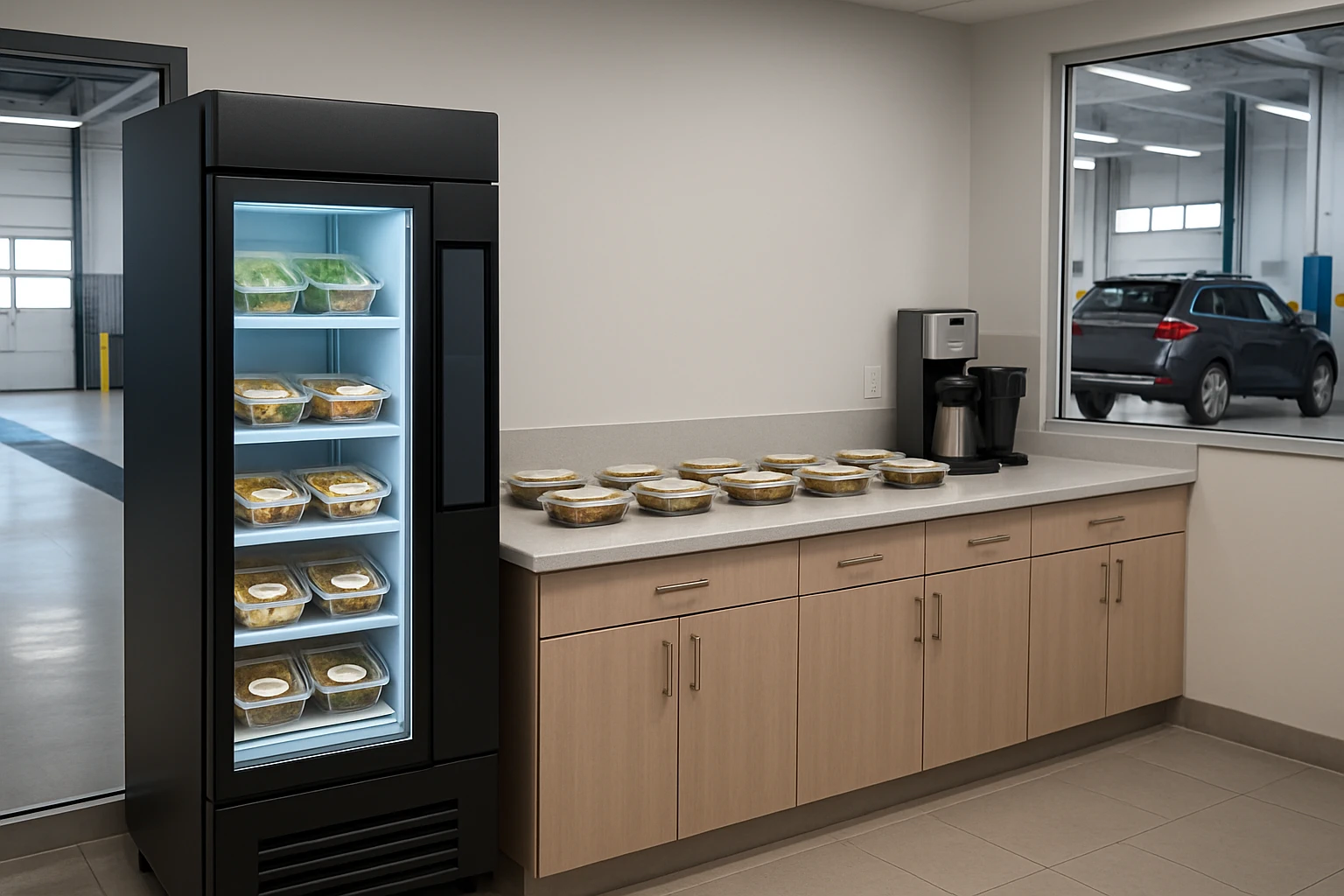
Auto dealership service departments have one of the highest voluntary turnover rates of any industry in Southern California. National Automobile Dealers Association data has consistently shown annual service advisor turnover rates of 50% or more at many stores, with technician turnover almost as high. The consequences are severe: customer relationships disrupted, CSI scores damaged, recruiting and training costs that accumulate year after year, and a constant cycle of experienced staff leaving and new staff getting up to speed. Dealers who have found traction on retention are using a combination of levers, and food, consistently provided, high-quality, accessible, is near the top of the list.
The reasons service advisors and technicians leave are well-documented: long hours, demanding customers, high-pressure commission structures, and the physical toll of standing for eight to ten hours a day. Service advisors in particular carry the stress of being the interface between customers who are unhappy about repair costs and technicians who need accurate write-ups and approvals to do their jobs. It is a role that requires patience, product knowledge, and emotional resilience every minute of every shift.
What this workforce needs from their employer is not complicated: respect, consistency, and evidence that the employer sees the difficulty of the job and takes it seriously. Food is one of the most concrete ways to express that. A dealer that feeds its service team every day, with real food, not vending, is making a visible, tangible investment in the people who are working the hardest and generating the most revenue in the building.
Service department staff work staggered hours and cannot take breaks on a structured schedule. A service advisor who is in the middle of a customer consultation at noon cannot stop to eat from a catered buffet that closes at 1pm. A technician who is under a vehicle for a flat-rate job cannot stop until the work is done, which might be 10:30am or 2pm depending on the day. Catering, buffets, and delivery windows fail this workforce because the work does not respect a lunch hour.
A smart fridge in the service department break area solves this directly. It is accessible at any moment during the day. When a tech gets a 15-minute window, they grab a meal, heat it, eat it, and get back. When a service advisor gets a gap between customers, same thing. There is no window to miss, no waste from unsold buffet items, and no penalty for a shift that runs long. The food is there when the employee can get to it, not when the catering schedule says it should be eaten.
In an industry where the standard benefit package is health insurance and a 401k, a food program stands out distinctly. When a dealer installs a smart fridge stocked with fresh, chef-prepared meals in the service break room, the message to existing staff is immediate and clear: the store is investing in our daily wellbeing. That is not a small signal in a sector where many workers feel the employer's investment flows primarily to the showroom floor and the sales department.
The signal also reaches prospective hires. Service advisors and technicians are a tight professional community. They know people at other dealers and talk. "That store feeds us, there's always fresh food in the back" travels through technician networks as effectively as any recruiting message. Dealers that operate at the intersection of good management and a visible food benefit see inbound inquiries from experienced staff at competitors who have heard about the work environment.
The math on food program ROI is compelling for dealerships specifically because the cost of service advisor and technician turnover is so high. NADA industry data and third-party HR research consistently estimate the cost of replacing a service advisor at $35,000–$55,000 when you account for recruiting, onboarding, and the productivity loss during the 6–12 month ramp period before a new advisor reaches full effectiveness. For technicians, the cost is similar or higher because of the scarcity of qualified techs and the training investment required.
A smart fridge program for a mid-size dealership service department, 15–30 service staff, costs roughly $20,000–$35,000 per year depending on subsidy level and usage. If the program retains one service advisor who would otherwise have left, it has likely covered its annual cost. If it retains two or generates two hires through word-of-mouth referrals from existing staff, the ROI is significantly positive by any reasonable calculation. The program does not need to be the only retention lever. It needs to be a meaningful contributing one.
MHP Food Service places a smart fridge in the service department break area, stocks it with fresh, individually labeled meals on a regular rotation, and handles all restocking and maintenance. The employer decides on the subsidy model, fully subsidized (meals are free to employees), partially subsidized (employer pays $X per meal and employees pay the rest), or access-only (employees pay market price). Most dealerships find that a partial or full subsidy generates the strongest retention signal; an access-only model still helps but does not carry the same "we're taking care of you" message.
The operational overhead for the dealer is minimal, one invoice, one point of contact, and no internal management required. The program runs itself once it is installed and stocked.
Food works best as part of a retention strategy, not as a standalone intervention. Dealers who are serious about reducing service department turnover are also looking at advisor pay structures, technician flat-rate vs. hourly compensation models, Saturday rotation policies, and management quality in the service drive. A food program in this context adds a daily, visible element to a package of improvements that signals the dealer is actively working on the problem.
The dealers who are most successful at service department retention tend to operate on a simple principle: treat the service team with the same investment and respect that the store gives to its customer experience. Food is one of the most tangible and affordable ways to act on that principle every single day.
MHP Food Service works with auto dealerships across Southern California. See our auto dealership service page and our related posts on smart fridges for auto dealerships in the IE and auto dealership lunch programs in the Inland Empire. Contact us for a service-specific recommendation and quote.
Service advisors and technicians face a combination of stressors that drive turnover: long hours (typically 7am–7pm with Saturday requirements), demanding commission structures, difficult customer interactions, physically demanding work for technicians, and limited downtime. Without consistent support from the employer on basic working conditions, including food, burnout accelerates.
Dealership service staff work staggered hours and cannot take structured breaks in the way an office team can. A technician who has a 20-minute window while a vehicle is in the air cannot wait for a catering delivery or walk off-site. A smart fridge in the service break area provides fresh, real food at any point during the day, which is exactly what the dealership work schedule requires.
If a dealership spends $25,000–$35,000 per year on a smart fridge program and retains one service advisor who would otherwise have left, the program has likely paid for itself. NADA data suggests the cost of replacing a service advisor (recruiting, training, and ramp-up productivity loss) is $35,000–$55,000. Retaining two advisors annually makes the program ROI-positive by a significant margin.
Often more. Technicians do physically demanding work for eight to ten hours, burn more calories, and have even less predictable break windows than advisors. A smart fridge that is accessible in the service department provides real value to the technician workforce, which is also the hardest to recruit and most expensive to replace in the dealership.
Service department employees talk to other service professionals at other dealerships. A dealer that feeds its service team gets mentioned positively in those conversations. Experienced service advisors and master technicians considering a move respond to concrete evidence that a dealer takes care of its people, and food is one of the most concrete and memorable signals available.
Tell us about your team and we will recommend the right program and a worksite-specific quote. No high-pressure sales.