Employee Benefits
Food as a return-to-office incentive: does it work?
Return-to-office has been one of the most discussed and most fraught, HR challenges of the last few years. Mandates have generated resentment. Vague encouragement has generated nothing. And somewhere in the middle, a growing number of HR leaders have landed on a solution that sounds almost too simple: just feed people. This post looks at whether that actually works, what the data says, and how SoCal employers are deploying food as an RTO tool in practice.
The clearest data point comes from ezCater's 2025 workplace food and hybrid work survey: 75% of hybrid workers said they would come into the office more often if their employer provided lunch. That is a majority of the hybrid workforce saying, explicitly, that a food benefit would move their behavior. This is not an abstract preference. It is a stated willingness to change where they work based on a specific benefit.
Supplementary research from SHRM and Gallup on workplace engagement identifies food programs as one of the top drivers of daily positive sentiment at work, alongside recognition and manager relationship quality. Employees who say they feel well cared for by their employer are more likely to come in voluntarily, stay longer, and describe their workplace positively to others. Food is consistently cited as a tangible expression of that care.
It is worth being clear about what the research does not say: no study has found that providing lunch is a complete substitute for other RTO strategies, or that it works in isolation regardless of the overall work environment. But as an incremental lever, one element of an RTO strategy, the evidence for food is consistently positive and stronger than for most other individual perks.
Consider the alternatives. Commuter stipends offset a cost, but they do not create a positive reason to come in. They say "we will make the commute cheaper" rather than "there is something genuinely worth coming in for." More meeting rooms, better coffee, and standing desks all help the in-office experience once someone is there, but they do not move the decision to commute in the first place. Free snacks in the kitchen are a nice touch but are not perceived as a benefit in the way a full meal is.
Food is different because it addresses a universal daily need. Everyone eats lunch. When coming into the office means that lunch is solved and solved well. It changes the cost-benefit calculation of the commute in a way that better chairs do not. The employee is not just getting a perk. They are getting something they would have had to spend money or time acquiring anyway, provided free and with real quality. That is a genuine economic and experiential argument for coming in.
Three conditions have to be true for food to work as an RTO incentive. First, the food must be genuinely good. A half-hearted catering order of sandwiches that employees could have assembled at home provides no incentive. Second, it must be reliable. A food program that shows up inconsistently or gets cancelled for budget reasons does not build the behavioral habit of coming in. It breaks it. Third, it must be framed correctly: as a reason to come in, not as compensation for having to come in. The framing matters because employees respond to positive incentives differently than they respond to mitigation of mandates.
The worst outcome is launching a food program with great fanfare, having it underdeliver on quality or reliability, and then having employees return to working from home and associate the failed food program with the RTO push that drove it. That sets back both the food benefit and the return-to-office effort simultaneously.
The most effective SoCal deployment pattern ties a food program explicitly to anchor days. "Tuesday and Thursday are our in-office days, and we provide lunch on both days." That pairing is simple, memorable, and immediately understood by employees as a positive reason to honor the anchor day schedule. It also gives HR a concrete, differentiating element to mention in return-to-office communications: "We know commuting adds time and expense, so on the days we ask you to come in, lunch is on us."
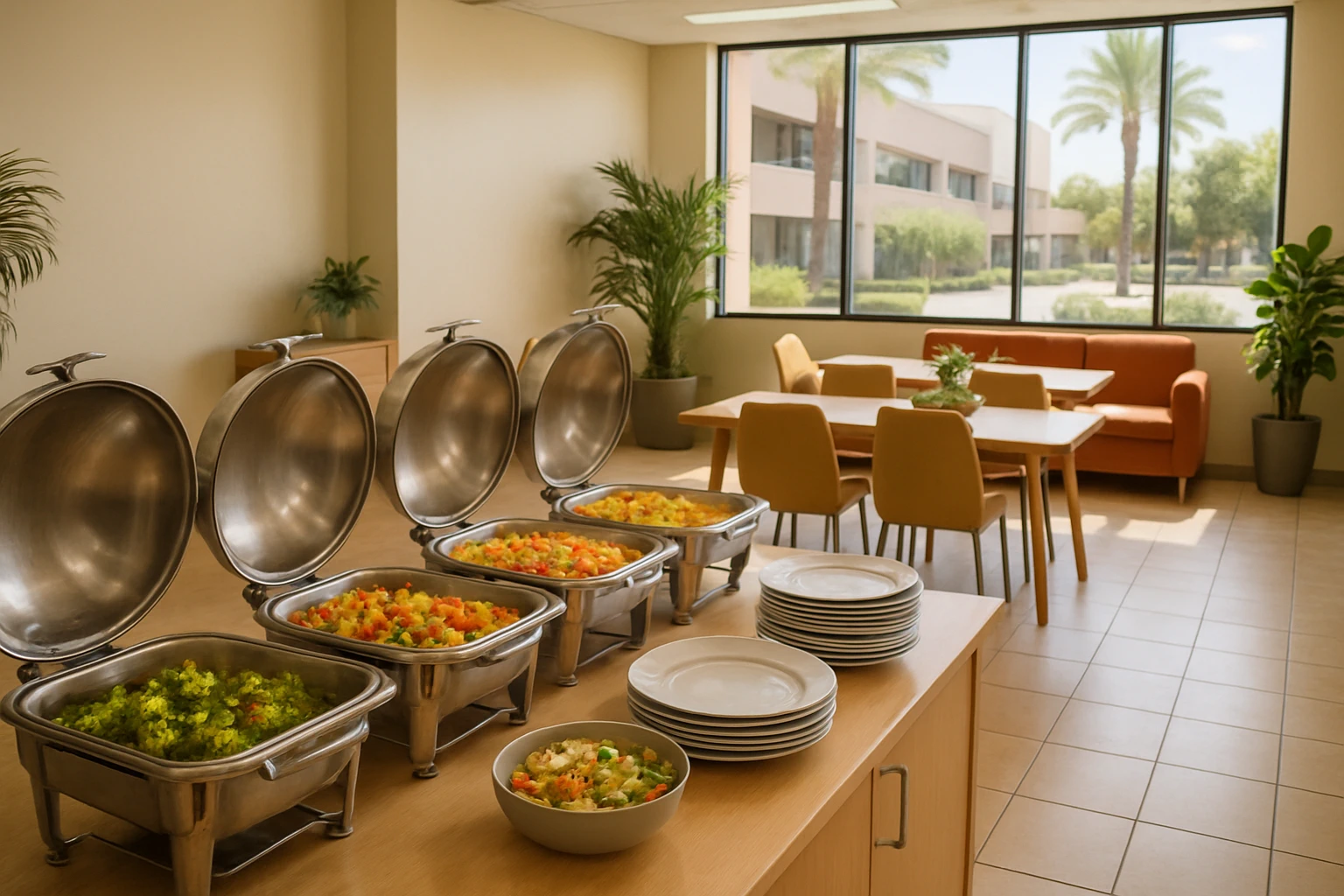
A daily drop-off buffet is the most visible format for this application. It creates a shared lunch moment and is immediately apparent to anyone who walks in. For offices where not everyone is in at the same time, a smart fridge lets employees access fresh meals on their own schedule without requiring a defined serving window. Both formats support the RTO goal; the right choice depends on headcount and office layout.
In surveys that ask employees to rank RTO incentives by influence on their decision to come in, food consistently ranks at or near the top. Commuter benefits rank second. In-person events (happy hours, team lunches as standalone events) rank third. But those are not sustainable as daily drivers. Improved office amenities rank lower than all three because they are experienced after the commute decision is made, not before it.
The pattern is clear: the incentives that address daily, practical needs outperform the incentives that improve the office environment once someone is already there. Food is the clearest example of the former. A well-designed food program reduces the daily cost of coming in (no need to pack lunch, spend money out, or skip eating) while adding a genuine positive experience. That combination is uniquely effective at the moment when the commute decision is being made.
Two approaches reliably fail. The first is using food as a punishment-adjacent policy: "If you don't come in on anchor days, you won't be eligible for the food program." That frames the food as conditional on compliance rather than as an expression of appreciation, which undermines its positive signal entirely. The second is over-rotating on food without addressing the underlying reasons employees prefer working from home, primarily flexibility, focus time, and commute cost. Food helps, but it does not fix a broken office environment or a poorly designed RTO policy. Think of it as an accelerant for an RTO strategy that is already reasonable, not as a substitute for one.
The best metrics are simple: office attendance on food days vs. non-food days, and employee feedback at the 60-day mark. Most employers who deploy a food program tied to anchor days see measurable attendance increases within the first month, not dramatic numbers, but consistent shifts of 10–20% more employees on food days. Over time, as the behavior becomes routine, the attendance differential often narrows because coming in becomes the default for anchor days regardless of the food program specifically. That is the outcome you want: the food converts the behavior into a habit, and the habit persists.
MHP Food Service works with SoCal employers to deploy workplace food programs that support RTO goals, with no long-term contract required for initial pilots. Tell us about your team and we will recommend a format and provide a worksite-specific quote. See also our overview of employee meal benefits and the ROI of feeding your team.
ezCater 2025 hybrid work and food survey data via HR.com. SHRM employee engagement and food benefit data via SHRM.org.
The evidence consistently says yes. ezCater's 2025 workplace food survey found that 75% of hybrid workers said they would come in more often if their employer provided lunch. The key caveat is that the food must be genuinely good and reliably on schedule, a disappointing lunch program will not move behavior.
Food addresses a real daily need. Employees have to eat regardless of where they work. When the office provides genuinely good food, it removes the friction of the commute trade-off: yes you have to drive in, but lunch is handled and it is good. That is a concrete reason to come in that resonates in a way that "nicer conference rooms" does not.
A mediocre or unreliable food program can backfire. If employees come in expecting lunch and it is subpar or missing, the disappointment undermines trust in the program and, by extension, in the RTO policy it was meant to support. Quality and consistency are non-negotiable. This is why a managed program with a professional provider matters more than ad-hoc catering.
Frame it as a positive reason to come in, not as compensation for the mandate. "Lunch is on us on your anchor days" works. "You have to come in so here is lunch" does not. The framing matters because employees respond to positive incentives differently than they respond to compensation for obligations.
In most surveys and HR studies, yes. Commuter stipends offset a cost but do not add a positive reason to come in. Food provides a positive experience that employees look forward to. Research consistently shows food outranking commuter benefits in terms of influence on hybrid work location decisions.
Tell us about your team and we will recommend the right program and a worksite-specific quote. No high-pressure sales.