Guides
Catering vs. recurring food service: what's the difference?
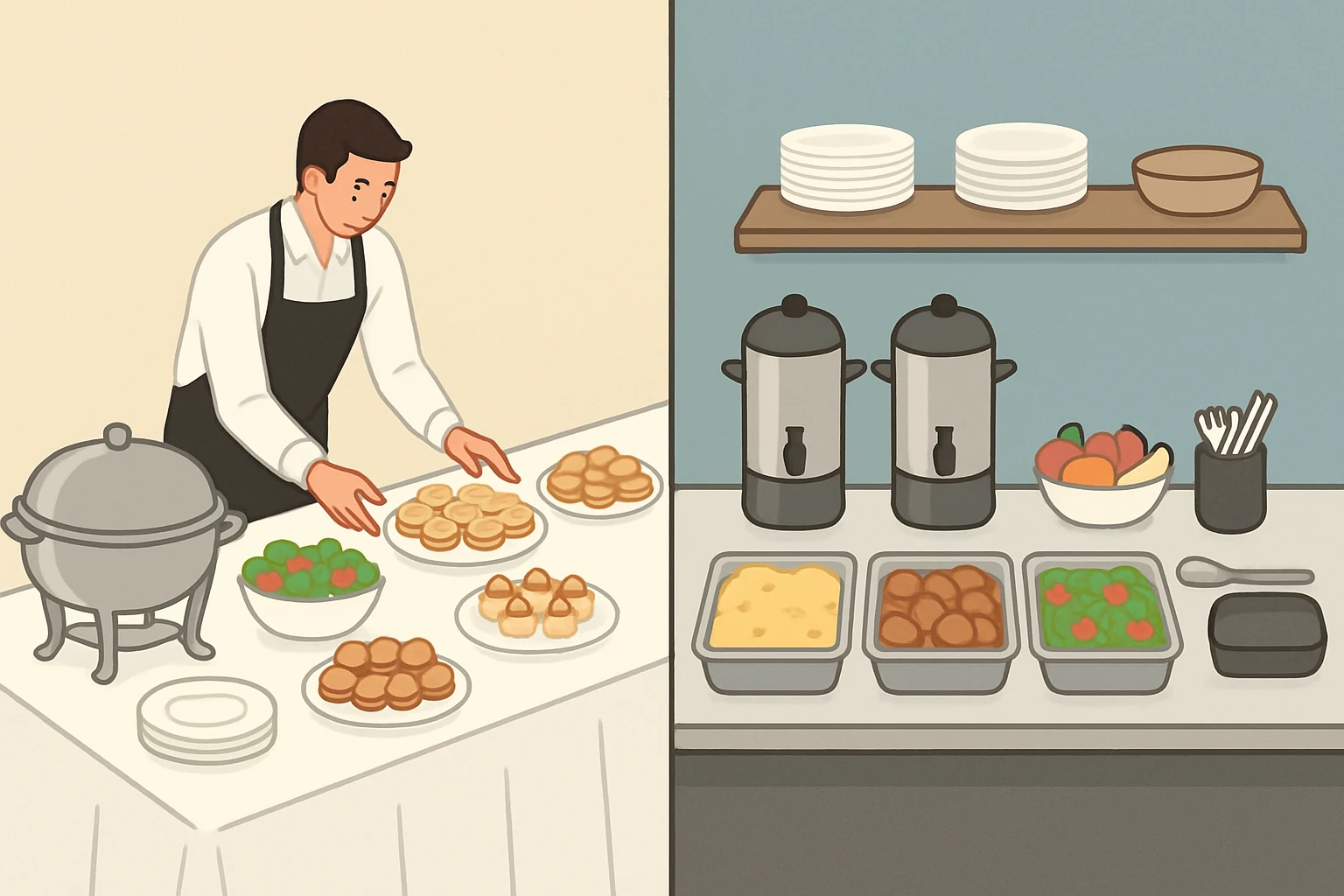
Most Southern California employers who want to feed their teams start with event catering. It makes sense: you know the model, there are plenty of vendors, and it feels low-commitment. But recurring workplace food service is a fundamentally different product, and once you understand the difference, the event-catering-for-everyday-lunch approach starts to look expensive, time-consuming, and inconsistent. This guide explains exactly where the two models diverge, and how to know which one your company actually needs.
Event catering is transactional. You have a board meeting, a quarterly kickoff, or a holiday lunch, you call a caterer, confirm a headcount, place an order, and someone shows up on the day. The relationship is one order at a time. Pricing is per-head with add-ons for setup, breakdown, staffing, rentals, and minimums. The caterer may or may not show up reliably, the menu may or may not match what you need, and the next time you want food you start the process over.
That model works fine for an annual holiday party or a once-a-quarter all-hands lunch. It breaks down when you try to use it for daily or weekly team feeding. The management overhead, researching vendors, placing orders, confirming dietary needs, chasing invoices, handling cancellations and weather and driver failures, accumulates fast. An Office Manager in Temecula or a People Ops team in Irvine who runs catering as a recurring function is spending 3 to 5 hours a week on logistics that add no value to the company.
A managed recurring food program is a service contract, not a series of orders. You set up the program once: agree on frequency (daily, three times a week, weekly), headcount, dietary parameters, delivery window, and pricing model. After that, food arrives on schedule without you doing anything. Menu rotation, restocking, logistics, and dietary labeling are all the vendor's problem. You get one invoice for the month.
MHP's programs work this way. Our Daily Drop-Off Lunch Buffet arrives on your schedule, gets set up, and is broken down, no coordination needed on your end beyond letting us know if the headcount changes. Our Weekly Team Meal Delivery drops pre-portioned individual meals into your break-room fridge on a set day each week. And our Smart Fridge is restocked on a rolling basis; your team never needs to order anything. The program runs in the background while your team does their jobs.
The price-per-head on a catering order looks simple, but the real cost is not on the invoice. It is in the time spent managing the process. A People Ops coordinator in Rancho Cucamonga or an office manager in Pasadena who handles catering as a recurring task is spending real hours each week on vendor research, dietary accommodations, re-ordering, and complaint management. That is not what those roles are for.
Then there is consistency. Event caterers are optimized for event days, not routine reliability. When a delivery is late or wrong on a board meeting day, it is a fixable problem. When a delivery is late every Tuesday for a team that now expects lunch as a benefit, it is a retention and morale problem. Recurring programs are built for consistent delivery because their entire model depends on showing up reliably, week after week.
There are events where one-off catering is exactly right. Hiring events, all-hands presentations, executive offsites, client appreciation lunches, and true celebrations are all good catering use cases. The key is using event catering for events and a managed program for routine team food. These are not competing products; they solve different problems.
A company in Corona or Diamond Bar might run a recurring weekly drop-off program for its regular team feeding, fully managed, predictable, no overhead and then call a traditional caterer for its annual holiday party. That combination is common and makes sense. What does not make sense is using event catering as a substitute for a managed program and absorbing the coordination cost week after week.
When MHP says fully managed, we mean your team's only job is to communicate schedule changes and provide access to the delivery area. We handle menu planning, food prep, portioning, labeling, delivery, setup if applicable, and any dietary adjustments you need from month to month. You do not have to think about it between deliveries. That is the premise, not "here is a vendor you can order from" but "here is a program that runs."
For HR and Operations leaders in the Inland Empire or Orange County who already carry a full workload, the distinction matters. A well-run recurring food program should add zero management overhead after the first two weeks of setup. If it is adding overhead, it is not a managed program. It is just a vendor with a subscription button.
Event catering pricing is unpredictable. Minimum orders, setup fees, staffing add-ons, and last-minute change fees all create invoice variability that makes it hard to budget. Recurring food programs price per meal or per delivery, making the monthly cost straightforward to forecast. For finance teams trying to track per-employee benefit spend, a predictable line item is significantly easier to manage than a series of catering invoices with different vendor names and fee structures.
Our guide to workplace lunch program costs in the Inland Empire goes deeper on the numbers, including how to frame the cost for finance approval.
If you are using event catering for routine team feeding and find yourself spending significant time on it every week, the switch to a managed program is usually straightforward. The questions to ask: How often do we feed the team? How much management time does that currently take? Is the food experience consistent enough that employees see it as a real benefit, or does it feel like a chore that sometimes produces food?
If the answer to the last question is "sometimes produces food," that is the moment to make the switch. Our guide to choosing the right on-site food program walks through the format options across team size and shift type. Or you can talk to us directly, we serve employers across Southern California from our Rancho Cucamonga kitchen, with no long-term contract required to get started.
Catering is ordered event by event, you place an order, a vendor delivers, and the relationship ends there. A recurring workplace food program is an ongoing managed service: the vendor delivers on a set schedule, handles logistics and restocking automatically, and you are invoiced for the program rather than individual orders.
Not necessarily on a per-meal basis. Event catering often carries setup fees, minimums, and per-head pricing that is higher than a recurring program rate. With recurring service, costs spread across a predictable schedule and are easier to budget. The real cost of catering is also the management time spent re-ordering, re-vetting vendors, and handling logistics each time.
Recurring programs scale down to smaller teams. MHP's weekly meal delivery and smart fridge programs serve sites as small as 25 to 30 people. You do not need a 500-person campus to justify a managed food program.
Fully managed means the vendor handles everything after the initial setup: menu planning, food preparation, delivery logistics, packaging, and any dietary labeling. Your team's job is to communicate any schedule changes and to provide space. You do not manage the program day-to-day, that is the vendor's job.
Yes. MHP Food Service operates without long-term contracts. You can start with a trial period and adjust or exit based on real program performance, not a multi-year commitment.