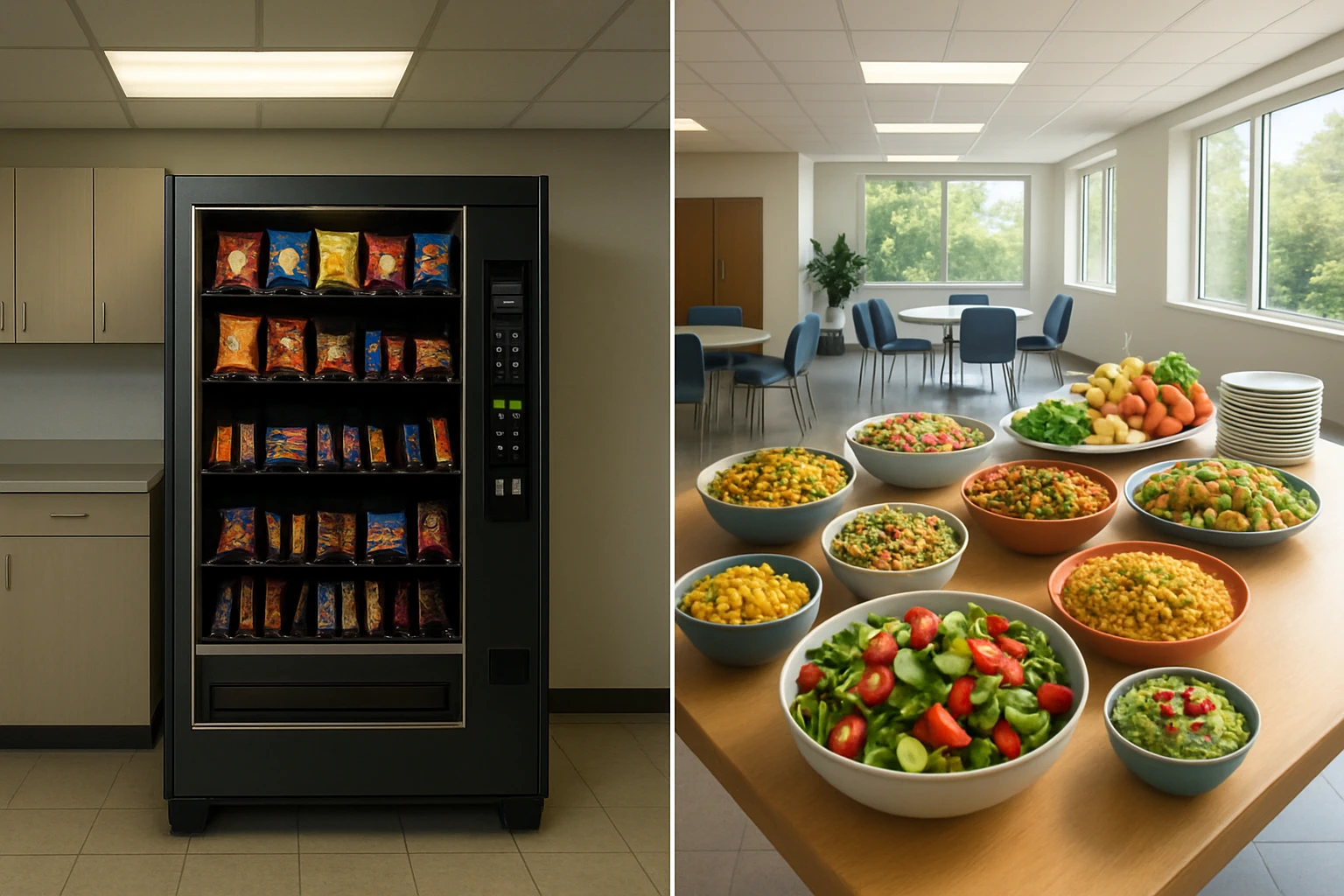
The standard conversation about workplace food programs starts with cost: how much does it cost to add a lunch program, install a smart fridge, or bring in weekly meal delivery? That is a reasonable question. But it misses a more important number, what it already costs to not provide food. For Southern California employers in the Inland Empire, Orange County, and Los Angeles, that number is often large enough to flip the entire decision.
This guide walks through four categories of cost that most HR and operations leaders either undercount or leave off the ledger entirely when evaluating a food program: productivity loss, turnover, California compliance exposure, and recruiting disadvantage. The math is not complicated, but most employers have not done it.
Cost 1: Productivity loss from skipped lunches
Start with who is actually eating. Research from StudyFinds found 55% of employed Americans skip lunch on hectic days; 51% skip at least once a week; 33% skip twice or more. For a 100-person office in Rancho Cucamonga or Fontana, that is roughly 30 to 50 people not eating on any given busy weekday.
The energy consequence is documented. Up to 75% of office workers experience a significant energy dip between 1 and 4 p.m., peaking around 3 p.m. For knowledge workers, the afternoon slump shows up as slower decision-making, lower output quality, and more errors. For production workers, warehouse associates, or healthcare aides, it shows up in safety incident rates and physical output.
What does that cost? There is no single clean number, but the Journal of Occupational and Environmental Medicine found that employees with access to nutritious meals and physical activity are 45% more productive than those without. For an employer paying $25 per hour across 100 workers with a 1% productivity gap on half of them, that is thousands of dollars a day in output lost to preventable fatigue. Scaled to a quarter or a year, it becomes a material number even with conservative assumptions.
The fix is not complicated: on-site food that is easy to access means workers eat, which means they maintain energy through the afternoon. The Daily Drop-Off Lunch Buffet and the Smart Fridge both address this directly.
Cost 2: Turnover driven by benefit gaps
This is where the math gets uncomfortable for employers who have been treating food programs as a luxury.
Gallup estimates the cost of replacing an employee at 50% to 200% of annual salary depending on the role: roughly 40% for frontline workers, 80% for technical professionals, and 200% for managers and leaders. Across the US economy, Gallup estimates voluntary turnover costs about $1 trillion annually.
For a Inland Empire employer with 100 workers, average wages of $50,000, and a 20% annual turnover rate (common in warehouse, manufacturing, and healthcare support roles), that is 20 exits per year. At a conservative replacement cost of 60% of salary, that is $600,000 per year in turnover cost before accounting for manager time, training, and the productivity gap while seats are vacant.
Now compare that to a food program. A fully subsidized daily buffet for 100 people, three days a week, runs roughly $60,000 to $90,000 per year depending on per-person pricing. A smart fridge requires no employer subsidy if you structure it as employee-pay. Weekly delivery for the same team runs $40,000 to $70,000 per year.
Research from Fooda found three in four companies offering catering report better staff retention rates. If a food program moves your voluntary turnover rate from 20% to 17%, a conservative three-point improvement. It saves 3 exits per year at $30,000 each, or $90,000 in turnover cost. At that math, the food program pays for itself before the end of year one.
Cost 3: California meal-break compliance exposure
This cost is specific to California, and it is one that many employers outside the state have not had to think about. California Labor Code Section 512 requires a 30-minute unpaid meal break before the end of the fifth hour of work. Miss a break, and you owe the employee a one-hour premium-pay penalty, equal to one hour at the employee's regular rate, per missed break.
If workers are skipping breaks because there is nothing to eat nearby, and those breaks are not being formally documented as provided, the employer is exposed. At scale, this becomes a class-action or PAGA (Private Attorneys General Act) risk. PAGA allows any employee to sue on behalf of all similarly situated employees, and PAGA settlements in meal-break cases routinely reach six or seven figures for companies of 100 to 500 employees.
An on-site food program does not eliminate the legal obligation to schedule and document breaks. But it removes the most common practical reason workers skip them: there is nothing to eat. In distribution centers in Ontario and Fontana, on hospital campuses in Riverside and Redlands, and in manufacturing plants across San Bernardino County, the presence of on-site food measurably reduces voluntary break-skipping. Our guide to California meal-break compliance and on-site food goes deeper on the legal context.
Cost 4: Recruiting disadvantage in a competitive market
Southern California's employer market is competitive, particularly for the industries that drive the Inland Empire economy: logistics, healthcare, manufacturing, and corporate operations. Employers in Rancho Cucamonga, Riverside, Ontario, and Temecula are competing for the same workforce against each other and against employers in Orange County and Los Angeles who often offer more visible perks.
SHRM's 2025 Employee Benefits Survey found 88% of employers now list health-related benefits as "extremely important" or "very important" in their total rewards package. Food benefits sit inside this category. They are observable, discussed in peer groups, and prominently featured in Glassdoor and LinkedIn reviews.
When a candidate between two similar offers evaluates "perks," free or subsidized lunch appears on lists more reliably than almost any other benefit except health insurance and PTO. Not offering it is not neutral. It is a visible absence that competing employers are actively using against you in their recruiting conversations.
The harder-to-measure version of this cost is time-to-fill. Positions that take 45 days to fill instead of 30 days cost money in manager time, contractor spend, and deferred productivity. If a food benefit reduces time-to-fill by even a few days on average, the value compounds across every open role each year.
The total picture: a rough tally
For a hypothetical 100-person SoCal employer, let's say a Chino Hills office with a mix of corporate and operations staff, the rough annual cost of not providing food might look like this:
| Cost category | Conservative annual estimate |
|---|---|
| Productivity loss (1% gap for 50% of team) | $20,000–$50,000 |
| Turnover cost attributable to benefit gap (partial) | $30,000–$90,000 |
| California meal-break exposure (annualized) | $5,000–$50,000+ |
| Recruiting disadvantage (extended time-to-fill) | $10,000–$30,000 |
| Total | $65,000–$220,000+ |
Compare that to the cost of a three-day-a-week buffet for 100 people: roughly $80,000 to $120,000 per year fully subsidized, or significantly less if you structure it as partially subsidized or employee-pay. The comparison is not exact, these are estimates, not accounting. But the direction is clear. The cost of doing nothing is often higher than the cost of the program.
What to do with this
If you are building the business case for a food program internally, start with the turnover math. It is the easiest number to make concrete using your own data: current headcount, current annual turnover rate, and your average cost-per-hire or cost-per-replacement. Plug in a conservative 2- to 3-point improvement in retention as the benefit of the program, and the ROI case usually presents itself clearly.
Our guide to building a workplace food program proposal for your CFO walks through how to frame this for a financial audience. The Inland Empire lunch program cost guide covers the expense side with specific pricing benchmarks for the region.
If you are ready to move from analysis to action, book a 20-minute call. We will put together a program recommendation and a worksite-specific quote that you can run against your own numbers. MHP Food Service operates without long-term contracts, which means the pilot commitment is low and the ROI data is real instead of projected.
Frequently asked questions
What does it actually cost when employees skip lunch?
Skipped lunches reduce afternoon productivity and increase fatigue-related errors. Research from Better Health Facts found up to 75% of office workers experience a significant energy dip between 1 and 4 p.m. For hourly and production workers, that translates directly to output. For knowledge workers, it shows up as slower decision-making and more errors in the hours following the missed meal.
How much does employee turnover cost compared to a food program?
Gallup estimates the cost of replacing an employee at 50% to 200% of annual salary depending on role. For a 100-person SoCal employer with average wages of $50,000 and 20% annual turnover, that is $500,000 to $2 million in replacement costs per year. A fully subsidized food program for the same team might cost $120,000 to $200,000 annually. The math strongly favors the food program if it moves turnover by even a few percentage points.
Is there a California compliance cost to not providing food?
Yes. California Labor Code Section 512 requires a 30-minute unpaid meal break before the fifth hour of work, with a one-hour premium-pay penalty per missed break. Without on-site food options, workers are more likely to voluntarily skip breaks, creating premium-pay liability and PAGA exposure for the employer.
Do food benefits actually affect employee retention?
Yes. Fooda's 2025 research found three in four companies offering catering report better staff retention rates. ezCater found 75% of hybrid employees would come in more often if their employer provided lunch. Food is among the most visible, used, and discussed employee benefits. It affects retention more than its per-employee cost suggests.
How do I build the business case for a food program?
Start with your current annualized turnover cost (headcount × turnover rate × replacement cost per role). Then estimate what a 2- to 5-percentage-point reduction in turnover would save. Compare that to the cost of a food program at your headcount. Most employers with 50+ workers find the ROI case is favorable even before accounting for productivity or compliance benefits.
Stop paying the hidden cost of doing nothing.
A worksite-specific food program quote takes 20 minutes. We will show you what a program costs and help you run it against your own turnover and compliance numbers.