Smart Fridge
Night shift food options in Fontana and Rialto warehouses
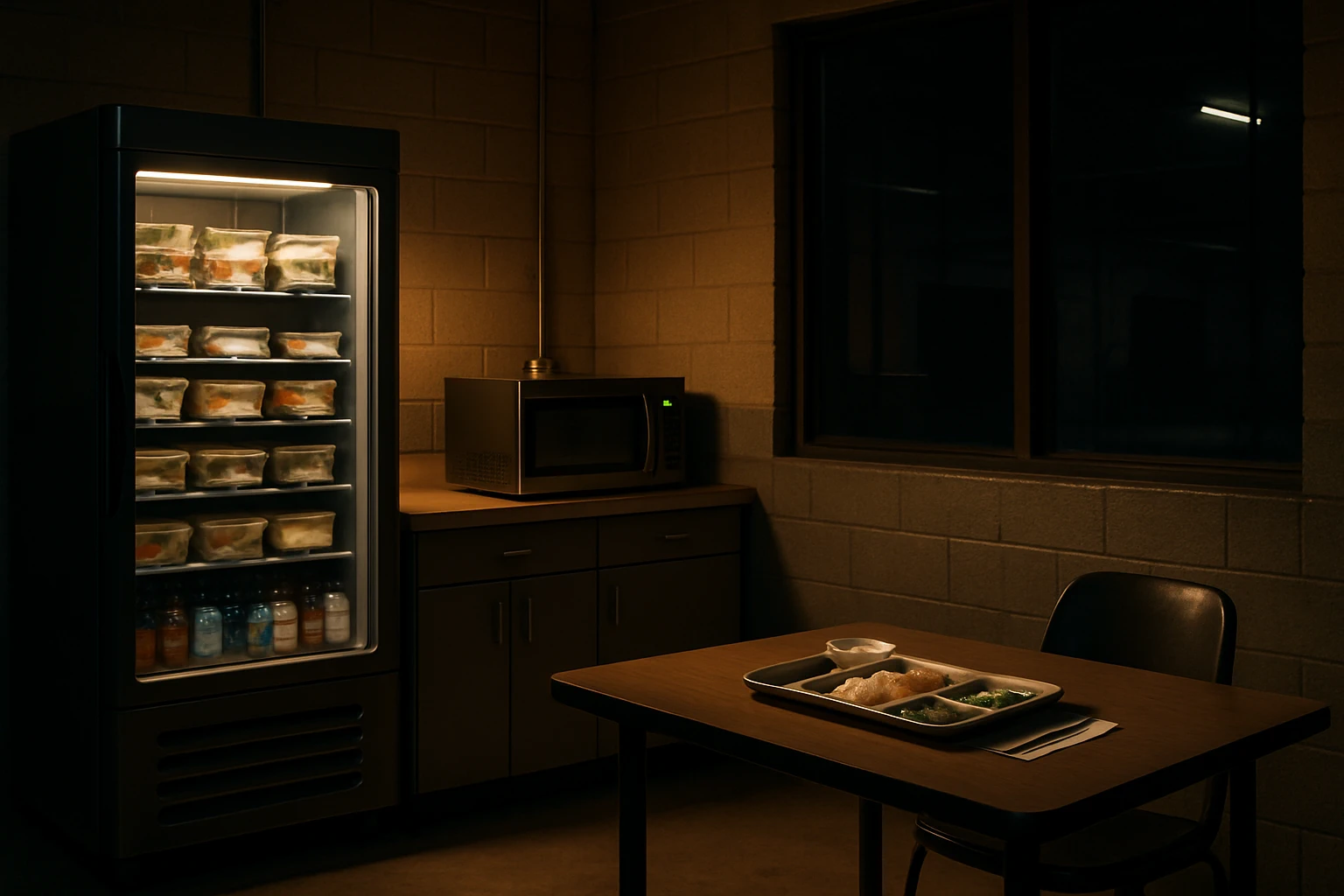
Fontana and Rialto are among the most warehouse-dense corridors in the United States. The stretch along the 10 Freeway between these two cities houses millions of square feet of distribution space, fulfillment centers, regional DCs, third-party logistics operations, cold storage facilities and nearly all of them run 24 hours a day, seven days a week. That means tens of thousands of workers clocking in at 10pm, midnight, and 3am, doing physically demanding work on the overnight and early-morning shifts. And the question of what those workers eat when their break comes at 2am is one that most employers have not solved well.
This is not a minor quality-of-life issue. It is a workforce health and safety question with real consequences for injury rates, energy levels, and turnover. And the honest answer is that the standard options in Fontana and Rialto after midnight range from bad to nonexistent.
The geography matters here. Fontana sits at the junction of the 10 and 15 freeways, making it a natural hub for West Coast distribution. Rialto neighbors it to the east and has seen massive warehouse growth over the past decade as e-commerce demand pushed developers further into San Bernardino County. Together they form one of the most active logistics markets in the country.
The workers who staff these facilities come largely from surrounding communities, Fontana, Rialto, San Bernardino, Bloomington, and Colton and many are on rotating shifts that include nights and weekends. The industrial areas where these warehouses sit are not built for pedestrian food access. There are no restaurants within walking distance of most of these facilities. The commercial strips nearest to the industrial zones are largely closed by 10pm. By midnight, a warehouse worker who needs to eat has almost no external options.
Here is what the food landscape looks like for a Fontana warehouse worker on the midnight shift:
The result is that night shift workers in these facilities routinely eat poorly, eat nothing, or leave the break room still hungry. This is not a matter of personal choice. It is a structural failure of the food environment around these facilities.
NIOSH, the National Institute for Occupational Safety and Health, has published extensive research on night shift worker health. The findings are consistent: night shift workers face elevated risks for metabolic disorders, cardiovascular disease, obesity, and type 2 diabetes compared to day shift workers. A significant contributor is disrupted eating patterns, including irregular meal timing and poor food quality during night hours.
The more immediate concern for warehouse operations is fatigue and injury risk. Fatigue is one of the leading contributing factors in warehouse accidents. OSHA data consistently shows that the hours between midnight and 6am are associated with elevated accident rates, driven in part by circadian fatigue but also by caloric deficit, workers who have not eaten a real meal are less alert, have slower reaction times, and are more prone to errors. A worker operating a forklift or an order-picking machine at 3am who has eaten only a bag of chips and a soda since their shift started is a genuine safety risk.
Proper nutrition during night hours does not fully offset circadian fatigue, but it meaningfully reduces it. A meal with adequate protein, complex carbohydrates, and moderate fat sustains blood glucose and supports alertness in ways that a vending machine purchase simply cannot. Employers who take night shift safety seriously should treat nutrition access as part of the safety infrastructure, not as a perk.
MHP's smart fridge is restocked during the day, which means that by the time the night crew takes their breaks, the fridge is full. A typical stock rotation for a warehouse setting includes:
Everything is labeled with ingredients and macros. The tap-to-pay access means there is no cashier, no app, and no wait, the worker taps, grabs their meal, and the break time is used for eating, not logistics. See our guide to feeding a 24/7 workforce for the full operational picture.
The realistic alternatives for night shift food access at a Fontana or Rialto warehouse are:
Vending machines: Universally available, universally inadequate. Shelf-stable snacks are not meals. The nutrition profile, high sugar, high sodium, minimal protein, is the opposite of what a night shift worker needs.
Meal stipends or food allowances: Stipends are only useful if there is somewhere to spend them. At 2am in an industrial park, there is nothing to order from. A stipend does not create food access; it just adds a payment mechanism to a food desert.
Pack your own: Some workers do bring their own food, and that is a reasonable individual adaptation. But it places the burden entirely on the employee, often results in the same poor options from a corner store on the way in, and does nothing for workers who do not have time to prepare food before a night shift or who do not have reliable transportation to stop somewhere on the way.
A smart fridge: The only option that provides actual fresh food, available at any hour, requiring no planning or logistics from the worker. The employer installs the fridge, MHP manages everything else, stocking, restocking, payment processing, food safety. The worker taps, grabs a meal, and eats.
For warehouse and logistics operations running multiple shifts, a smart fridge is not a luxury. It is the only food infrastructure that actually works for the people doing the overnight work.
Adding a smart fridge to a Fontana or Rialto warehouse is straightforward. It requires a standard electrical outlet and a few square feet of break room space. MHP handles installation, typically completed in under two hours with no construction or permitting. Restocking is managed entirely by MHP on a schedule calibrated to your shift patterns and usage volume. There is no ongoing work for HR or facilities, the fridge operates like infrastructure, not like a catering program requiring day-of coordination.
For facilities with multiple break rooms or very high overnight headcount, additional units can be placed in different areas of the building. Many larger DCs opt for one fridge near the dock area and one near the main facility entrance so workers on different parts of the floor are not walking across a 500,000-square-foot building during their break.
Beyond the health and safety case, there is a straightforward retention and recruitment argument. In the current labor market for warehouse workers in San Bernardino County, wages are competitive but similar across major employers. The differentiating factors, the things that make one employer more attractive than another, are benefits and working conditions. A visible, genuine benefit like free or subsidized fresh meals on every shift, including the overnight, signals that the employer takes care of its workforce. That signal is worth more in a recruiting conversation than it might seem.
Turnover in the Inland Empire warehouse sector is historically high, and the cost of replacing a warehouse associate, recruiting, onboarding, training, is estimated at several thousand dollars per employee. If a fresh food benefit at a smart fridge retains even a small percentage of overnight workers who would otherwise leave for a competitor, the program pays for itself. See our post on warehouse lunch programs in Fontana and Rialto for more on the retention angle.
At most Fontana and Rialto warehouses, the only on-site option is vending machines. External options, delivery apps, fast food, convenience stores, are limited or impractical at 1 and 2am in industrial areas. A smart fridge is the most practical solution for providing real food access on the overnight shift.
NIOSH research links poor nutrition during overnight hours to increased fatigue and elevated accident risk. Night shift workers who eat high-sugar, low-protein food experience steeper energy crashes during their shift. Workers operating forklifts, picking machinery, or heavy equipment at 3am need real nutrition, not vending machine snacks, to maintain safe alertness levels.
MHP typically restocks during daytime hours, ensuring the fridge is fully stocked before overnight crews begin their breaks. Restocking frequency is calibrated to the facility's headcount and usage patterns. A high-volume DC may receive daily restocking; smaller facilities may be restocked every other day.
Yes. Many employers choose to fully subsidize smart fridge meals as a shift benefit, particularly for overnight crews where the food access gap is most severe. Others use a partial subsidy model. MHP supports whichever arrangement works for your benefits structure.
Yes. Large DCs can deploy multiple smart fridge units in different break rooms or areas of the facility. MHP manages all units under a single service arrangement, with restocking coordinated to your shift schedule and headcount. Multiple units ensure that workers in different parts of a large facility do not have to walk far during a short break.
Tell us about your team and we will recommend the right program and a worksite-specific quote. No high-pressure sales.