Smart Fridge
Smart fridges for Anaheim and Garden Grove manufacturers
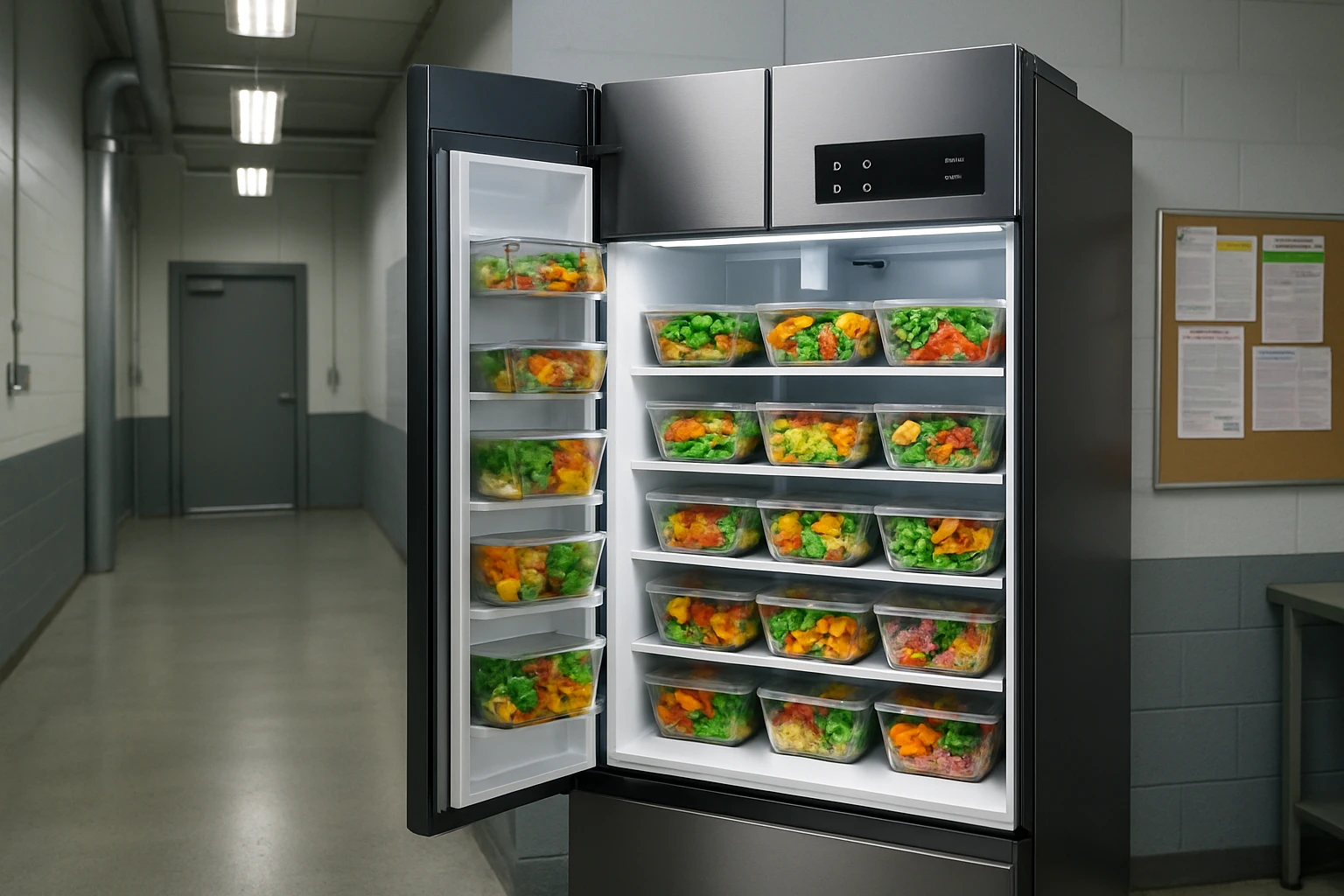
Anaheim and Garden Grove are the industrial backbone of North Orange County. Behind the tourist corridors and the retail strips is a dense concentration of manufacturing, aerospace components, electronics, food production, auto parts, medical devices, industrial equipment. These facilities collectively employ tens of thousands of production workers, many of them on two- or three-shift schedules that run from early morning through the overnight hours. Feeding those workers well, on every shift, not just the day shift, is one of the most practical investments a manufacturer in this area can make.
A smart fridge is the format that fits manufacturing best. Here is why, and how it works for Anaheim and Garden Grove specifically.
Anaheim's industrial areas cluster along the 57 Freeway corridor, around the Anaheim Canyon business park, and in the older industrial zones west of Disneyland. Garden Grove's manufacturing base is concentrated in the city's industrial corridors along Chapman Avenue, Garden Grove Boulevard, and the 22 Freeway. Together these two cities represent one of Orange County's largest manufacturing employment zones.
The industries are diverse: aerospace and defense manufacturers that supply the broader Southern California aerospace cluster, electronics assembly and component manufacturers, food processing and packaging operations, automotive parts suppliers, and plastics and industrial manufacturing. The common thread is that these are facilities with floor workers doing skilled or semi-skilled production work on machines, lathes, presses, assembly lines, CNC equipment, packaging machinery.
Most of these facilities run at minimum two shifts. Many run three. The day shift has the widest food access, restaurants are open, delivery apps work, and workers can sometimes leave the site on a long break. The second and third shifts do not have the same options, and this is where the food access gap becomes a real operational problem.
A day-shift worker in Anaheim has options: restaurants along Harbor Boulevard, delivery apps that work during business hours, a lunch buffet if their employer has one. A third-shift worker at the same facility at 3am has a vending machine.
This inequality in food access creates real operational problems. Workers on overnight shifts are operating the same equipment as day-shift workers, making the same precision decisions, handling the same materials. In many manufacturing contexts they are doing so with less supervision, fewer managers are in the building at 2am, which means individual worker focus and judgment carry more weight, not less. The idea that these workers need the same quality of nutrition as their day-shift counterparts is not just an equity argument. It is an operational one.
OSHA data on manufacturing safety consistently identifies fatigue as a major contributing factor in production-floor accidents. Worker fatigue peaks in the early morning hours, roughly 2am to 6am, due to circadian effects. But fatigue is not purely a function of circadian rhythm. It is also a function of caloric status. A worker who has gone five hours into an overnight shift on a bag of chips and a soda has compounded circadian fatigue with a nutritional deficit. That combination is the highest-risk scenario on a manufacturing floor.
Real food at a break, a protein-forward meal with complex carbohydrates, does not eliminate circadian fatigue, but it attenuates it. It provides glucose that releases steadily over the next two to three hours rather than spiking and crashing within thirty minutes. For workers operating presses, running CNC machines, or assembling precision components, that difference in sustained alertness matters.
Manufacturing environments have specific constraints that make some food solutions impractical and a smart fridge particularly well-suited.
No caterer on-site at 2am. A hot buffet is the best food experience for a large team, but it requires a vendor to be present. Nobody is setting up a buffet for a third-shift crew at midnight. A smart fridge requires no vendor presence at all during service hours. It is stocked during the day and runs autonomously.
Short, staggered breaks. Manufacturing floors often take breaks in waves, department by department, line by line, to avoid shutting down production entirely. This means individual workers may be breaking at different times with as little as 20 to 30 minutes. A smart fridge serves any break at any time. There is no service window to miss.
Space constraints. Manufacturing break rooms are often functional rather than spacious. A smart fridge requires roughly 2 to 4 square feet and a standard outlet. A micro-market or full buffet setup requires far more space. The fridge fits where other solutions do not.
Food quality for physical workers. Manufacturing work is physically demanding in ways that most white-collar workers do not experience. Line workers and machine operators are on their feet for eight to twelve hours, making physical movements repeatedly, lifting, handling materials. Their caloric needs are real. Vending machine snacks are not adequate fuel for this kind of work. A smart fridge stocked with protein-forward, balanced meals gives these workers what they actually need to perform.
MHP's smart fridge menu for a manufacturing environment is built around sustained energy and physical performance. Typical rotation items include:
All items are labeled with ingredients and nutrition information. Every meal was cooked in MHP's Rancho Cucamonga kitchen and is fresh, not frozen, not shelf-stable. This is what distinguishes an MHP smart fridge from a vending machine or a micro-market: the food is actually food.
Orange County manufacturing has faced consistent labor market pressure. Skilled production workers are in short supply, and turnover is expensive, replacing a trained assembly or machine operator can cost several thousand dollars once recruiting, training, and lost productivity are accounted for. Benefits and working conditions are a significant factor in retention, particularly among workers who can choose among multiple manufacturers in the area offering similar wages.
A smart fridge stocked with real food, available on every shift, subsidized or fully covered by the employer, is a tangible, visible benefit. It is not an abstract wellness program or a gym membership that few workers use. It is food, a basic human need, provided at the workplace. Workers notice when this is available and they notice when it is not. Employers in Anaheim and Garden Grove who invest in this program report that it comes up in retention conversations, in onboarding surveys, and in word-of-mouth recruiting among the worker communities that staff these facilities.
See our guide to feeding Anaheim's workforce and our manufacturing and production page for more context on how MHP serves this industry.
For an Anaheim or Garden Grove manufacturer, getting started involves a short conversation about your facility: how many workers are on each shift, where the break rooms are, whether you want a subsidized benefit or a full employee-pay model, and what your current food situation looks like.
MHP installs the fridge, a process that takes under two hours and requires only a standard 120V outlet and begins stocking. Restocking is managed entirely by MHP on a schedule tuned to your usage patterns. For manufacturers running three shifts with 50 or more workers per shift, daily restocking is typical. For smaller operations, every-other-day service is often sufficient.
There is no contract that requires multi-year commitment to start. Employers can begin with a pilot and scale based on participation. Our 24/7 workforce guide walks through the pilot and scale-up process in detail.
The realistic alternatives for Anaheim and Garden Grove manufacturers are:
Vending machines: Inadequate for the reasons discussed above. The nutritional profile of standard vending machine food does not support eight to twelve hours of physical manufacturing work.
Hot buffet at lunch: An excellent program for day-shift headcount of 75 or more, but does not serve second or third shift workers. Many manufacturers run both, a buffet for the day shift and a smart fridge for nights.
Meal stipends: Ineffective for second and third shift workers where there is nothing nearby to spend a stipend on after 9pm.
On-site cafeteria: Cost-prohibitive for all but the largest facilities. Requires dedicated space, equipment, staff, and compliance with health department requirements. A smart fridge delivers the food access benefit at a fraction of the cost and operational complexity.
If you are ready to discuss a smart fridge installation at your Anaheim or Garden Grove facility, reach out to MHP and we will put together a recommendation based on your shift schedule and headcount.
Because most manufacturing facilities run two or three shifts, and a smart fridge is the only food solution that serves all shifts equally. Day-shift workers have some food options nearby; overnight workers have vending machines. A smart fridge corrects that imbalance by providing fresh chef-prepared meals at any time of day or night, without requiring a vendor to be on-site during service hours.
OSHA data consistently identifies fatigue as a leading factor in manufacturing accidents. Fatigue is worsened by caloric deficit and poor nutrition. Workers on overnight or late shifts who eat high-sugar, low-protein vending machine food experience steeper energy crashes during the back half of their shift. Real food, the kind a smart fridge provides, supports sustained alertness and reduces accident risk.
MHP typically restocks during the day or early afternoon, ensuring the fridge is fully stocked before second and third shift breaks begin. For high-volume facilities, daily restocking keeps the fridge adequately stocked across all shifts. The restocking schedule is set based on your headcount and observed usage patterns.
Yes. MHP's program supports full employer subsidy, partial subsidy, or full employee pay. For manufacturers competing for skilled production workers in the Orange County labor market, subsidized meals are a meaningful differentiator. Many OC manufacturers treat smart fridge meals as an equivalent to the tech-company meal perks their workers compare against.
Yes, though the case is different. For a single-day-shift manufacturer, a smart fridge provides grab-and-go meal access during the shift, including early morning and late afternoon breaks when nearby restaurants may be inconvenient. It also eliminates the need for workers to leave the site for lunch, which reduces break-time vehicle incidents and keeps workers on-site and accessible. Even without an overnight component, it is a practical benefit.
Tell us about your team and we will recommend the right program and a worksite-specific quote. No high-pressure sales.