Workplace Lunch
Feeding Anaheim's workforce: lunch programs for large teams
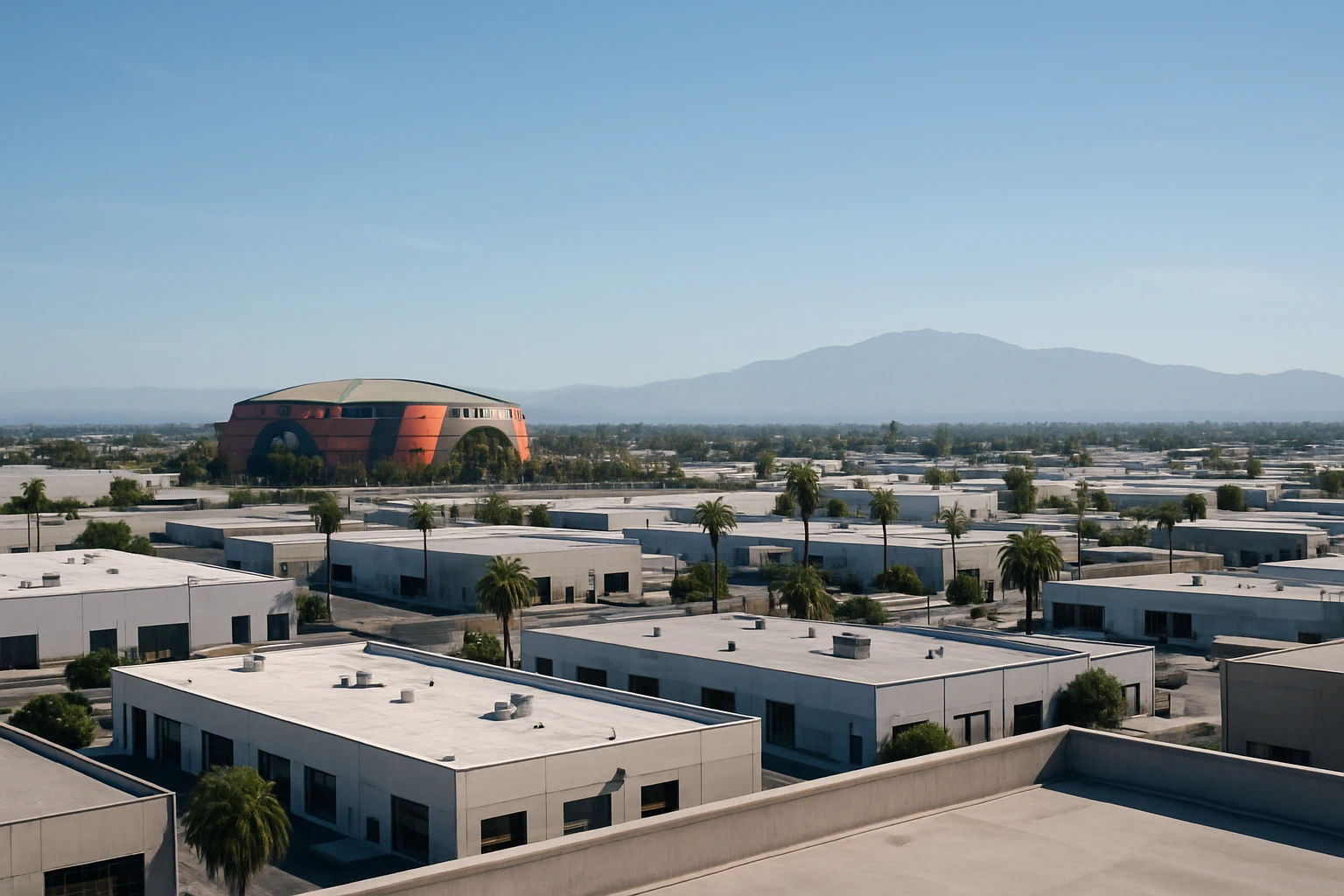
Anaheim is the most populous city in Orange County and one of the most industrially diverse in Southern California. Alongside its well-known tourism economy, Anaheim hosts a large manufacturing base along the I-5 and State Route 91 corridors, distribution centers serving the regional retail and hospitality supply chain, and a growing corporate office presence near the Platinum Triangle. What these employers share is a workforce measured in the hundreds and a food problem that shows up every day at noon.
This guide is for HR, operations, and facilities leaders at Anaheim companies with 100 or more people on-site who want a real workplace food program, not another delivery app account. Here is what works in Anaheim, what does not, and how to match the format to your worksite.
For a 20-person marketing team, a group delivery order from DoorDash or Grubhub can be a workable solution. For an Anaheim manufacturing plant with 200 employees clocking out for a staggered 30-minute lunch, it falls apart fast. The logistics alone, coordinating who ordered what, handling dietary restrictions, covering missed orders, managing a $1,000+ daily spend across 15 different restaurants, creates more work for HR than it solves.
The alternative most large Anaheim employers default to is the same one that shows up in every industrial park: a vending bank in the break room and a fast food cluster on nearby State College Boulevard. Workers who need to eat in under 25 minutes, accounting for walk time, hand washing, and checkout, spend most of that time in a drive-thru line or in front of a vending machine. The food quality, and by extension worker energy and satisfaction, suffers accordingly.
A daily drop-off hot buffet is built for exactly the scale problem Anaheim's largest employers face. We deliver hot pans to your break room before the lunch window, your team serves themselves over a 60 to 90 minute period, and we handle all the setup, serving equipment, and cleanup. There is no one from your team managing the food; it just appears, gets used, and disappears.
The buffet format works best when:
At Anaheim manufacturing plants and distribution centers along the SR-57 and SR-91 corridors, the buffet solves the on-site food problem at a per-head cost that is typically lower than what workers spend on daily fast food and far lower than the administrative overhead of coordinating daily group delivery orders.
Anaheim's industrial workforce is predominantly Latino. Orange County's broader manufacturing and warehouse sector mirrors the pattern documented across Southern California, where the majority of frontline industrial workers are Latino and many prefer Spanish as a primary language. Standard corporate catering menus often miss this workforce entirely, sandwiches and wraps ordered from an English-first app simply do not land the same way as a rotating menu of carne asada, chicken tinga, chile verde, or pollo asado served warm with rice and beans.
MHP's programs are built from a kitchen in Rancho Cucamonga that has been cooking for SoCal workers since 2015. The menu reflects the actual food preferences of the region's workforce. That is not a minor detail; participation rates are directly tied to whether workers actually want to eat what is being served.
Anaheim's manufacturing and distribution sites often run extended or round-the-clock operations. The Platinum Triangle office developments house corporate tenants with late-working staff. An afternoon shift crew at an Anaheim plant does not get the same food access as the day team, especially after 10pm when surrounding fast food options thin out.
For sites running second or third shifts, a smart fridge stocked with fresh, tap-to-pay meals closes the gap. Workers grab what they want whenever their break lands, no app, no minimum order, no cold delivery bag. For a facility that also runs a day-shift buffet, adding a smart fridge for the overnight crew means everyone on the clock has a real food option. One kitchen, one invoice, two formats.
Our guide to feeding a 24/7 workforce goes deeper on how the combination works in practice.
California requires a 30-minute unpaid meal break for any shift over five hours, and a second meal break for any shift over ten hours. An employer who fails to provide a compliant break owes one additional hour of pay per missed break. For an Anaheim plant with 200 workers on a 10-hour shift, a systematic meal break problem is not a soft HR issue. It is a quantifiable labor cost and a litigation risk.
The practical connection to on-site food: workers skip or shorten breaks when there is nothing worth eating nearby and not enough time to leave and return. When food is on-site and ready in under two minutes, the barrier to taking the full break disappears. No commute, no drive-thru line, no vending machine as the only option. This is the same logic explored in our guide on meal break compliance and on-site food in California.
Anaheim's office market, the Platinum Triangle, the Disneyland Resort-adjacent corporate complex, the biotech and healthcare offices near ARMC, has a different flavor than the industrial side. These teams are smaller (often 40 to 150 people), more likely to work standard business hours, and more focused on the culture and retention angle than the compliance angle.
For Anaheim corporate teams, the drop-off buffet serves as a visible perk: a shared lunch that builds informal connection between colleagues. Research from the ezCater 2025 Food for Work report found that 75% of hybrid employees would come into the office more often if lunch was provided, a direct argument for Anaheim companies managing return-to-office expectations.
For smaller Anaheim offices of 30 to 80 people, a weekly team meal delivery is often a better fit than daily buffets, lower overhead, still a tangible benefit, and easy to scale up as headcount grows.
MHP cooks out of Rancho Cucamonga, roughly 35 miles from Anaheim via the 91 freeway. That is a direct shot with no major interchange complications during off-peak delivery hours. For Anaheim employers comparing a local SoCal kitchen to a national vendor routing out of a central facility, the proximity matters in practical terms: real-time schedule adjustments are a phone call, not an operations escalation. And because we are a single kitchen, not a platform aggregating third-party restaurants, menu quality is consistent day to day.
If your Anaheim worksite has 100 or more people on a regular schedule, the conversation starts with three questions: headcount by shift, break room or common area setup, and how much administrative involvement you want. Get in touch and we'll cover those and put together a worksite-specific proposal. No long-term commitment required to start. If you want to understand the full cost picture first, the Inland Empire cost guide covers the main variables, much of it applies to Orange County sites as well.
Manufacturing plants, distribution centers, healthcare facilities, corporate offices, and any large team sharing a predictable work schedule. The common thread is 100 or more people on-site who need a faster, better option than the drive-thru cluster on State College or Harbor Boulevard.
Yes. MHP cooks in Rancho Cucamonga and serves the full Southern California region including Anaheim, Garden Grove, Orange, Fullerton, and the Orange County industrial corridor along the 91 and 57 freeways.
100 or more on-site employees per lunch window is the practical starting point for a daily drop-off buffet. For smaller Anaheim teams, a weekly meal drop-off or smart fridge is a better fit.
Yes. MHP's programs include Spanish-language menus and rotating menu items that reflect regional food preferences, carne asada, chile verde, pollo asado, and similar dishes alongside more broadly familiar options.
No. MHP does not require a long-term contract to start. Most Anaheim clients begin with a pilot period, confirm participation, and then adjust frequency and format based on real usage.
Tell us about your team and we will recommend the right program and a worksite-specific quote. No high-pressure sales.