Smart Fridge
Feeding mixed shifts in Riverside: the case for an on-site smart fridge
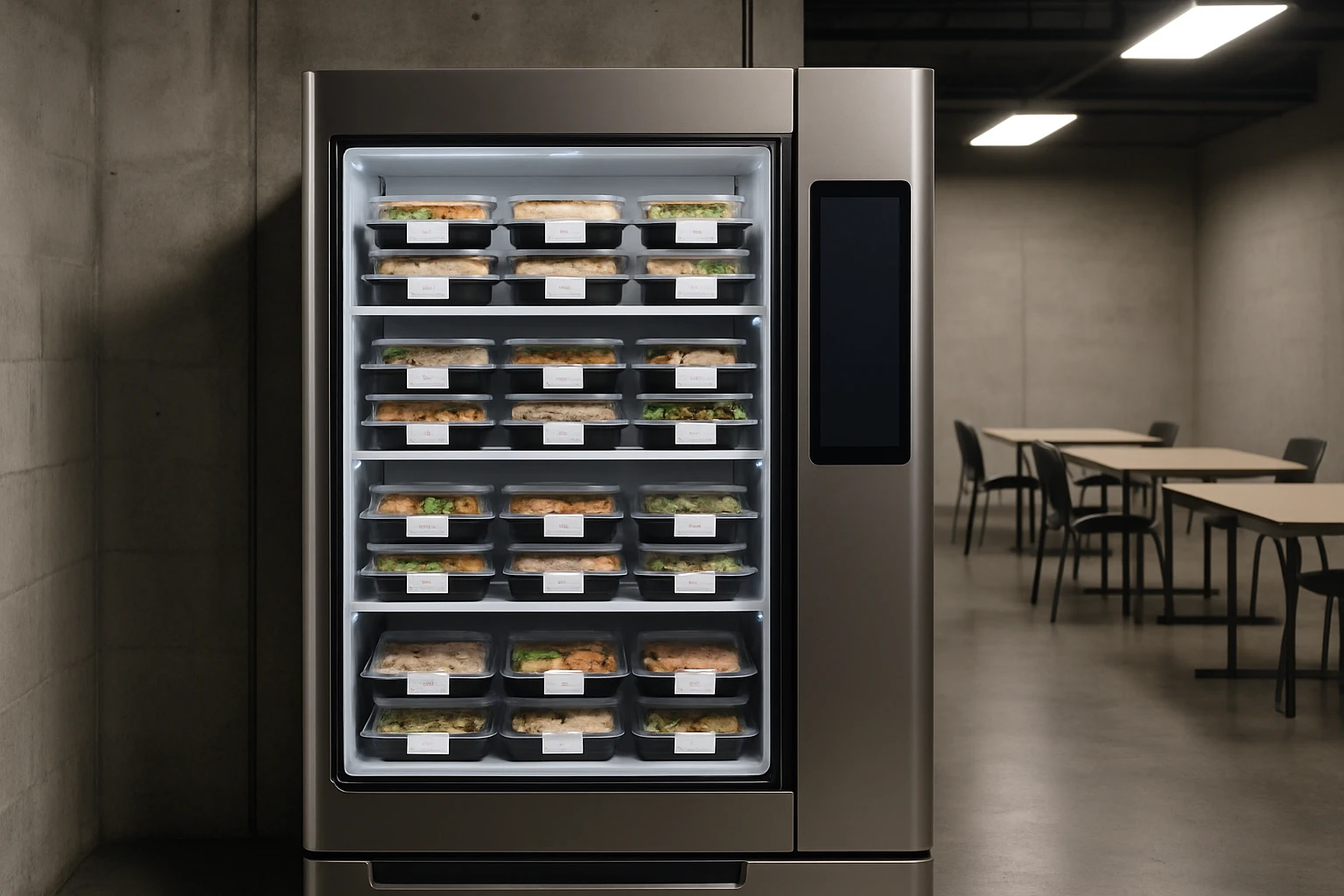
Riverside is one of the Inland Empire's largest employment centers. Its industrial parks along the 91 and 215 corridors are home to logistics operations, manufacturing plants, healthcare facilities, and distribution centers running around the clock. A significant share of Riverside's workforce does not work a standard 8-to-5. They cycle through day, swing, and overnight rotations that create a structural food access problem that most employers have not fully solved.
The problem is not that employers do not care about feeding their teams. It is that the traditional solutions, a catered lunch buffet, a hot food program, daily delivery, are built for a single shift window. When you run two or three shifts, you either over-invest in a program designed for one time slot or you leave most of your workforce without a reliable meal option. The smart fridge closes that gap in a way no buffet-based model can.
Riverside County is home to more than 45,000 businesses and a workforce that spans healthcare, manufacturing, logistics, public safety, and education. The city of Riverside itself concentrates a large portion of that activity: the county medical center, several large distribution campuses, manufacturing operations in the Eastside and Casa Blanca industrial districts, and a growing base of corporate and government employers near downtown.
What many of these employers share is a 24-hour or near-24-hour operational footprint. The distribution center on Commerce Center Drive does not close at 5pm. The manufacturing plant running three shifts on Innovation Drive does not pause between rotations. The county medical center never closes. For all of them, feeding a workforce that arrives and leaves at multiple points throughout the day is an ongoing operational challenge.
Riverside also sits at a practical distance from the kind of dense restaurant corridors that make delivery apps viable. Many of the industrial parks and medical campuses in Riverside are not walkable to food options in any meaningful sense. Workers who want a real meal are dependent on what is available on-site and in most cases, that means a vending machine.
Consider a logistics facility running three eight-hour shifts: day shift from 6am to 2pm, swing from 2pm to 10pm, and overnight from 10pm to 6am. A catered lunch program serves the day shift reasonably well, food arrives at 11am and workers eat at noon. But the swing shift starts after the buffet is long gone. The overnight shift arrives at 10pm when every food option in the facility and nearby is closed or closing.
This is not an edge case. It is the normal operating reality for a large share of Riverside's industrial workforce. And the consequence is not just inconvenience. It is a measurable nutritional deficit for workers who are already putting their bodies under significant physical stress.
A single smart fridge deployed in the break room solves this problem for all three shifts simultaneously. The day shift grabs a meal before their break. The swing shift arrives and the fridge is restocked and ready. The overnight crew accesses real food at 2am, hot meals in microwave-ready containers, without any additional setup or vendor coordination. The same unit that serves breakfast-hour workers also serves the people who showed up at 10pm.
There is a fairness dimension to the multi-shift food problem that HR leaders in Riverside are increasingly paying attention to. When a company provides catered lunch for the day shift but vending machines for the overnight crew, it sends a message, intentional or not, that overnight workers are second-tier employees. That message compounds over time into turnover.
Overnight and swing shift workers are often among the hardest positions to fill and retain. They accept less desirable schedules in exchange for the job. When the job also offers fewer benefits, including something as basic as access to a real meal, the calculus of staying versus leaving shifts. Employers in Riverside who have added smart fridges for their multi-shift operations consistently report that the program lands hardest as a positive signal for exactly the workers who were previously getting the least.
Shift rotation creates real physiological stress that most employers treat as invisible. Workers who rotate between days, swings, and overnights are cycling their sleep schedules on a cadence that disrupts circadian rhythms. Research on shift work and metabolic health is consistent: rotating shift workers have higher rates of metabolic syndrome, elevated cortisol, disrupted insulin response, and higher baseline fatigue than workers on fixed schedules.
Consistent, high-quality nutrition does not eliminate the metabolic stress of shift rotation, but it does moderate it. Workers who eat regular meals with adequate protein, complex carbohydrates, and healthy fats maintain more stable energy levels across shifts. They are less likely to experience the afternoon or mid-shift energy crashes that lead to errors, accidents, and early fatigue. For industries like manufacturing and logistics, where physical precision matters and fatigue-related errors have real consequences. This is not a soft wellness metric. It is an operational one.
The food in an MHP smart fridge is designed with this in mind: protein-forward meals with clean ingredients, adequate caloric density for physical work, and enough menu variety to encourage consistent participation rather than occasional use.
Most Riverside industrial employers have limited break room footprint to work with. Warehouses have designated break areas that may not have the space or infrastructure for a full food service setup. Manufacturing facilities have break rooms that function primarily as rest spaces. The smart fridge is the right form factor for these environments: a footprint of roughly two square feet, a standard 110-volt outlet, and no food service staff, no delivery windows, no ongoing coordination from facilities.
MHP handles the entire program. We assess the site, place the unit, stock it on a schedule calibrated to usage, manage payment access (badge, card, or employer-subsidized), and rotate the menu regularly. The facility's HR or operations team does nothing beyond the initial setup conversation. The fridge is simply there, stocked, and ready, for all three shifts, every day.
For employers in Riverside running complex multi-shift operations with limited HR bandwidth, that simplicity is often the deciding factor. A lunch buffet requires scheduling, setup, cleanup, and coordination. A smart fridge requires none of that. It delivers the same outcome, real food available to all workers, with a fraction of the operational overhead.
See our Smart Fridge program page and our manufacturing and production industry page for more detail. Our post on feeding a 24/7 workforce covers the operational mechanics in depth, and our Riverside healthcare post addresses the healthcare side of this same market.
A catered lunch is a one-time-window solution. It works for the shift that happens to be on break when the food arrives, and it works for nobody else. A smart fridge is available at all hours without additional cost per shift. For facilities running two or three shifts, the smart fridge delivers food access equity that a buffet physically cannot match.
Yes. MHP's menu is designed for workers doing real physical or cognitively demanding jobs, adequate protein, balanced macros, and portions sized for people who are actually working, not sitting at a desk. The meals are not protein bars and snacks. They are full meals in microwave-ready containers.
MHP restocks the fridge on a schedule calibrated to your site's usage patterns. For multi-shift operations, we typically restock during the lowest-traffic window, often early morning, so that the fridge is fully loaded before the next busy cycle begins. The overnight crew always has access to a fully stocked unit.
Cost depends on program structure. Some Riverside employers pay per meal consumed, subsidizing partially or fully. Others set up a pay-per-use model where employees purchase their own meals at a set price. Either way, the per-meal cost is comparable to a fast food meal and the food is significantly better. We build a custom quote based on your team size and shift structure.
From initial conversation to first stocked fridge is typically one to two weeks for most Riverside sites. Site assessment, placement confirmation, power verification, and access setup are the main steps. Installation itself takes under two hours. You do not need to do anything special to prepare, a standard break room outlet and a few square feet of floor space is all that is required.
Tell us about your team and we will recommend the right program and a worksite-specific quote. No high-pressure sales.