Workplace Lunch
Healthcare workers in Riverside: solving the break-room food problem
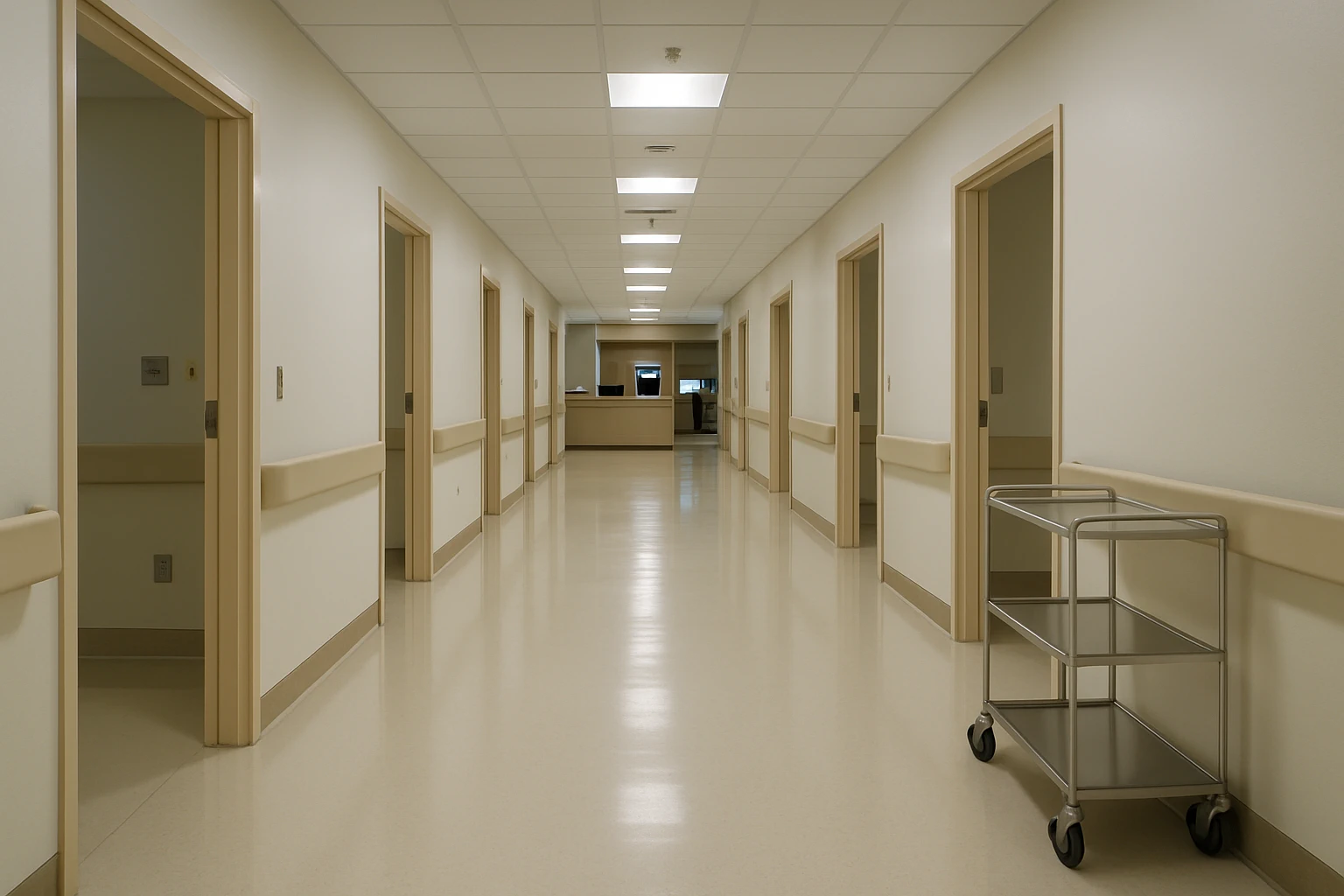
Riverside County is the second largest county in California by area and one of the fastest-growing healthcare markets in the state. Riverside University Health System, Desert Regional Medical Center, Eisenhower Health in Rancho Mirage, and dozens of outpatient surgical and specialty practices employ tens of thousands of nurses, technicians, support staff, and clinical professionals working 12-hour shifts across three rotating crews. What most of them share is the same break-room problem: a hospital cafeteria that closes before the night shift eats, a vending bank that constitutes the only option from 8pm to 6am, and a 30-minute break window that does not allow for leaving the facility.
This guide is for HR, operations, and nursing leadership at Riverside healthcare employers who want a better food solution for their clinical teams, one that works for day, evening, and night shifts without requiring a full cafeteria operation.
The structural food problem at Riverside healthcare facilities is the same one that shows up at every hospital in the state. Hospital cafeterias are optimized for visitors and day-shift staff. They typically close by 7pm or 8pm, which is exactly when the evening and night clinical teams are starting to think about dinner. By 10pm, the options are whatever is left in the vending machine, whatever the night shift brought from home, or a delivery app order to a nursing station (which varies by facility policy and often creates as many issues as it solves).
The impact on clinical staff is documented. Research on nurse fatigue and nutrition consistently links missed or inadequate meals to higher rates of medication errors and patient safety incidents. An analysis published in NCBI/PMC found that healthcare shift workers had significantly worse diet quality scores during overnight shifts compared to day shifts, with more reliance on vending and ultra-processed food and less fresh food consumption. For Riverside healthcare employers who are managing nurse retention and patient safety simultaneously, the break-room food problem is not a minor HR issue.
For day-shift clinical teams of 100 or more eating during a predictable window, a daily drop-off hot buffet is the most common format. Hot pans arrive before the lunch window, clinical staff serve themselves between patients, and there is no management overhead from the nursing or HR team. The buffet stays active for 60 to 90 minutes, accommodating staggered breaks across departments.
For evening and night-shift coverage, the 3pm to 3am crew that the cafeteria never serves, a smart fridge stocked with fresh meals fills the gap. Nurses tap a badge or card, grab a labeled fresh meal, and are back in three minutes. No delivery window, no app required, no one calling a nursing station from the parking lot. The fridge is restocked on a regular schedule and the contents rotate weekly with labeled ingredients and allergen information, relevant for clinical staff with dietary preferences or restrictions.
The combination of a day-shift buffet and an overnight smart fridge is what we refer to as full-clock coverage: one kitchen, one invoice, all three shifts. The guide to feeding a 24/7 workforce covers this combination in detail.
Nurse turnover in California runs above the national average, driven by a combination of housing costs, commute distances in the IE, and compensation competition from travel nursing agencies. The Inland Empire healthcare market, Riverside University Health System, Loma Linda University Health, Riverside Community Hospital, and the network of outpatient facilities along the 60 and 91 corridors, has invested significantly in retention programs because replacing an experienced RN costs a hospital between $40,000 and $65,000 per departure, according to healthcare workforce research cited by the American Nurses Association.
Food appears consistently in nurse satisfaction surveys as a quality-of-work indicator. In facilities where night-shift nurses describe their break-room experience as a vending bank and a shared microwave, engagement scores are measurably lower than in facilities with a real food option. This is not because food is the only retention driver. It is not. But because it signals whether an employer has thought about the actual experience of working a 7pm to 7am shift. Our post on employee meal benefits and retention covers the broader research on why visible food benefits outperform stipends in satisfaction surveys.
Healthcare workers at Riverside facilities represent the full spectrum of dietary preferences, vegetarian, halal, gluten-aware, and more. Standard vending options satisfy almost none of these needs, and a single-restaurant catering delivery fails the dietary range of a 200-person clinical staff. MHP's rotating menus include multiple proteins per service, a vegetarian option, labeled allergens, and items that reflect the dietary preferences of Riverside's predominantly Latino clinical workforce. The food benefit only works as a retention tool if people actually eat it, and that starts with the menu being something the staff wants.
Not every Riverside healthcare site is a 500-bed hospital. Specialty clinics, outpatient surgical centers, dialysis centers, and medical group offices in Riverside range from 20 to 100 staff. For these sites, a weekly team meal delivery is often a better fit than a daily buffet: pre-portioned fresh meals delivered once or twice a week, stored in the office fridge, and grabbed whenever staff are ready. Lower overhead, still a tangible benefit, and easy to scale up if the practice grows. For clinic sites with extended evening hours, a smart fridge provides continuous access without any delivery window.
If your Riverside hospital, medical center, or clinical facility has 50 or more staff on a regular schedule, the conversation starts with shift coverage, break room space, and what you want the program to accomplish. Get in touch and we will put together a worksite-specific proposal for your Riverside location. No long-term contract required. You can also learn more about how MHP serves healthcare employers on our healthcare and hospitals page.
For day-shift clinical teams of 100 or more, a daily drop-off hot buffet. For night-shift and overnight staff, a smart fridge with 24/7 access. Many Riverside healthcare facilities run both to cover the full clock with one invoice.
Yes. MHP cooks in Rancho Cucamonga and serves all of Riverside County including hospitals, medical offices, and clinical sites in Riverside, Corona, Moreno Valley, and surrounding areas.
Research on healthcare retention consistently identifies break-room conditions and on-site food access as meaningful contributors to nurse satisfaction. A real meal option is cited in nurse satisfaction surveys as a basic quality-of-work expectation and a visible one that separates employers in competitive markets.
A smart fridge is a tap-to-pay refrigerator stocked with fresh labeled meals available 24/7. Night-shift nurses access fresh food whenever their break lands, at 2am the same as at noon, with no delivery window or app required.
No. MHP does not require a long-term contract. Most healthcare clients pilot the program for 30 to 60 days before committing to a regular schedule.
Tell us about your team and we will recommend the right program and a worksite-specific quote. No high-pressure sales.