Smart Fridge
Smart fridge in Moreno Valley: a guide for HR and facilities
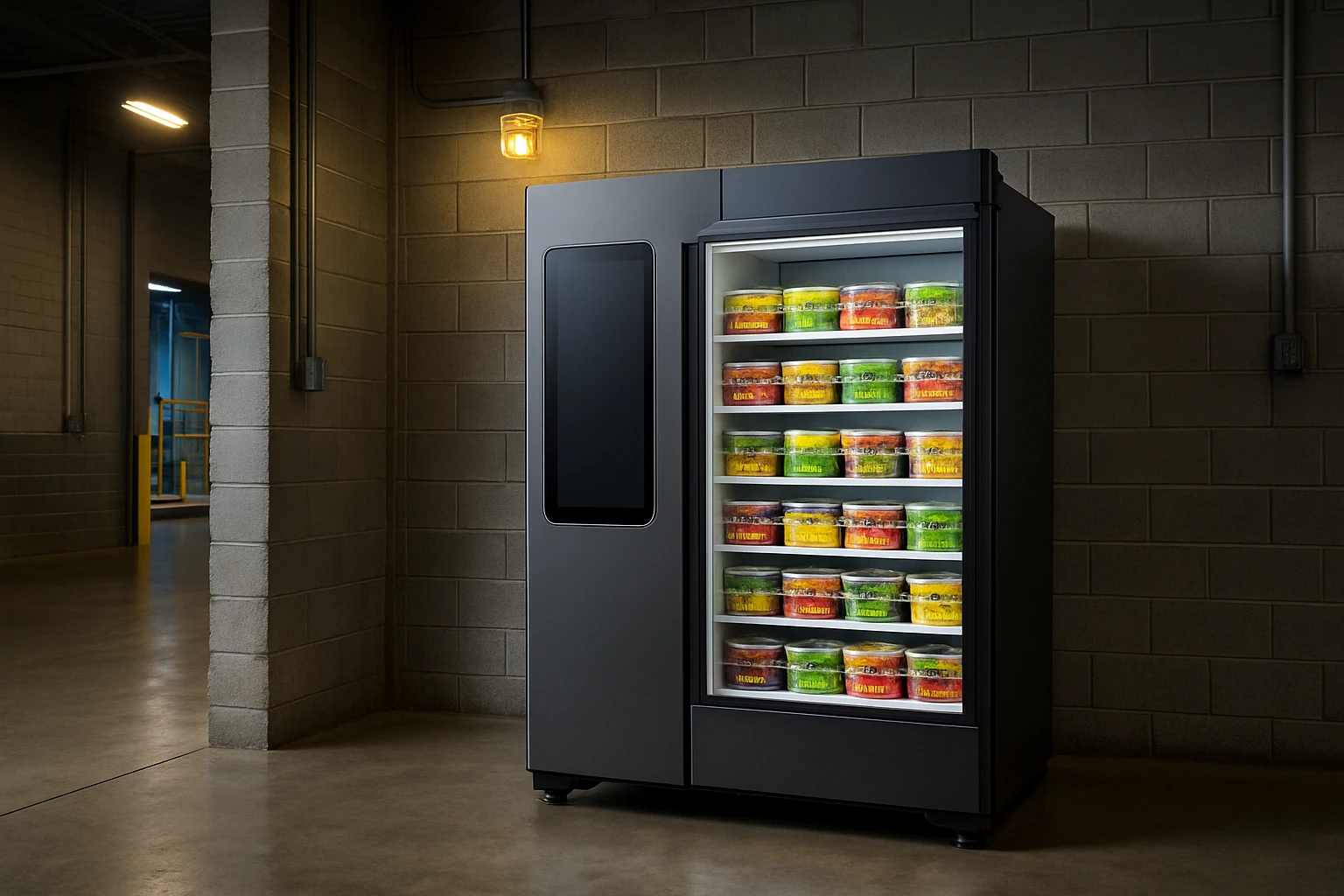
Moreno Valley doesn't always make the top of the list when people think about Inland Empire business hubs, that distinction more often goes to Ontario, San Bernardino, or Riverside. But in terms of sheer employer concentration in logistics, healthcare, and defense-adjacent industries, Moreno Valley has quietly become one of the most significant employment centers in the eastern IE, and one of the areas where the on-site food access gap is most pronounced.
If you are an HR manager or facilities director at a Moreno Valley employer trying to figure out whether a smart fridge makes sense for your site, this guide is written specifically for you. We'll cover the employer landscape, the food access problem that characterizes eastern IE worksites, what a smart fridge setup actually involves from your perspective, and the health and performance case for getting this right for your team.
Moreno Valley's growth as an employment center has been driven by a few converging factors: available large-footprint industrial land along the SR-60 and I-215 corridors, proximity to the March Air Reserve Base joint-use facility (which brings both military and civilian aviation-related employers), and the eastward expansion of the IE's logistics and distribution infrastructure as sites closer to Ontario and Chino reached capacity.
The result is a distinctive employer mix. On the logistics and distribution side, Moreno Valley hosts large fulfillment and distribution operations, including significant Amazon infrastructure, along with regional distribution centers for retail and consumer goods companies. These facilities typically run two or three shifts, employ 200 to 1,000 or more workers per site, and operate around the clock or close to it.
On the healthcare side, Moreno Valley Medical Center (MVMC) is the area's primary acute care hospital, with clinical, nursing, and support staff working round-the-clock shifts. Healthcare workers, particularly nursing and clinical staff, face food access challenges during 12-hour shifts that are structurally similar to the challenges at any 24-hour facility.
Near March Air Reserve Base, a cluster of defense contractors, aviation maintenance and modification companies, and logistics-adjacent operations add another layer of employers with significant shift workforces. The base itself generates civilian employment in facilities management, logistics, and support roles that are covered by standard civilian HR practices including employee benefits.
Moreno Valley's geography creates a food access problem that is more acute than at comparable facilities in the western IE or Orange County. The city's commercial development has not kept pace with its industrial growth, large stretches of the SR-60 and I-215 industrial corridors have limited nearby restaurant options, particularly during off-peak hours. Workers on the overnight shift at a distribution center near Cactus Avenue or Alessandro Boulevard at 2am have very few options beyond whatever is in their break room and whatever fast food is open along the highway.
This matters because the population working these shifts relies on their employer's break room more than their counterparts at, say, an Irvine office park with a half-dozen restaurants within a five-minute walk. When the break room has only a vending machine, the default for overnight and swing shift workers is either skipped meals or fast food that requires a significant detour on a short break.
The employer population in Moreno Valley is also heavily weighted toward physically demanding work, warehouse picking and packing, materials handling, loading dock operations, where nutrition has a direct, measurable connection to performance and safety. This is not an abstract wellness consideration; it is an occupational performance and injury risk factor.
California's AB 701, effective since 2022, requires large warehouse distribution centers to disclose productivity quotas and any work speed requirements that could interfere with workers' right to take meal and rest breaks. The regulation was driven by documented concerns that quota-driven environments discouraged workers from taking breaks to avoid falling behind productivity benchmarks.
The food access implication of this is direct: if workers in quota-driven environments are effectively rationing their breaks to protect their productivity numbers, the quality of the food available during the time they do take to eat becomes even more important. A worker who has 20 minutes for a meal break and spends 10 of those minutes at a vending machine eating chips has not eaten in any meaningful sense. A worker who can grab a high-protein grain bowl from a fridge 30 steps from the break table, heat it for 90 seconds, and sit down for a real meal has actually fueled their body for the next four hours of physical work.
For HR and facilities teams at large Moreno Valley distribution operations, the smart fridge is partly a compliance-adjacent investment: it ensures that the breaks workers do take actually result in nutrition, which supports the sustained performance and safety outcomes that good break policies are designed to protect.
HR and facilities teams at large sites sometimes assume that adding a food service involves significant operational complexity, vendor management, food service licensing, daily coordination with kitchen staff. A smart fridge from MHP is specifically designed to avoid all of that.
Here is what the process looks like from your side:
Initial consultation: MHP assesses your site, headcount, shift structure, break room configuration, power and space availability. This is a brief conversation and a site visit, not a procurement process. Most sites qualify for a standard installation without any facility modifications.
Installation: The unit is delivered and placed by MHP. It requires a standard 110V outlet and a footprint of roughly 2.5 to 3 feet wide by about 6 feet tall. For large sites with multiple break rooms, multiple units can be placed simultaneously. Installation is typically completed in a single visit. From your facilities team's perspective, the operational load is comparable to installing any break room appliance.
First delivery: From initial contact to first delivery is typically one to two weeks for standard setups. There is no long procurement lead time, no licensing application on your end, and no hiring or training of food service staff.
Ongoing management: MHP handles all restocking, quality control, and unit maintenance. Your HR team does not manage inventory, coordinate deliveries, or interact with the food service operation on a day-to-day basis. The ongoing operational burden on your team is essentially zero.
Pricing and subsidy structure: You can offer the fridge as a fully employee-paid service (no cost to the employer beyond the space and electricity) or subsidize meals at whatever level fits your benefits budget. Many Moreno Valley employers in logistics and distribution use partial subsidies, for example, covering a set dollar amount per employee per shift, as a retention and morale benefit.
Physical labor at scale, warehouse picking, loading, materials handling, generates significant metabolic demand. A distribution center worker walking 15 or more miles per shift and lifting cases throughout that time burns substantially more calories than a sedentary office worker. Without adequate nutrition during the shift, performance degrades: reaction time slows, decision-making deteriorates, and injury risk increases, particularly in the final hours of a long shift when glycogen depletion compounds fatigue.
Healthcare workers at MVMC face a different but parallel challenge: sustained cognitive and physical demands over 12-hour shifts, with the added emotional and physiological stress of clinical environments. Nurses and clinical staff who skip meals or eat poorly during shifts report higher rates of burnout and are more prone to medication errors and reduced patient care quality, outcomes that translate into direct operational and liability costs for the facility.
MHP's smart fridge addresses both contexts with a menu designed for physical and cognitive performance rather than convenience snacking. Protein-forward entrées, complex-carbohydrate bases, and balanced macros are the framework, not chips, candy bars, and soda.
For more on what the program looks like and how to start, see our Smart Fridge program page. We've also written a detailed guide specifically for warehouse and logistics employers, and a post on how Moreno Valley distribution centers solve the lunch problem. If you're still evaluating whether a fridge is right for your specific site configuration, our smart fridge setup and installation guide walks through the full process in detail.
Yes. Large multi-shift distribution and logistics sites are among MHP's most common placements. For a 400-person facility running two shifts, we would typically assess whether a single large-capacity unit or two strategically placed units better serves the workforce. Restock frequency is calibrated to total daily throughput, a high-volume site gets more frequent service than a smaller one. The setup and management process is the same regardless of size; the logistics scale to the site.
For most Moreno Valley sites, the timeline from initial contact to first stocked unit is one to two weeks. This covers a brief site assessment (usually a single visit), unit placement, and first stocking. There is no lengthy procurement process, no food service licensing required on your end, and no hiring or training of on-site food service personnel. MHP handles the full setup from its side. For facilities with urgent timelines, expedited placement is sometimes possible, contact us to discuss your specific situation.
Moreno Valley's workforce is notably diverse, reflecting the city's demographic composition and the broad hiring profiles of large distribution and healthcare employers. MHP's rotation is built to serve this diversity, halal-certified proteins, plant-based entrées, gluten-aware options, and high-protein formats are all standard in the menu. For sites with particular dietary composition (for example, a workforce that is predominantly observant Muslim and requires consistent halal availability), we can weight the rotation accordingly. The goal is that every employee on every shift can find something that works for them, which is the threshold at which a food benefit actually functions as a benefit.
Yes. Healthcare settings, both acute care hospitals and the range of outpatient, ancillary, and medical office facilities that operate in and around Moreno Valley, are well-suited for smart fridge placement. The 24-hour operational model, the shift structure, and the physical and cognitive demands of clinical work make the food access problem in healthcare particularly acute. MHP has experience with healthcare facility requirements, including the need for placement in staff-only areas that maintain the boundary between staff and patient services. The unit operates as a standalone service with no connection to any food service operation the facility runs for patients or visitors.
Yes, and this is a common path for larger sites. Starting with a single unit in your primary break room or highest-traffic staff area lets you assess usage patterns, gather employee feedback, and build the business case for additional units before committing to a multi-unit installation. MHP tracks usage data that can inform that conversation, both the absolute volume and the distribution across meal types and times of day, which helps with decisions about whether to add a second unit, adjust the restock schedule, or modify the menu mix for your specific workforce.
Tell us about your team and we will recommend the right program and a worksite-specific quote. No high-pressure sales.