Smart Fridge
Smart fridge for Orange County offices: a buyer's guide
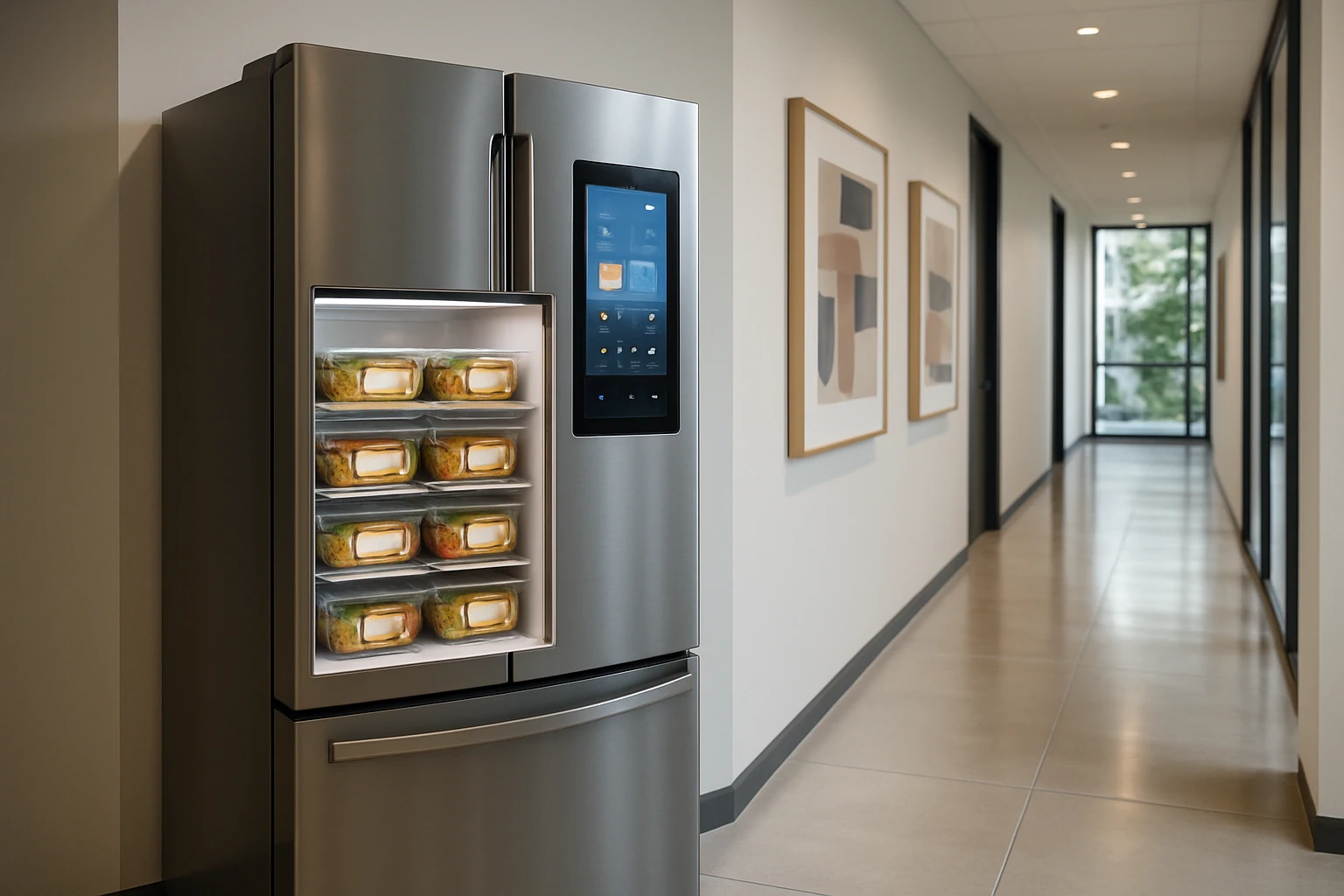
Orange County has one of the most diverse office landscapes in Southern California. Irvine's tech and biotech corridors, the corporate campuses in Anaheim and Brea, the creative agencies in Costa Mesa and Santa Ana, the financial firms in Newport Beach, the mid-size businesses scattered across Tustin and Lake Forest, OC employers range from 30-person startups to regional headquarters for Fortune 500 divisions. What many of them share in 2026 is a food problem that did not exist five years ago at the same scale: a hybrid workforce where different people are in the office on different days, and planning a catered lunch around that unpredictability is nearly impossible.
A workplace smart fridge is the answer many OC HR and facilities teams are landing on. This guide explains what it is, how it works in an office context, what goes inside it, and how to decide whether it is the right fit for your specific situation. If you are comparing a smart fridge to other options, vending, delivery apps, weekly drop-off, or a hot buffet. This guide addresses all of those comparisons directly.
The shift to hybrid work changed the calculus for office food programs. In a five-days-a-week office, a recurring catered lunch or a regular buffet delivery made straightforward sense: you knew how many people were in, you planned the food accordingly, and nearly everyone ate. In a hybrid office, three days a week on staggered schedules, with different team members in on different days, the math breaks down. A buffet that sets up for 80 people at noon on a Tuesday when only 35 people are actually in produces waste, frustration, and an awkward visual of half-eaten trays.
A smart fridge does not have this problem. It is stocked for the week, not for a specific headcount at a specific hour. Someone who comes in early and skips the noon hour can grab a meal at 9am. Someone working late can grab something at 5pm. The person who works Tuesdays and Thursdays is as well-served as the person who comes in every day. The food is there when the person is there, which is the core advantage in a hybrid office context.
Cognitive performance, the thing OC office employers are paying for, is directly affected by nutrition. This is not a controversial wellness claim; it is straightforward physiology. The brain consumes approximately 20% of the body's total energy at rest, and it is sensitive to glucose availability, meal timing, and the quality of what you eat. Skipping lunch or replacing it with vending machine snacks produces measurable effects on concentration, working memory, and decision quality in the afternoon hours.
Research on workplace nutrition and cognitive function consistently finds that employees who eat adequate, balanced meals perform better on tasks requiring sustained attention and analytical reasoning than those who skip meals or rely on processed snacks. For an office environment where the product is the quality of people's thinking, in meetings, in writing, in analysis, in client interactions. This is not a peripheral concern. An employee who skips lunch to grind through a deadline and then loses an hour of real productivity to a mental fog in the mid-afternoon has not gained time; they have traded it.
A smart fridge stocked with real food, not chips and candy, gives OC office workers consistent, accessible nutrition that supports rather than undermines the work they are being paid to do. That is the practical case for a well-stocked workplace fridge, separate from any wellness or retention framing.
MHP stocks its smart fridges from the same kitchen that supplies its buffet and weekly drop-off programs, a commercial facility in Rancho Cucamonga. Meals are cooked fresh, portioned individually, labeled, and delivered on a restocking schedule. The menu rotates to prevent repetition and covers a range of options: grain bowls with roasted vegetables and a protein, grilled chicken or salmon entrees with sides, chopped salads, wraps, and occasionally hot entrees for reheating.
Every container is labeled with the full ingredient list and allergen information, which matters in an OC office environment where dietary variety, vegetarian, gluten-free, dairy-free, high-protein, is common. MHP builds the menu with that diversity in mind. There is always something for the person who does not eat red meat, and always something for the person who wants a higher-calorie, protein-forward option. The rotation keeps it from feeling stale week to week.
This is worth contrasting with what a standard vending machine offers: ambient, shelf-stable, processed products. The nutritional profile of a bag of pretzels or a granola bar is categorically different from a grain bowl with roasted squash and sliced turkey. A smart fridge is not a premium vending machine. It is a different category of food program entirely.
For a facilities team evaluating this, the operational footprint is small. The fridge unit requires approximately two square feet of floor space. It fits in a kitchen nook, a hallway, or alongside existing break room equipment and a standard 110V outlet. No plumbing, no special electrical work, no ventilation modification. Installation is done by MHP and takes less than an hour. Once it is in place, your facilities team's ongoing involvement is essentially zero.
MHP handles all restocking, typically visiting two to three times per week based on consumption. On restock visits, the driver loads fresh meals, removes anything approaching the use-by date, and wipes down the interior. You do not manage inventory. You do not deal with expired food. You do not coordinate delivery timing. The program runs in the background with one point of contact at MHP if anything needs attention.
Access is configured to your site. For most OC office environments, employees access the fridge with an existing badge or a tap-to-pay card. You set the access permissions during setup; after that, employees manage their own access without HR involvement.
There are three standard ways to structure the cost, and OC offices use all three depending on their budget and culture.
In a fully employer-subsidized model, the company pays a per-meal rate for every meal consumed and employees access the fridge at no charge. This is the cleanest from an employee experience standpoint, there is no friction at the point of access and it is increasingly common among OC tech and biotech employers who treat the food benefit as a retention and return-to-office investment. In a fully employee-pays model, workers tap their card and are charged the meal price directly. The employer's cost is minimal; the program is essentially a managed service that delivers better food than a vending machine at a similar price point for the employee. The split model sits in the middle: the employer subsidizes a portion of each meal and employees pay the remainder.
Any of the three can be set up cleanly from day one. If your situation or budget changes, the model can be adjusted. A common pattern is starting with a partial subsidy as a pilot and moving to full subsidy if utilization is high and the retention impact is visible.
A smart fridge is not the right answer for every OC office. It is helpful to be clear about where it fits and where it does not.
Smart fridge versus vending machine: A vending machine is a reasonable option if the only goal is putting something accessible in the break room. If the goal is providing real, nutritious food that employees actually value as a benefit, a smart fridge is in a different category. The food is better, the perception is better, and the utilization is typically higher.
Smart fridge versus delivery apps: Meal stipends and app-based delivery require employees to manage their own ordering, wait for delivery, and hope the timing aligns with their schedule. In many OC office parks, particularly those without direct building access for couriers. This is also operationally unreliable. A smart fridge eliminates all of that friction. Read more in our comparison guide on vending machines versus smart fridges.
Smart fridge versus weekly drop-off: Weekly drop-off, pre-portioned meals delivered once or twice a week, is a lighter-footprint option that works well for very small offices or satellite locations. For a site with 30 to 50 employees, weekly drop-off and a smart fridge are comparable in cost and convenience. For larger OC offices with 50 or more people, the fridge tends to drive higher participation because it is always visible and always accessible.
Smart fridge versus hot buffet: A hot buffet is MHP's highest-volume format and works well for OC offices with 100 or more employees on a predictable schedule who eat at roughly the same time. If your hybrid schedule makes that headcount unpredictable, or if you have significant after-hours or early-morning use, the smart fridge covers the gaps that a buffet cannot. For a deeper look at how to choose between them, see our guide to feeding a 24/7 workforce.
For employees, the benefit is simple: real food is available when they are in the office, without any friction or coordination. For employers, the benefit is layered. A smart fridge is a visible, daily-use perk, unlike a gym membership or a transit subsidy that many employees never use, a food benefit in the break room is something employees interact with every time they are in. It signals that the employer takes the in-office experience seriously, which matters in an OC hiring market where competition for professional talent remains significant.
There is also a direct productivity argument. Knowledge workers who eat adequate, quality meals in the afternoon do better work than those who do not. For OC corporate offices, biotech campuses, and tech companies where the work product is ideas, analysis, and judgment, supporting that cognitive baseline is not incidental. It is part of the operating environment. See how MHP serves corporate office clients for more on how these programs run across OC office types.
Cost depends on the payment model you choose. In an employer-subsidized program, you pay a per-meal rate for each meal consumed, typically in the range of $8 to $14 per meal depending on menu selections. In an employee-pays model, workers pay at the point of access and your cost is minimal. A split model sits in between. Contact MHP for a quote based on your headcount and preferred model.
A vending machine stocks ambient, processed products, chips, candy, crackers, that sit unrefrigerated for weeks. A smart fridge stocks fresh, cooked meals with a refrigerated shelf life of a few days, labeled with ingredients and allergens. The food is chef-prepared and nutritionally substantive in a way that vending food is not. The access mechanism is similar, tap and go. But the product is in an entirely different category.
Yes, and that is one of the strongest use cases for a smart fridge in an OC office context. Unlike a catered buffet that requires a minimum headcount at a fixed time, a smart fridge is stocked for the week and available whenever employees are on-site. If 20 people come in on Tuesday and 60 come in on Thursday, the fridge serves both days. MHP monitors inventory and adjusts restock schedules accordingly.
MHP stocks its smart fridges with rotating fresh meals from our Rancho Cucamonga kitchen, grain bowls, grilled proteins, salads, wraps, and hot entrees. Every container is labeled with the full ingredient list and allergen information. The menu rotates so employees are not eating the same thing every visit. Dietary variety is built in: options typically include choices suitable for vegetarian, high-protein, and lower-carb preferences.
Very little. The fridge needs approximately two square feet of floor space and a standard 110V outlet. MHP handles delivery, installation, stocking, and restocking, typically two to three visits per week. Facilities does not manage inventory, deal with expired food, or coordinate anything on a day-to-day basis. The program is designed to run without requiring ongoing attention from your team.
The conversation to get started is short. MHP needs to know your office location, your approximate on-site headcount on a typical day, your break room dimensions, and your preferred cost model. From that, we can confirm whether a smart fridge is the right fit or whether weekly drop-off or a buffet would serve you better and we can put together a worksite-specific quote. There is no long-term contract to start, which means you can pilot the program and see how your team actually uses it before committing.
If you are an HR or facilities lead at an Orange County office and want to explore this, reach out to MHP Food Service here. We work across OC, Irvine, Anaheim, Santa Ana, Costa Mesa, Newport Beach, Brea, and beyond and we can typically have a program running within a week or two of the initial call.
Research on nutrition and cognitive performance: Harvard Health Publishing on brain nutrition. Workplace nutrition and productivity: CDC Workplace Health Promotion, Nutrition.
Tell us about your team and we will recommend the right program and a worksite-specific quote. No high-pressure sales.
Hot buffet lunches, a 24/7 smart fridge, or weekly meal drops — cooked in our Rancho Cucamonga kitchen and run as one simple program.