Guides
Vending machine vs. smart fridge: what's right for your worksite?
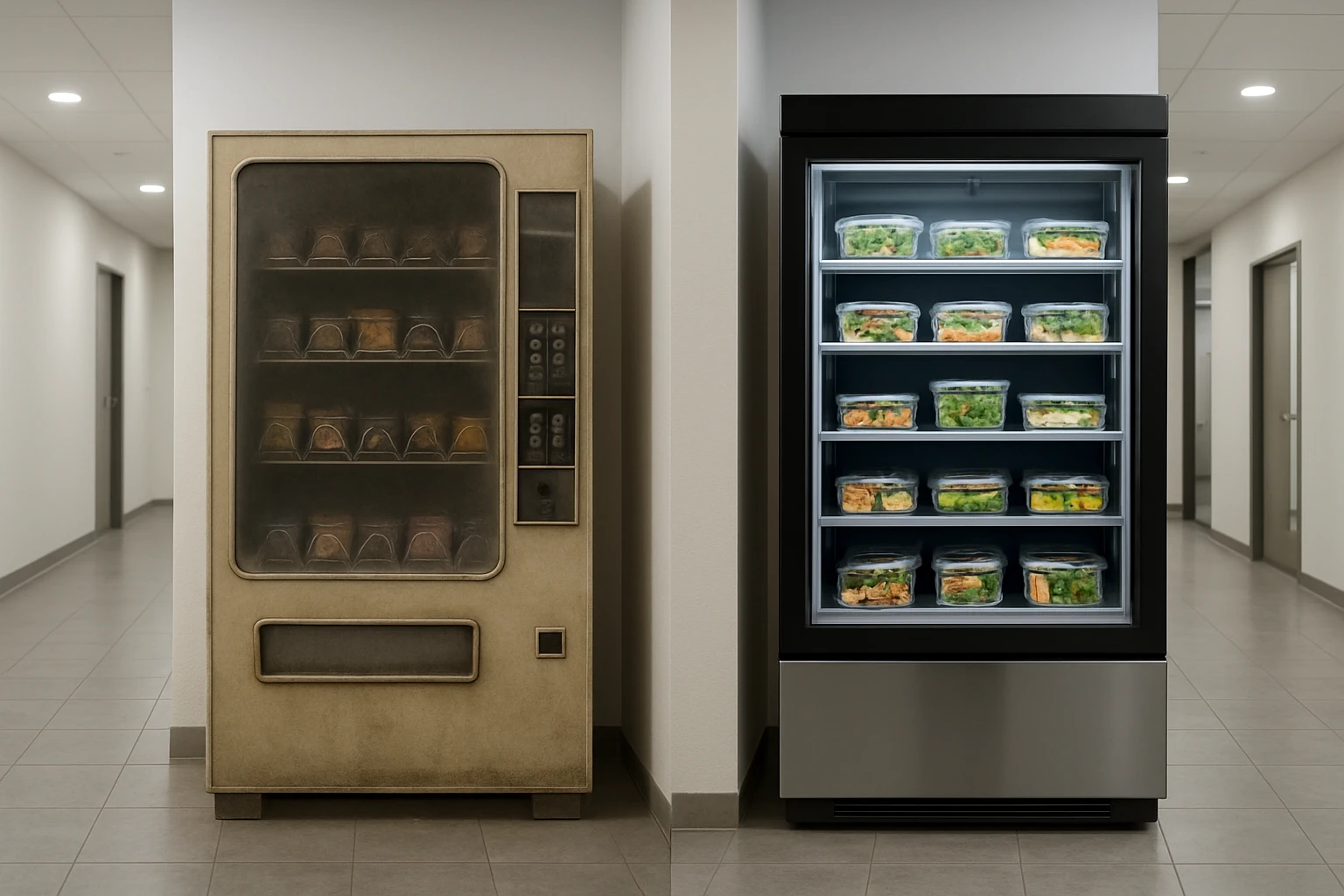
If your team works odd hours, covers multiple shifts, or is based in a Southern California industrial park where the nearest restaurant is a five-minute drive and a 30-minute break, this comparison is for you. Vending machines are the default because they are familiar and low-cost to install. Smart fridges are increasingly the replacement because the default is failing workers. Here is what actually separates the two, and how to decide which one belongs in your break room.
A vending machine is a dispense mechanism filled with shelf-stable or lightly refrigerated packaged goods, chips, candy, protein bars, sandwiches that survive ambient temperature swings, and canned or bottled drinks. The food inside is primarily engineered for shelf life, not nutrition. The machine earns revenue on volume and margins are built around processed ingredients. Restocking is handled by a regional route driver on a schedule that may or may not match your team's consumption pace.
A workplace smart fridge is a full refrigerator stocked with fresh, chef-prepared meals, real food cooked in a commissary kitchen and delivered on a regular schedule. Employees tap a card or badge to access the fridge, grab a meal, and pay at the point of grab. There are no spirals, no dispense failures, and no 90-second checkout lines. The food is typically rotated every 48 to 72 hours to maintain freshness. The stocking, delivery, and inventory management are handled entirely by the vendor.
Vending machines are a nutritional dead end for workers doing physical or cognitively demanding jobs. Research on night-shift diet quality consistently finds that when fresh food access is absent, workers default to high-sugar, high-sodium packaged options, which produce a blood-sugar spike followed by a hard crash, exactly the wrong fuel pattern for a warehouse picker, a healthcare aide, or a manufacturing line operator pushing through a 10-hour shift (MDPI Nutrients, Shift Work and Dietary Choices, 2024).
A smart fridge solves that directly. Fresh proteins, vegetables, complex carbohydrates, and varied entrees replace chips and candy as the on-site default. For Inland Empire employers whose workforce skews toward physically demanding roles, warehouses in Ontario and Fontana, manufacturing plants in Rancho Cucamonga, logistics centers in Moreno Valley, the difference in how workers feel and perform in the second half of a shift is real and measurable.
This is where smart fridges pull ahead most clearly. Vending machines are available around the clock, but the food inside them does not qualify as a meal for most people. After a 10-hour shift, a bag of trail mix is not what gets someone home safely.
A smart fridge is also always on, which makes it the right answer for any site running multiple shifts, nights, weekends, swing shifts, on-call rotations. Night-shift workers in Riverside, San Bernardino, or Anaheim have the same access to real food as the day crew. That matters for morale, for equity, and for retention. Our guide to feeding a 24/7 workforce goes into detail on how this plays out in practice across different types of sites.
Vending machines are placed for free under a revenue-sharing arrangement. The vending company owns the revenue; you get the machine and the electricity bill. Restocking happens on the vendor's schedule, not yours, which means a machine that ran out of everything popular by Tuesday might not be refilled until Friday. Your facilities team fields complaints but has no control over the stocking or menu.
A smart fridge placement under a managed program like MHP works differently. We own the stocking schedule, the menu rotation, and the restocking frequency. Your team has one point of contact and one invoice. Installation typically takes less than a day and requires a standard electrical outlet and about two square feet of floor space. There is no long-term contract required to start, which means you can pilot a fridge for a quarter and evaluate on real participation data before committing.
Vending machines are free to install and generate a small revenue share, which is part of their appeal. But that free placement comes with a food-quality ceiling. The economics only work for the vendor if the food has a long shelf life and high margin, which is a description of processed snacks, not fresh meals.
Smart fridge pricing is transparent per meal. Employers can choose to fully subsidize the cost (employees eat for free), partially subsidize (employees pay a reduced rate), or run it on a full employee-pay basis. The per-meal cost is typically in the same range as a fast-food combo, and for a workforce in Ontario or Fontana that is otherwise buying a $12 to $14 burger on a 30-minute break, the comparison is favorable. Many employers fold the cost into their employee wellness or total-rewards budget, see our piece on meal benefits and retention for the ROI framing.
A standard snack vending machine is roughly 72 inches tall by 38 inches wide, plus a service clearance. A drink machine adds a similar footprint. Together they typically occupy 12 to 20 square feet of break-room wall space. A smart fridge is a single commercial refrigerator, similar dimensions to a large residential unit and requires one outlet. It has a smaller footprint than a two-machine vending setup and a much smaller footprint than a micro-market.
A smart fridge is not the right answer for every situation. If your team is 200 or more people eating a hot meal during a set lunch window, our Daily Drop-Off Lunch Buffet is a better fit. It delivers hot, served food at scale and covers the full team in one window. The smart fridge shines for mixed shifts, smaller on-site populations (30 to 150 daily users), satellite locations, or any site where the buffet model does not fit the schedule. The comparison guide at choosing the right on-site food program covers when to use each format.
| Factor | Vending Machine | Smart Fridge (MHP) |
|---|---|---|
| Food quality | Shelf-stable snacks and packaged items | Fresh, chef-prepared meals rotated every 48–72 hours |
| 24/7 access | Yes, but for snacks only | Yes, for real meals |
| Dietary variety | Limited; typically no fresh, allergen-labeled, or culturally varied options | Rotating menu with proteins, vegetables, and dietary labels |
| Installation cost | Free (revenue share) | Placed under program agreement; no long-term contract |
| Employer control | Little, vendor owns the menu and schedule | One contact, one invoice, customizable program |
| Space | Large (typically 2 machines) | Single refrigerator footprint |
If your break room currently has a vending machine and workers are routinely leaving site to buy food, or if your night and weekend crew has nothing real to eat, the smart fridge is a direct upgrade. If your team is 20 people in a small administrative office and a mix of vending and a well-stocked pantry is genuinely working, you may not need to change. But if "working" means workers are skipping meals or driving to fast food on a 30-minute break, that is the signal that vending alone is not enough.
MHP is based in Rancho Cucamonga and serves employers across the Inland Empire, Orange County, Los Angeles, and Temecula Valley. If you want to see whether a smart fridge makes sense for your site, book a short call and we will walk through your shift pattern and headcount with you. No pressure, and no long-term commitment to start.
A vending machine dispenses shelf-stable or lightly refrigerated packaged snacks via a coin or card mechanism. A workplace smart fridge is a full refrigerator stocked with fresh, chef-prepared meals that employees access via tap-to-pay or badge, with no dispense mechanism, no spirals, and food cooked within the past 48 hours.
The cost structure is different. Vending machines are typically placed for free under a revenue-sharing model, but the employer sees no food-quality benefit. A smart fridge involves a placement and stocking agreement, MHP handles delivery and stocking with no long-term contract required and the per-meal cost is transparent. Many employers fully or partially subsidize the price as a benefit.
Yes. That is one of the primary use cases. The fridge is stocked and accessible 24/7, so night-shift and weekend workers get the same fresh-meal access as day-shift workers, which is exactly the gap vending machines leave open.
Warehouses, distribution centers, healthcare facilities, auto dealerships, and any site with mixed or off-hours shifts are strong fits in Southern California. Office buildings with under 100 on-site employees daily also benefit, especially in office-park locations where walk-up food is limited.
Yes. MHP is based in Rancho Cucamonga and delivers across the Inland Empire, including Ontario, Fontana, Riverside, San Bernardino, and Moreno Valley, as well as Orange County and greater Los Angeles.