Smart Fridge
Smart fridge vs. micro-market: which is right for your site?
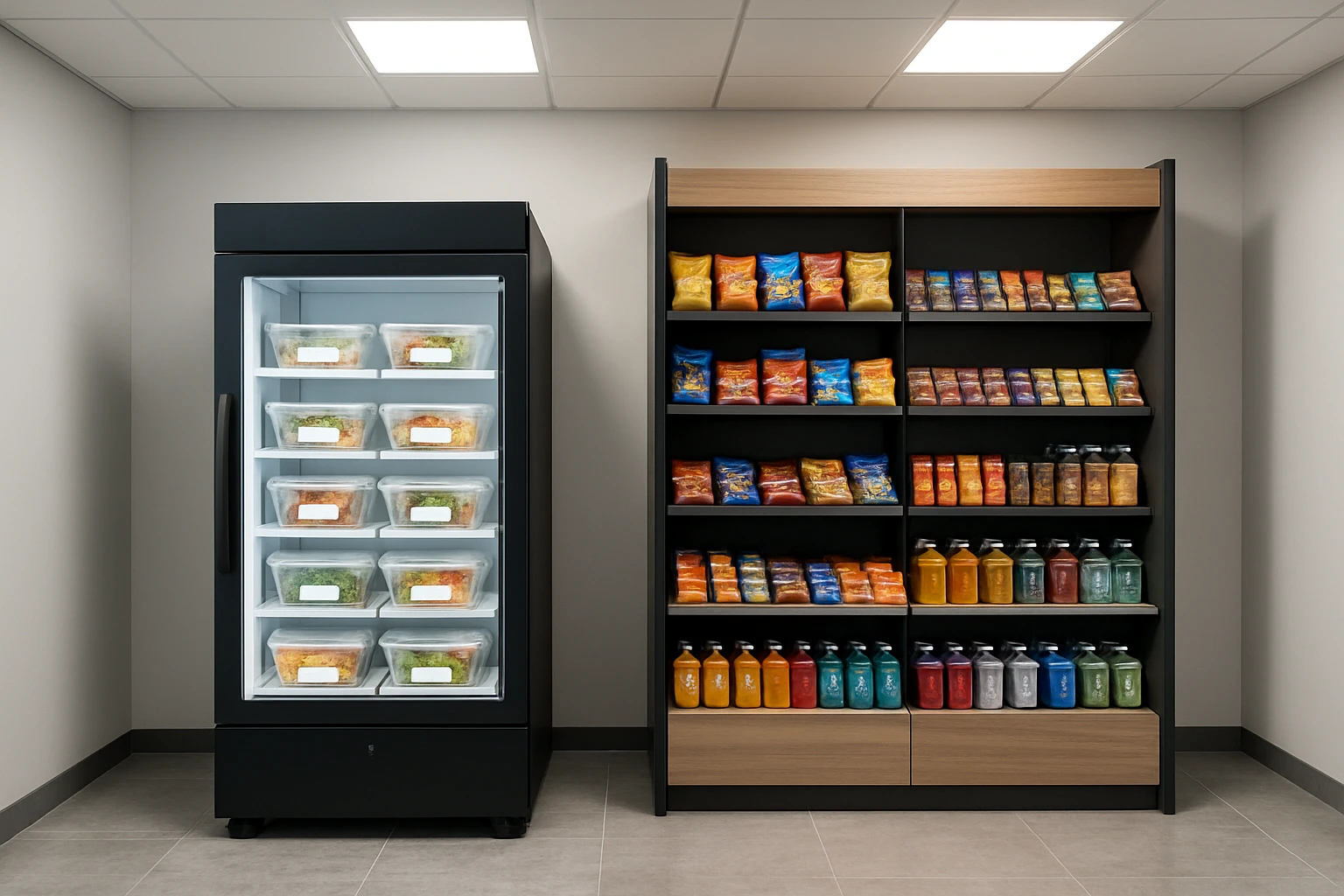
If you are looking at on-site food options for your Southern California workplace, two formats come up most often: the smart fridge and the micro-market. On the surface they look similar, both sit in your break room, both let employees grab something without leaving the building, and both are managed by an outside vendor. But they solve very different problems, stock very different food, and have very different implications for your workforce's health and energy. Choosing the wrong one is a common mistake, and it usually becomes obvious six months in when participation drops or employees are still running out at lunch.
This guide breaks down exactly what each format is, how they differ where it matters, food quality, nutrition, cost, and health outcomes and how to decide which one fits your site.
A smart fridge is a locked refrigerated unit stocked with fresh, chef-prepared meals. At MHP, those meals are cooked in our Rancho Cucamonga kitchen and delivered to the fridge on a rotating schedule, typically proteins with sides, grain bowls, salads, and similar real-food items portioned for a single person. The fridge uses a tap-to-pay system: an employee taps a card, badge, or phone, the door unlocks, they take a meal, and the transaction is logged automatically. No app required, no ordering ahead, no waiting.
The defining characteristic of a smart fridge is the food itself. Every item was cooked recently by a professional kitchen, refrigerated, and labeled with ingredients and macros. A smart fridge is not a place to grab chips and a soda. It is a place to grab a grilled chicken and rice bowl or a turkey and vegetable plate at 11pm when no restaurant is open. The food is built around real nutrition: whole proteins, complex carbohydrates, vegetables, balanced macros.
A micro-market is essentially a small open-shelf convenience store installed in your break room. It typically includes refrigerated sections for drinks and some packaged foods, a snack rack with chips, candy, crackers, and protein bars, and sometimes a small selection of frozen items or sandwiches. Employees shop the open shelves, scan their items at a self-checkout kiosk, and pay. Because the shelves are open, the footprint is larger than a smart fridge, a typical micro-market takes up a 10-by-12-foot or larger section of break room space.
Micro-markets excel at variety and volume. They can stock hundreds of SKUs, including branded snacks that employees recognize. They appeal to employees who want a candy bar, an energy drink, or a bag of pretzels. Some micro-markets carry pre-made sandwiches or wraps from a commissary, but the nutritional profile of those items tends to be closer to convenience-store food than chef-prepared meals. The driving logic of a micro-market is convenience and impulse purchase. It is the office equivalent of a 7-Eleven.
This is where the two formats diverge most sharply, and where the stakes are higher than most employers realize.
A typical micro-market snack purchase, a bag of chips, a candy bar, a flavored drink, delivers a rapid spike in blood sugar followed by a steep drop. That drop is what most people experience as the afternoon slump: the fog, the difficulty concentrating, the irritability that sets in around 2 or 3pm. Research from institutions including the Harvard T.H. Chan School of Public Health consistently links high-glycemic, processed-food diets to reduced cognitive performance, shorter attention spans, and lower energy in the hours after eating. For workers who operate equipment, manage complex tasks, or need sustained focus, a micro-market snack lunch is not just nutritionally empty. It actively undermines their performance for the rest of the shift.
A smart fridge meal, by contrast, is built to sustain. A grilled protein over a complex carbohydrate base with vegetables provides several hours of stable blood glucose, which translates to sustained energy, better concentration, and lower injury risk. NIOSH research on occupational health consistently identifies nutrition as a significant variable in worker alertness and fatigue-related incident risk. Feeding a warehouse crew or a manufacturing line vending machine snacks is not neutral. It is actively choosing a worse health outcome for your team.
Beyond the immediate shift, regular access to real food reduces the frequency of missed meals, which is its own health risk. Workers who skip lunch because the only option is a snack rack often eat nothing, then overeat later, creating a pattern that compounds metabolic stress over time. A smart fridge with actual meals removes the barrier to eating well during a break.
Neither format requires you to buy the equipment outright in most managed programs, the vendor installs and owns the hardware and handles restocking. The cost structure differs in how value flows.
With a micro-market, the vendor makes money on product sales. Margins are built into the snack and drink prices, which employees pay directly. Employers may have the option to subsidize purchases partially or fully, but the baseline model is that employees buy snacks at a markup. Setup is free or low-cost to the employer, and the vendor profits on volume.
With a managed smart fridge like MHP's, the structure depends on the specific arrangement. Some employers fully subsidize meals as a benefit, the company absorbs the meal cost and employees eat free. Others run a hybrid where the employer subsidizes a portion and employees pay a reduced price. Others let employees pay the full meal price, in which case the employer's cost is essentially zero. Because smart fridge meals are real food rather than shelf-stable packaged goods, the per-item price is higher than a snack, typically $8 to $14 for a full meal. But employees are getting a full lunch, not a bag of chips.
When you think about the total picture, subsidizing real meals at a smart fridge is a meaningful but defensible benefit cost. The ROI case is made through reduced sick days, lower turnover (workers value real food benefits), and the productivity gains that come from a team that ate actual meals instead of vending machine snacks.
A smart fridge requires a standard 120V electrical outlet and roughly 2 to 4 square feet of floor space, depending on the unit size. That is it. Installation is typically completed in under two hours with no construction, no plumbing, and no permanent changes to the space. For worksites with limited break room square footage, which describes most Southern California warehouses and manufacturing plants. This matters.
A micro-market requires substantially more space because of the open shelving and checkout kiosk. You need 10 to 20 feet of wall space at a minimum for a standard installation, plus clearance for foot traffic around the display and kiosk. Some setups require a dedicated area more similar to a small room. There is more installation complexity and a longer setup window. For an already cramped break room, a micro-market may simply not fit.
A smart fridge is the better choice when your goal is worker health, sustained energy, and genuine nutrition access. It works best for sites where:
If your goal is supporting a corporate office where employees primarily want a quick mid-afternoon snack and already have lunch options nearby, a smart fridge may be more than what the situation calls for. But in most physical industry settings, the nutrition gap it fills is significant. See our Smart Fridge program page for the full picture of how MHP's fridge works.
A micro-market makes sense when the primary need is variety and convenience-store-style access. It fits well in office settings where employees are already eating lunch elsewhere and want a place to grab a snack, a drink, or a light item. It also works well when the employer has no interest in subsidizing food, the vendor handles everything, employees pay retail, and HR involvement is near zero.
If your workforce is primarily desk-based, shift patterns are standard daytime hours, and a hot buffet or delivery app covers lunch, a micro-market can layer in snack access without much complexity. The tradeoff is that it does nothing for the workers who actually need a real meal during their break.
Some larger worksites run both. A smart fridge in the main warehouse area serves the floor workers who need real meals on every shift, while a micro-market near the office wing serves the administrative staff who want grab-and-go snack access during the day. This is not common for smaller sites, but it comes up in facilities with 200 or more workers split across office and production areas. Our vending machine vs. smart fridge guide also covers the three-way comparison if you are evaluating traditional vending alongside these options.
A smart fridge and a micro-market are not the same thing with different branding. One is a fresh meal delivery mechanism that happens to live in a break room. The other is a convenience store. If your workers need real food to perform their jobs safely and sustainably and in most physical industries, they do, a smart fridge is not a luxury upgrade. It is the format that actually solves the problem. A micro-market stocks snacks for convenience; a smart fridge supports the health of the people doing the work.
If you are deciding between the two for a Southern California worksite, reach out to MHP and we will walk through your specific situation, shift pattern, headcount, space, and what the team actually needs to eat well.
A smart fridge is a locked refrigerated unit stocked with fresh chef-prepared meals, accessed via tap-to-pay. A micro-market is an open-shelf convenience store format with snacks, drinks, and packaged items at a self-checkout kiosk. The primary difference is food quality: smart fridges offer real meals; micro-markets offer convenience-store products.
A smart fridge is significantly healthier. Chef-prepared meals with whole proteins, complex carbohydrates, and vegetables support sustained energy and cognitive performance. Micro-market snacks, chips, candy, packaged goods, tend to cause blood sugar spikes and crashes that reduce afternoon performance and increase fatigue-related risk.
A smart fridge needs roughly 2 to 4 square feet and a standard outlet. A micro-market typically requires 10 to 20 or more linear feet of wall space plus kiosk clearance. For smaller break rooms, a smart fridge is the only practical option.
Yes. MHP's smart fridge program supports full employer subsidy (employees eat free), partial subsidy (reduced price), or full employee pay. Subsidized meals function as a genuine food benefit that shows up in engagement and retention surveys. Many SoCal employers treat it as a comparable benefit to the tech-company meal perks they compete against for talent.
MHP specializes in smart fridges stocked with fresh chef-prepared meals, not micro-market installations. Our focus is on real food nutrition for the worksite, the kind of program that actually changes what workers eat and how they feel on shift. If you are looking for snack convenience only, a micro-market vendor may be a better fit; if you want to genuinely feed your team, we should talk.
Tell us about your team and we will recommend the right program and a worksite-specific quote. No high-pressure sales.