Smart Fridge
How smart fridges are changing workplace food in Los Angeles
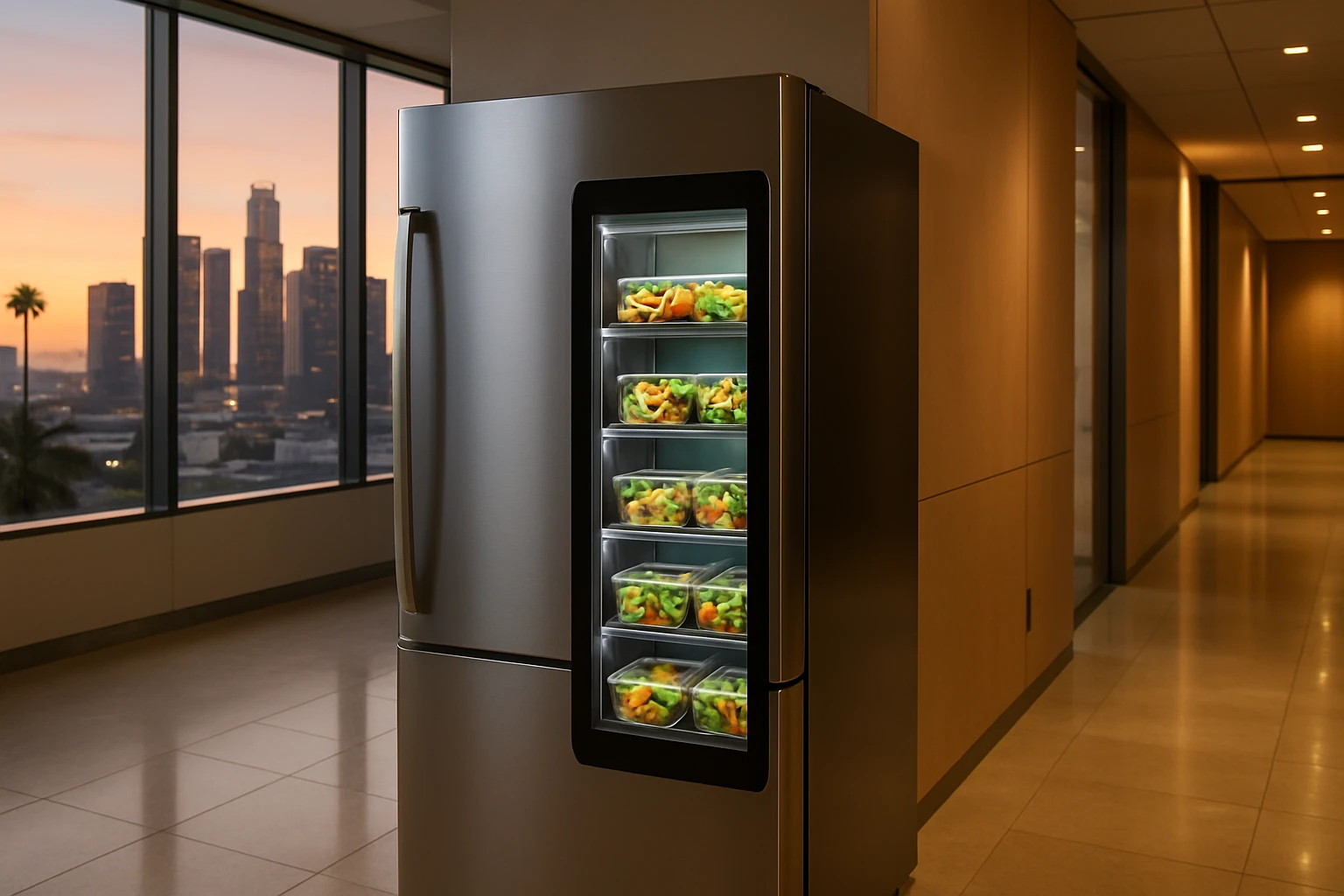
Los Angeles is a city with a complicated relationship with food. It is home to some of the best restaurants in the country, a wellness culture that takes nutrition seriously, and a workforce that holds strong opinions about what they eat. It is also a city where the typical office lunch experience involves a 30-minute drive to find parking, a 20-minute wait for a meal, and a rushed 10 minutes to eat before getting back to the desk. Or it involves a delivery app that estimated 25 minutes and arrived in 55.
LA employers are figuring out that the traditional model of "employees figure out lunch on their own" does not work in a city where leaving the building for food is a logistical event. The smart fridge is part of a broader shift happening across the Los Angeles market, from reliance on restaurants and delivery apps to always-on, on-site food access that works regardless of traffic, delivery windows, or whether it happens to be noon or 6pm.
Los Angeles is one of the most diverse employment markets in the United States. The industries driving office and commercial employment span entertainment and media (Hollywood, Burbank, Culver City), technology and startups (Silicon Beach, Playa Vista, Santa Monica), aerospace and defense (El Segundo, Torrance, Hawthorne), healthcare (UCLA, Cedars-Sinai, USC, Kaiser), logistics (Long Beach, Compton, Vernon), and financial and professional services (Downtown LA, Century City, Glendale).
Each of these sub-markets has its own workplace culture and its own food access challenges. The Culver City tech office in a converted industrial building may have no café on-site and a lunch block that nobody schedules around because half the team is in different time zones. The El Segundo aerospace facility has a cafeteria, but it serves the day shift, the engineers running tests in the evening have vending as their only option. The Glendale media production company has a constant stream of staff at all hours and no predictable lunch window at all.
The smart fridge addresses the food access challenge across all of these contexts because it does not depend on a scheduled service window or a predictable headcount at noon. It is stocked and available from before the first employee arrives to after the last one leaves and if the facility runs 24 hours, that means 24-hour access.
For much of the past decade, the premium workplace food benefit in Los Angeles was a catered lunch. Tech companies, media companies, and professional services firms built their food culture around a communal midday meal, often served family-style, often expensive, and often genuinely good. That model worked when everyone was in the office on a predictable schedule with a shared lunch hour.
The hybrid work era disrupted that model in a specific way: if a company has 60 people in the office on Tuesday and 20 on Wednesday, a catered lunch on Wednesday either wastes money or requires advance coordination to scale down. The catering model demands predictability that hybrid work does not provide.
The smart fridge is the right food infrastructure for a hybrid office because it scales automatically. When 20 people are in, the fridge serves 20. When 60 are in, MHP has already adjusted the restock schedule to match. The employer pays for what gets consumed, not for what was ordered. For LA companies managing unpredictable in-office attendance, this is not a small operational detail. It is a fundamental advantage over any headcount-dependent food model.
MHP serves employers across the Greater Los Angeles area, with growing concentration in the following neighborhoods and corridors:
Downtown LA. High-rise offices, law firms, financial services, government agencies, and creative companies are all represented. Downtown workers face the challenge of being surrounded by food options that are expensive, crowded at noon, and require elevator rides and street crossing to access. A smart fridge in the building, floor 22, break room adjacent to the conference suite, is faster than walking to the lobby and back.
El Segundo and Torrance. The South Bay aerospace and defense corridor has large facilities with varied shift structures and employees who work through traditional lunch windows. El Segundo in particular has a dense concentration of aerospace, tech, and media companies that run lean on food infrastructure relative to the size of their teams. We wrote about this in our post on office lunch in Torrance and El Segundo.
Culver City and Playa Vista. The LA tech and media cluster, Amazon Studios, Apple TV, Google, Snapchat, TikTok, sets a high baseline expectation for workplace amenities. Smart fridges fit naturally into these environments as a complement to existing food infrastructure or as the primary food benefit for smaller tenants in the tech campuses.
Burbank and Glendale. Entertainment production, animation studios, and broadcast media. Irregular hours, long production days, and crews with no consistent lunch window make the always-on smart fridge ideal.
Long Beach. Port logistics, healthcare (Long Beach Memorial, St. Mary), and corporate offices running along the 405 corridor. Mixed shift operations that benefit from 24/7 access.
Los Angeles has a food culture that is specific and real. LA workers are not looking for a vending machine upgrade. They want food that reflects the city's culinary identity, fresh, ingredient-forward, diverse in protein and grain options, and recognizably good rather than institutional.
MHP's menu for LA sites reflects this: grain bowls with California-grown ingredients, protein wraps with clean builds, roasted vegetable and protein combinations, fresh salads with substantial toppings, and seasonal rotations that track with what is actually good and fresh rather than what is cheapest to procure. The menu is the same menu that MHP cooks out of its Rancho Cucamonga kitchen for clients across Southern California, developed with the understanding that workers who care about what they eat will not use a food program that does not meet their standard.
Dietary variety is equally important in an LA context. A team of 30 at a Culver City tech company will include vegetarians, people eating halal, people tracking macros, and people with various allergen considerations. MHP's menu rotation includes options across these requirements with full labeling, so workers with different dietary needs can all find something they can eat without having to flag their situation to HR or navigate an unlabeled grab-and-go cooler.
Los Angeles has a stronger wellness culture than almost any other American city. Employers in the LA market are expected to take employee health seriously. It is part of the implicit contract with the talent they are trying to attract. A smart fridge stocked with fresh, California-cuisine meals from a company focused on real food and clean ingredients is not just a convenience. It is a brand signal.
When an LA employer installs a smart fridge, it says something about the company's values that a vending machine does not. The food is real. It was made by people who care about nutrition and flavor. It matches the identity of a company that takes wellness seriously. For a media company in Culver City or a health tech company in Playa Vista, that signal matters, both to the employees who experience it daily and to candidates who tour the office during recruiting.
See our Smart Fridge program page for the full program overview. Our corporate offices industry page covers the office market in detail. Our post on workplace food programs in Los Angeles covers the broader landscape, and our South Bay office lunch post addresses the Torrance and El Segundo corridor in detail.
MHP serves employers across Greater Los Angeles, including Downtown LA, the Westside (Culver City, Playa Vista, Santa Monica), the South Bay (El Segundo, Torrance, Hawthorne), the San Fernando Valley (Burbank, Glendale, Sherman Oaks), Long Beach, and the broader LA metro. If you are within our service area, we can discuss a program. Contact us with your location and we will confirm coverage and provide a quote.
The smart fridge is consumption-based, not headcount-based. MHP calibrates the restock schedule based on actual usage data from the unit. If your office has 30 people in on Tuesday and 10 on Thursday, the fridge reflects that over time, stocked heavier for high-attendance days, lighter restock on low-attendance days. You pay for what gets used, not for what was ordered to match a projected headcount.
MHP's menu is designed for the LA market: grain bowls, wraps, protein-forward salads, roasted vegetable and protein dishes, and seasonal options. The menu rotates regularly and includes vegetarian, protein-heavy, and various dietary options with full labeling. The food is made in MHP's Rancho Cucamonga kitchen with fresh ingredients, not frozen, not institutional. It is the kind of food LA workers actually want to eat.
A smart fridge is the food infrastructure component of a workplace wellness program. It addresses the most practical dimension of employee health, access to good food during the workday, without requiring enrollment, tracking, or employee behavior change. Workers eat from the fridge because it is convenient and the food is good. That daily touchpoint with real nutrition is more impactful than a wellness seminar or a step-counting app. It complements structured wellness programs by filling the nutrition access gap that those programs typically do not address.
Yes. Multi-location accounts are standard at MHP. An employer with offices in Downtown LA, Culver City, and Burbank can run smart fridges at all three locations under a single agreement with consolidated billing. Each location has its own restock schedule calibrated to its usage, and the account is managed through a single point of contact at MHP. This is common for growing LA companies with distributed office footprints.
Tell us about your team and we will recommend the right program and a worksite-specific quote. No high-pressure sales.