Guides
From food trucks to smart fridges: the evolution of on-site meals
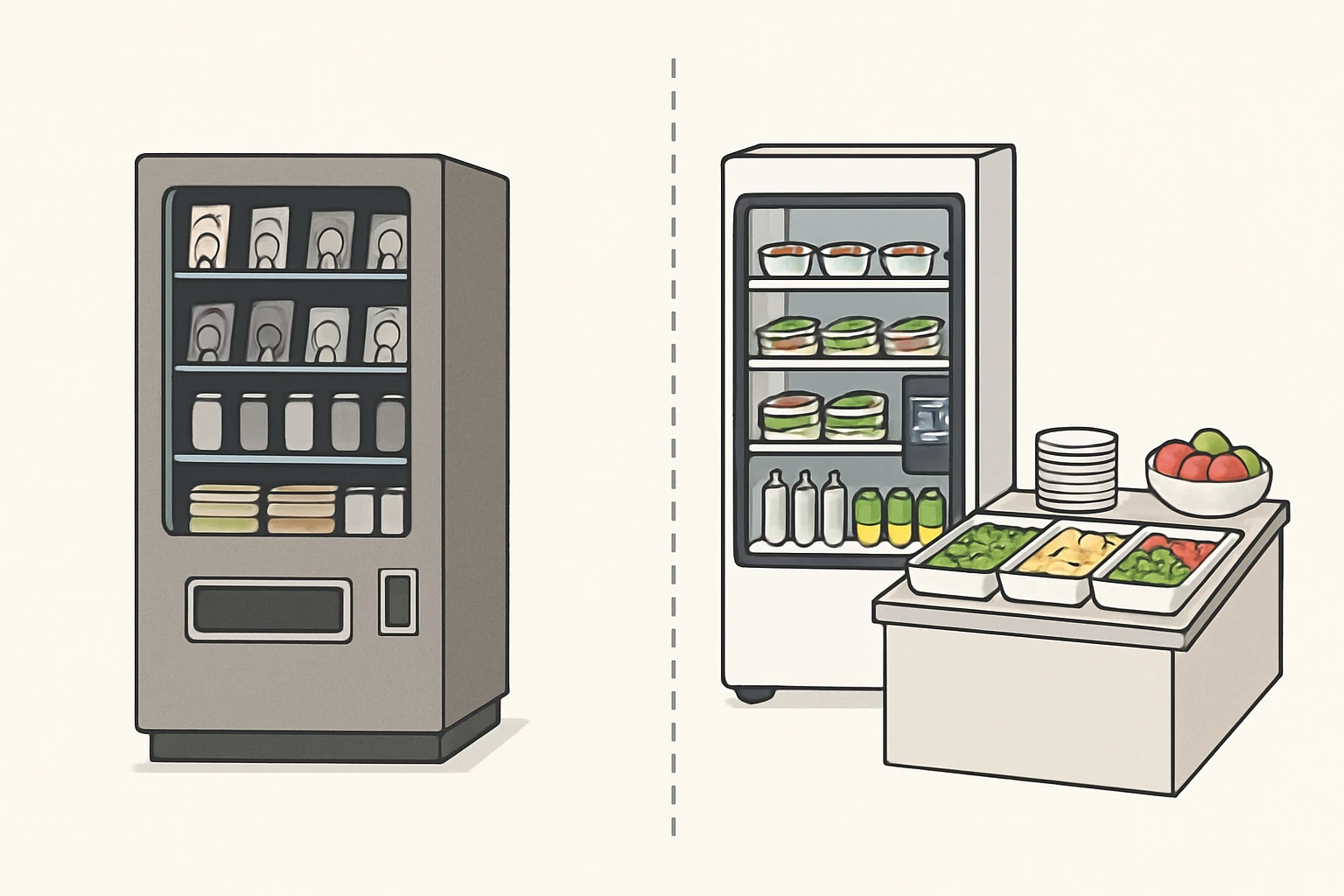
The way employers feed their workers on-site has changed more in the last decade than in the four before it. The shift is not just about technology, smart fridges versus vending machines. It is about what employers are trying to accomplish with food in the first place. This piece traces how on-site workplace meals evolved, what drove each change, and where the market is today for Southern California employers in the Inland Empire, Orange County, and Los Angeles.
For most of the 20th century, the two formats for on-site workplace food were the cafeteria and the vending machine. Cafeterias were built around the assumption that workers would gather for a mid-shift meal at a predictable time, the factory lunch break, the hospital shift change, the corporate lunch hour. They required permanent space, kitchen equipment, cafeteria staff, and a food service contract with a provider like Sodexo, Aramark, or AVI. They also required enough daily traffic, typically 500 or more workers per day, to justify the overhead.
Vending machines filled the gap for smaller sites and off-hours. They did not require staff, worked around the clock, and had low maintenance overhead. But their ceiling was always low: shelf-stable snacks and processed meals that employees ate because there was nothing else, not because the food was good.
Through the 2000s and into the early 2010s, food trucks emerged as a novelty option for office parks and corporate campuses. The appeal was obvious: variety, rotation, and real food from real kitchens. Some large tech campuses in the Bay Area and LA built entire food truck programs as part of their benefits story.
The problems became apparent quickly. Food trucks require significant outdoor space and good weather, a constraint that matters in the Inland Empire, where summer heat regularly hits 100°F. They run on their own schedule, which means if the truck does not show up, no one eats. Menu quality varies by vendor and by day. And for employers whose workforce is not concentrated at noon on a Tuesday, warehouses running three shifts, healthcare facilities with staggered break windows, auto dealerships where the service drive does not stop for lunch, the format was never a real solution.
The 2020 pandemic created an unusual moment for workplace food. With offices mostly closed or at reduced capacity, the corporate cafeteria and buffet model collapsed virtually overnight. What replaced it for many employers was a delivery-app stipend: give employees a Grubhub, DoorDash, or UberEats credit and let them order individually. The approach worked acceptably when most people were remote and ordering for home delivery. It started breaking down as people returned to offices.
The problems with delivery apps for on-site teams are well-documented. Platform fees, markups, and tips routinely push a $13 meal to $24 or more delivered. Third-party delivery fees can reach 30–40% of order value. When 80 people order from the same building between 11:45 and 12:15, the delivery window becomes unpredictable, the lobby fills with drivers, and a significant share of orders arrive cold or wrong. Finance teams looking at monthly food spend started asking whether a managed program would be both cheaper and better.
The managed drop-off buffet is, in effect, a modernized cafeteria without the cafeteria. A vendor cooks fresh food, delivers it in chafing pans to the worksite, sets up the buffet in about ten minutes, and breaks it down after service. The employer gets a shared, hot meal experience with none of the capital cost, kitchen infrastructure, or staffing overhead of a traditional cafeteria. For teams of 80 to 400, the range that is too large for individual delivery but too small for a full-on cafeteria build-out. This is the natural fit. The Drop-and-Go Lunch Buffet page covers how this program works.
MHP Food Service has operated this model out of our Rancho Cucamonga kitchen since 2015. What changed around 2022 and 2023 was the demand signal: employers who had limped through on delivery app stipends started looking for the managed alternative when the cost math became undeniable.
The single biggest limitation of the managed buffet is timing: it requires a predictable lunch window and a team that is largely on-site at the same time. For Inland Empire warehouses running first, second, and third shifts, operations in Ontario, Fontana, Rialto, and Moreno Valley where thousands of workers are on-site around the clock, a noon buffet misses most of the workforce. Vending machines were the default answer for off-hours workers. Smart fridges are the upgrade.
A smart fridge is a tap-to-pay, stocked-and-managed fridge of fresh chef-prepared meals available whenever a break happens. The technology is not new, the refrigeration is conventional, and the tap-to-pay hardware has been in retail for years. But the managed service model around it is the breakthrough. The fridge is installed, stocked on a regular schedule, and maintained entirely by the vendor. The employer does not manage inventory, restocking, or equipment. For employers with mixed or non-standard shifts, the smart fridge is the most complete solution available today. Our guide to feeding a 24/7 workforce goes deep on this use case, and the Smart Fridge page covers installation and stocking.
The third format that has gained ground is weekly meal delivery, pre-portioned, chef-prepared meals delivered once or twice a week to a team's refrigerator. This format solves the problem that neither a buffet nor a fridge fully addresses: the small team or satellite office. A 30-person office in Pasadena that does not justify a daily buffet and does not have space for a fridge can still run a credible food benefit with weekly drop-off. The meals are portioned individually, refrigerated, and ready to grab whenever someone wants them. The Weekly Meals page covers the details.
In 2026, the workplace food market in Southern California has largely sorted into three use cases, each served by a different format:
The cafeteria has not disappeared, but it has retreated to the largest sites where the economics work. Vending machines persist but are increasingly seen as a baseline, not a benefit. Delivery app stipends are contracting as employers run the cost comparison. And food trucks remain useful for events but have not proven out as a reliable recurring benefit.
If you are evaluating which format fits your team, the program comparison guide is the most practical starting point. If you want to talk through your specific situation, book a call and we will help you choose the right format based on your headcount, shifts, and location.
The shift has been from fixed-hour cafeterias and vending banks toward flexible, managed formats: hot buffet drop-off for large teams, smart fridges for 24/7 access, and weekly meal delivery for smaller or satellite offices. Delivery apps rose through the pandemic years and are now partly retreating as managed programs prove more cost-effective.
Food trucks are inconsistent in scheduling, menu, and quality. They require outdoor space and good weather. For a recurring employee food benefit, unpredictability is a dealbreaker, employees who cannot count on food being there stop counting on it.
A managed workplace food program is a recurring, fully handled food service where the vendor manages sourcing, cooking, delivery, setup, and cleanup. The employer sets a schedule and budget; the vendor handles everything else.
Only at very large sites. Self-operated cafeterias typically require 500 or more daily traffic to pencil out financially. For most IE, OC, and LA employers in the 50–400 range, a managed drop-off or smart fridge is a better fit.
The managed hot buffet drop-off has become the practical cafeteria replacement for teams of 80–400. It delivers the same shared meal experience without the capital cost, cafeteria staff, or fixed infrastructure.
Tell us about your team and we will recommend the right program and a worksite-specific quote. No high-pressure sales.