Smart Fridge
Smart fridge for Corona and Eastvale logistics parks
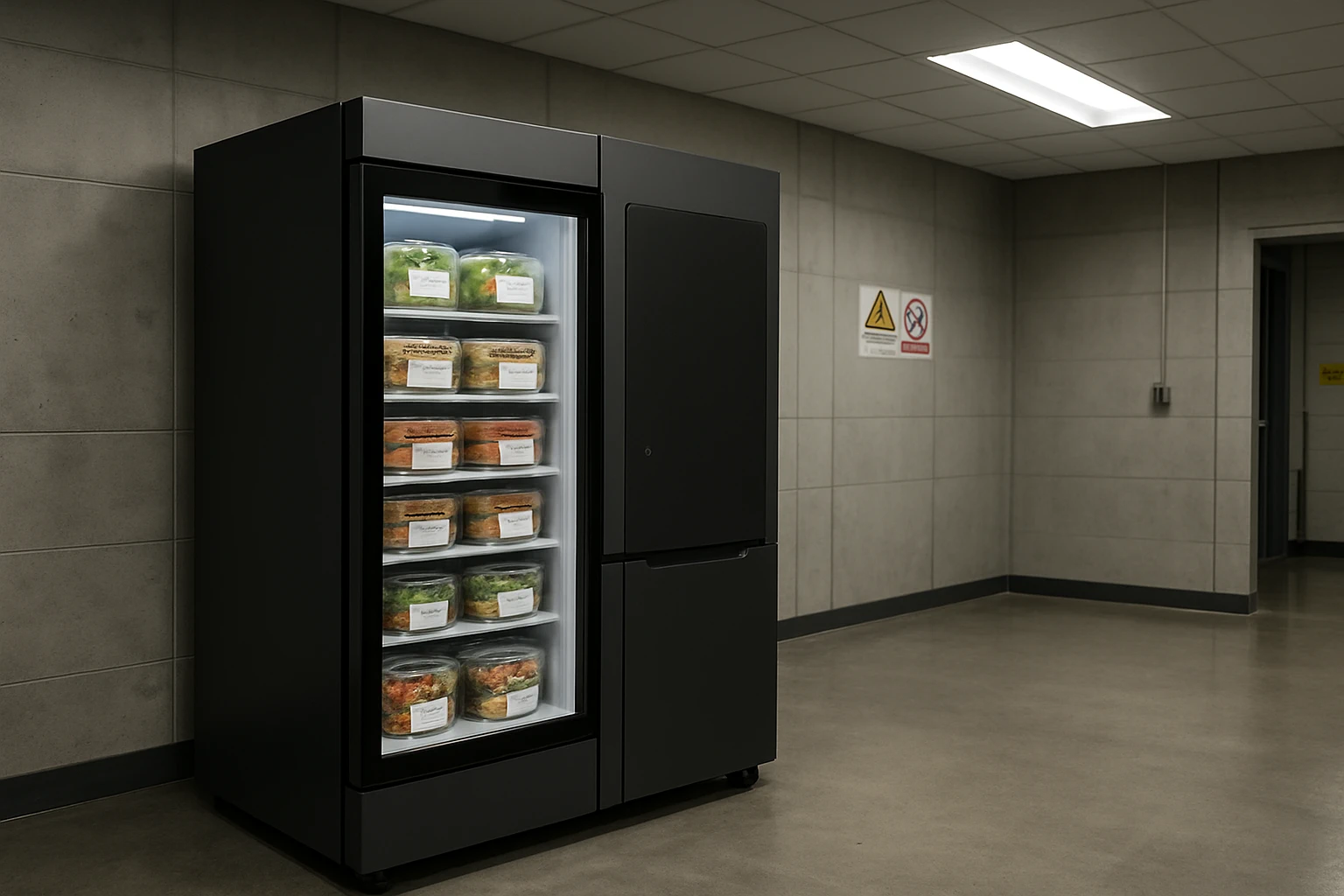
The stretch of freeway where the 15 and 91 intersect in western Riverside County is one of the most economically consequential pieces of asphalt in Southern California. Corona and Eastvale sit at and around that junction, and over the past decade they have become two of the most active logistics nodes in the entire Inland Empire. Industrial parks line Hamner Avenue, Limonite, and the warehousing corridors running east and west from the freeway interchange. Distribution centers, Amazon fulfillment hubs, regional cold-chain operations, and third-party logistics providers have built out millions of square feet of floor space here, and the workforce that fills those buildings runs 24 hours a day, seven days a week.
Feeding that workforce is a harder problem than it looks from the outside.
Corona is one of the fastest-growing industrial cities in the Inland Empire. Its proximity to Orange County, the 91 connects directly to Anaheim and beyond, makes it attractive for companies that need to reach both the IE and the OC market efficiently. The result is a dense logistics footprint: large distribution centers servicing consumer goods, e-commerce fulfillment operations, medical supply chains, and food distribution all operate here within a few miles of each other.
Eastvale, which incorporated as a city in 2010, has followed a similar path on its eastern side. The Hamner Avenue corridor and the areas around the intersection of the 15 and 60 freeways have attracted significant industrial development. Eastvale's workforce in logistics and manufacturing is substantial and growing, with major employers operating shifts around the clock.
What both cities share, beyond their logistics identity, is a food access challenge that is characteristic of fast-growing industrial corridors everywhere. The restaurant and retail infrastructure has not kept pace with the industrial footprint. Workers on day shifts may find a fast food option within a few miles, but for anyone running a swing or overnight rotation, the picture looks very different. Restaurants are closed, delivery windows are unreliable or nonexistent at 2am, and the vending machines in the break room offer chips and candy, not the kind of nutrition a warehouse associate burning physical energy for eight hours actually needs.
Large-scale logistics facilities in Corona and Eastvale do not operate on a nine-to-five schedule. Amazon fulfillment centers, for example, run four primary shift types with staggered start times throughout the day and night. Regional distribution centers serving grocery chains often run overnight receiving and outbound shipping simultaneously to meet morning delivery windows. Third-party logistics operations that service multiple clients may have production schedules that change weekly depending on client volume.
The common thread is that some percentage of the workforce is always on site, and that workforce needs to eat. For day-shift workers, a 30-minute drive to a nearby restaurant may be an acceptable lunch option. For someone working a 6pm to 6am shift, that option does not exist. The restaurants are closed by midnight, delivery apps stop running reliably in industrial areas after 10pm, and the fastest food available is whatever is in the vending machine, which is typically not food in any meaningful nutritional sense.
This is where a smart fridge earns its place as a serious operational tool rather than just a nice-to-have amenity.
There is a direct, documented relationship between nutrition and performance in physically demanding jobs. Research published by the National Safety Council and the National Institute for Occupational Safety and Health has consistently shown that fatigue is a leading contributor to workplace accidents and that fatigue is accelerated by inadequate nutrition, dehydration, and irregular eating patterns.
Warehouse and logistics work is among the more physically demanding in the industrial sector. Forklift operators, pick-and-pack associates, loading dock workers, and inventory management staff are on their feet for the majority of their shifts. They are lifting, bending, operating machinery, and making judgment calls in fast-moving environments. A worker who has not eaten properly, who is running on vending machine crackers and a soda because there was nothing else available at 11pm, is not operating at full cognitive and physical capacity.
The implication for employers is not abstract. Fatigue-related errors in logistics include mis-picks that create downstream supply chain problems, forklift incidents, and loading dock injuries. The cost of a single serious workplace incident in terms of workers' compensation, OSHA reporting, operational disruption, and morale impact dwarfs the annual cost of a comprehensive on-site food program. Smart fridges stocked with real, protein-forward meals are not a perk. They are a safety infrastructure investment.
The logistics environment has specific requirements that distinguish it from a standard office deployment. Break schedules are staggered, workers rotate through the break room in waves throughout a 10-hour or 12-hour shift rather than all arriving at noon. This means a food solution needs to be self-service and available at any time, not a catered setup that requires a scheduled delivery window.
The smart fridge satisfies this requirement by design. It is stocked and available continuously. Workers access it during their scheduled break regardless of what time that break falls. The payment is handled through the unit itself, tap to pay, app-based, or company-subsidized, so there is no cash handling, no manual accounting, and no HR involvement in individual transactions.
The physical environment also matters. Large logistics facilities are typically not set up for catering operations. There is no commercial kitchen, no dining room, and no facility staff dedicated to food management. The smart fridge sits in the break room, plugs in, and operates independently. MHP handles restocking on a schedule calibrated to usage. The facility manager's only job is to make sure there is an outlet and enough floor space.
MHP's commissary kitchen is in Rancho Cucamonga, which puts it approximately 15 to 20 minutes north of the Corona and Eastvale logistics corridors depending on traffic. That proximity is not incidental. It is why MHP can service industrial clients in this part of the Inland Empire with the frequency that large warehouses require.
High-volume logistics facilities typically need restocking multiple times per week. A distribution center with 200 or more workers across multiple shifts will move through a full fridge in two to three days during peak periods. MHP's restocking routes are designed around actual consumption data from the smart fridge units, so restock frequency is not guesswork. It adjusts dynamically as usage increases during high-volume operational periods like peak e-commerce season.
The food itself is prepared fresh at the Rancho Cucamonga kitchen and transported in temperature-controlled conditions. Every item is labeled with full nutritional information, ingredients, and allergen callouts. This matters in a logistics workforce context because warehouse teams are typically diverse, with a range of dietary requirements, religious food observances, and health conditions that need to be accommodated. A smart fridge that provides real food with real labeling is a meaningful equity benefit. It serves the whole workforce, not just workers who happen to have the same dietary baseline.
Logistics employer turnover in the Inland Empire is one of the industry's persistent operational challenges. The competition for hourly warehouse workers in the Corona-Eastvale-Ontario corridor is intense, with multiple major employers offering similar base wages and comparable schedules. In that environment, secondary benefits, food programs, break room amenities, wellness investments, become differentiated recruiting and retention tools.
A smart fridge stocked with fresh, quality meals communicates something specific to a prospective employee doing a facility tour: this employer takes care of you. It is a tangible, visible signal that the company has invested in the daily experience of its workers beyond the paycheck. For workers who have experienced the alternative, a vending machine selling chips for $2 at midnight when there are no other options. It is not a small thing.
Employers in Corona and Eastvale who have implemented smart fridge programs report that workers mention the food benefit consistently in stay interviews and onboarding conversations. It is one of the amenities that workers actively notice and appreciate, which makes it a more durable retention tool than benefits that are invisible during the workday.
For more context on how the smart fridge program works from the ground up, see our Smart Fridge program page. Our warehouse and logistics industry page covers the sector in detail. We have also written about the 24/7 workforce food challenge specifically and about smart fridges for Ontario warehouse operators, which covers an adjacent market with similar dynamics.
Restock frequency is based on actual consumption data from the unit, not a fixed schedule. For a large distribution center with 150 or more workers across shifts, that typically means two to three restock visits per week during normal operations, with higher frequency during peak periods like Q4 e-commerce season. MHP monitors usage and adjusts the restock calendar without the employer needing to track inventory or place orders.
Yes. Employer subsidy is one of the most common configurations at logistics facilities. The employer covers a fixed amount per transaction, for example, the first $8 of each meal and the worker pays the remainder if the item costs more. This can be set up through MHP with billing going directly to the employer account. Some facilities provide fully subsidized access, particularly for overnight shift workers where food options are extremely limited.
The menu is designed with physical labor in mind: protein-forward meals with complex carbohydrates that provide sustained energy rather than a spike and crash. Typical options include chicken and rice bowls, beef and vegetable combinations, grain bowls with legumes, wraps, and fresh salads with substantial protein toppings. MHP avoids candy, chips, and sodas, the fridge is a wellness benefit, not a vending machine upgrade. The menu rotates weekly to maintain worker engagement over time.
A standard 120V outlet and approximately 24 square feet of floor space in the break room. The unit does not require plumbing, special ventilation beyond normal break room conditions, or any IT infrastructure beyond a standard WiFi connection for inventory monitoring. Installation is typically completed within a few hours on the delivery day. See our full smart fridge setup guide for everything to expect during installation.
Yes. The entire operational value of a smart fridge is that it serves every shift, not just the day crew. Workers arriving for a 10pm shift access the same stocked fridge as the morning crew. MHP calibrates restock timing so the fridge is freshly stocked before the highest-usage shifts, but access is continuous. There is no shift that goes without food access, that is the fundamental problem the smart fridge solves that no catering-based program can match.
Tell us about your team and we will recommend the right program and a worksite-specific quote. No high-pressure sales.