Blog › Workplace Lunch › School district staff lunch IE
Workplace Lunch
School district staff lunch programs in the Inland Empire
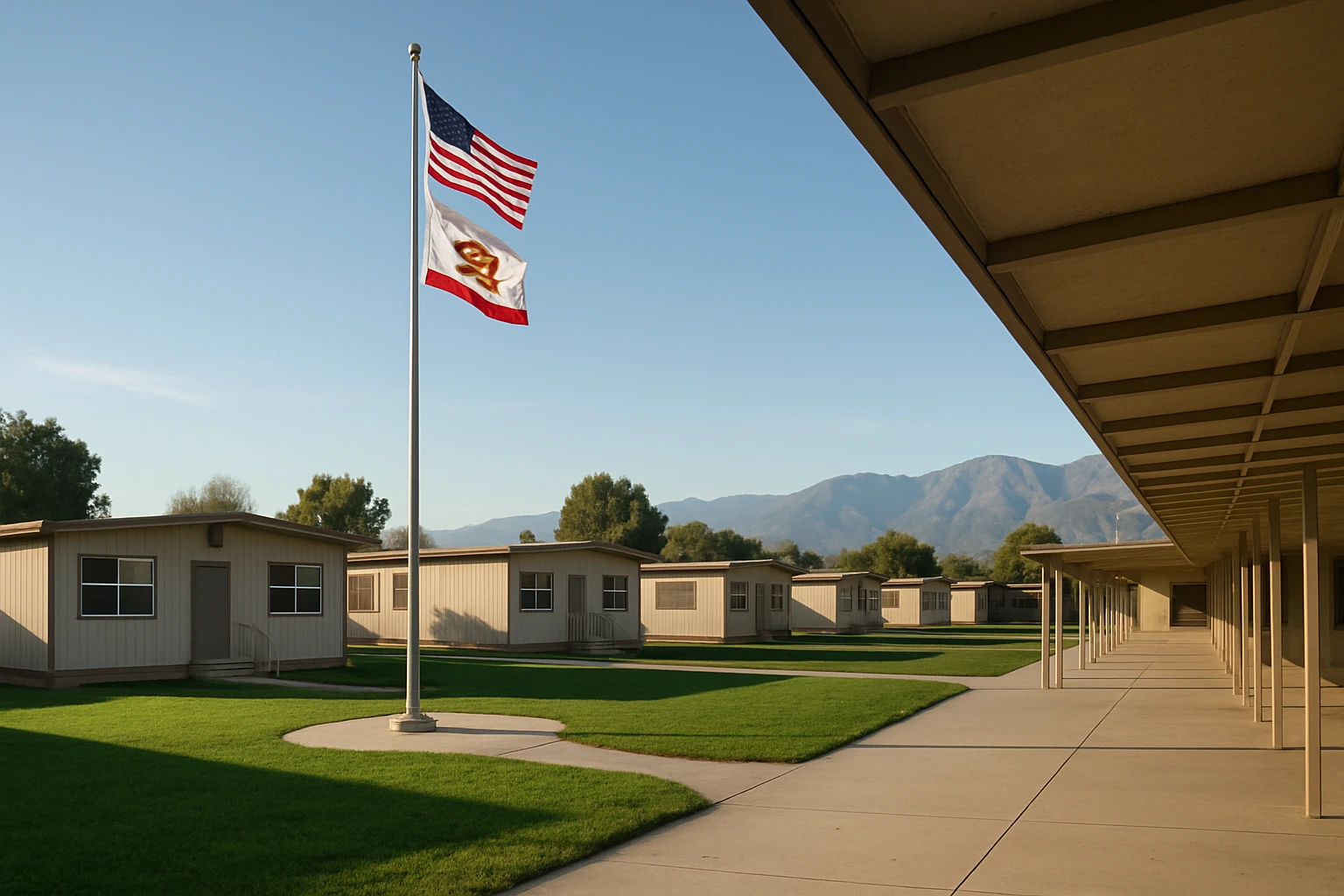
The Inland Empire's K-12 education sector employs tens of thousands of teachers, counselors, instructional aides, custodians, transportation staff, and administrative workers across dozens of districts in Riverside and San Bernardino counties. Riverside County alone has 36,000 or more educational employees across 23 school districts. San Bernardino County adds another 33 districts. Combined, the region's K-12 workforce is one of the largest and most dispersed employer populations in the IE and almost none of them have a real option for lunch during their 30-minute break.
This post is for HR directors, Chief Business Officers, Superintendents, and wellness program coordinators at Inland Empire school districts who are trying to do something practical about staff food access. We will cover why the break room vending machine is not a food program, what a realistic district staff lunch program looks like, which formats fit which campuses, and how to start without a large budget or a board-level vote.
California law gives K-12 teachers a 30-minute duty-free lunch, as near noon as reasonably possible. In theory, that is enough time to walk to a break room, eat something, and walk back. In practice, it is not enough time to leave campus, drive to a restaurant, eat, and return, which is the only way a teacher can access a real meal at most Inland Empire schools.
Many IE school campuses are in residential neighborhoods or light commercial areas where there is no fresh food within a 10-minute round-trip drive. Food deserts that affect students' home lives also affect the same teachers' lunch options. A teacher at a school in Fontana, Rialto, or Moreno Valley may have fast food as the only practical option within driving distance during a 30-minute break. Research by University of Newcastle educator Tammie Jakstas documented the pattern clearly: "I found that I would put so much energy into my lessons and my classes, and I would get to the end of the day and realise I forgot to eat lunch, you just get so stuck with everything."
The student cafeteria is not a real alternative for most teachers. The food is designed for children, the lines are not designed for adults, and eating lunch next to 300 students during the only 30 minutes of a teacher's day without supervision responsibility is not the "duty-free" break the law intends. Most teachers eat whatever they brought from home, if they remembered to pack something, or skip lunch entirely.
Classified staff face a harder version of the same problem. Custodians working a 2 PM to 10 PM shift arrive after the cafeteria closes and work through dinner with no campus food infrastructure. Food service workers spend their shift feeding students and often have no defined break for their own meal. Instructional aides working 3 to 4 hours may not legally trigger meal break requirements at all. The classified workforce is consistently the most underserved group in district wellness conversations and in food access conversations specifically.
Inland Empire school districts are competing for teachers and classified staff in a tight labor market. The Learning Policy Institute estimates that teacher turnover costs approximately $25,000 per departure in a large district. For a district of 3,000 employees at the national teacher turnover rate of 7 percent, that is roughly 210 departures per year at $25,000 each, over $5 million annually in replacement costs. Any credible staff wellness investment that makes even a small dent in that number pays for itself many times over.
The California Teachers Association has found that 40 percent of California educators are financially stretched thin and considering leaving the profession. Food is a tangible, visible benefit that signals to teachers and classified staff that the district takes their daily experience seriously, not just in the staff handbook but in what is actually in the break room. Districts that have a lunch program to talk about during recruiting conversations are differentiating meaningfully from districts that do not. San Bernardino City Unified has been working to address a significant teacher pipeline problem, with UC Riverside launching a paid residency program in May 2025 to help replenish the supply. In that environment, visible workplace benefits matter.
School campuses have distinct logistical characteristics that shape which food program format works best.
For an elementary or middle school with 30 to 80 certificated and classified staff, weekly pre-portioned meal delivery is the lightest and most practical format. Labeled meals arrive at the school break room twice a week. Staff grab a meal during their break period, no buffet line, no delivery window to coordinate with the bell schedule, no minimum headcount to fill. The program runs in the background without requiring the principal or office manager to manage it. This is the format described on the Weekly Meals page.
For a high school with 100 to 200 staff, a district administration building, or a community college support facility, a recurring hot buffet works well if there is a defined break window when most staff are off duty simultaneously. The food arrives before the break starts, is set up in chafing pans in the break room, and staff serve themselves. Coordinating delivery around the school bell schedule is straightforward, we build the delivery window around your schedule, not a fixed noon window. The Drop-and-Go Lunch program fits this use case.
For any campus with classified staff working afternoon, evening, or overnight shifts, custodians, security, after-school program staff, a smart fridge in the main break room provides access at any hour. It restocks on a regular schedule regardless of when individual staff breaks fall. The night custodian who arrives at 4 PM and works until midnight gets the same quality meal access as the day shift teachers. The Smart Fridge page covers what placement and stocking look like for a school setting.
Many school campuses benefit from a combination: weekly meal drop-off or a buffet for the day shift, and a fridge for the classified staff who work before school, after school, and into the evening.
The most common structure for IE school district accounts is employee-pays: staff purchase meals at the point of service, and the district's cost is essentially zero. The district provides break room space and sends an internal communication at launch. This structure avoids a formal procurement process in most cases because the district is not spending money. The benefit is the access itself, a fresh, real-food option that was not there before.
A subsidized structure, where the district contributes $2 to $5 per meal toward the cost, creates higher participation and is a stronger retention signal. This can be funded from the wellness budget, the professional development budget, or a benefits line, depending on how the district classifies it. Per-employee cost at a partial subsidy runs roughly $8 to $12 per person per meal. For a 100-person staff at two subsidized lunches per week, that is $1,600 to $2,400 per month, a small line item compared to the cost of replacing even one teacher.
Procurement in school districts requires attention but is not necessarily a barrier. Most California school districts have informal procurement thresholds (typically $10,000 to $25,000 per year) below which the CBO can approve a vendor directly without a formal Request for Proposals. A pilot at a single campus or for a single semester, scoped to stay below that threshold, is almost always possible without board action. The pilot produces usage data that makes the case for a formal, ongoing contract.
California school district employees are represented by CTA (certificated) and CSEA (classified), and adding a food program may involve a Meet-and-Confer process under the Educational Employment Relations Act. This is worth planning for but is not typically a barrier. CSEA, which represents the classified staff who are often the least-served group in district wellness conversations, is generally supportive of food access improvements. Framing a program as a benefit for all staff, including the custodians and aides who are rarely the first beneficiaries of district wellness initiatives, tends to generate union support rather than resistance.
The strongest starting points in the Inland Empire are large comprehensive high schools and district office campuses where a defined staff break window aligns with a buffet delivery, and where the headcount justifies the logistics. Secondary schools in Chaffey Joint Union, San Bernardino City Unified, Riverside Unified, Fontana Unified, and Moreno Valley Unified all have staff populations large enough for a buffet program. District administration buildings, where HR, finance, and operations staff work conventional business hours, are also strong candidates. Community college campuses at San Bernardino Valley College, Riverside City College, Norco College, and Chaffey College have significant non-student employee populations who are prime candidates for a weekly delivery or smart fridge program.
The fastest path to a district staff lunch program is a single-campus pilot: pick one high school or district office building, run a weekly meal drop-off or buffet for six to eight weeks, and let teachers and staff experience the program. Track participation and feedback. After two months, you will have enough data to justify expansion to additional campuses or a more formal district-level agreement.
Get in touch and we will come back with a program recommendation specific to your campus size and shift structure. You can also read more about how MHP serves schools and campus employers, or review the retention case for meal benefits if you need to build an internal argument for the investment.
Yes. The most common model has employees pay at the point of service, with the district contributing nothing beyond break room space and internal communication. A zero-subsidy program still dramatically improves access compared to vending machines or expecting staff to leave campus on a 30-minute break.
It depends on the scope and cost. Programs where staff pay directly and the district incurs no direct cost are often manageable within the business officer's discretionary authority. Subsidized programs may require board approval as a benefits addition. A short pilot scoped below the district's competitive bid threshold is often the cleanest starting point.
Pre-portioned, labeled meals are delivered to the school break room once or twice per week. Staff grab a meal from the refrigerator when their break allows. There is no buffet setup, no daily delivery window to coordinate, and no minimum headcount for the lighter weekly formats.
A smart fridge in the main break room serves staff at any hour, the day shift, the afternoon classified staff, and the custodial crew starting at 4 PM. It restocks on a set schedule regardless of when individual staff breaks fall.
In California, adding a food program may require Meet-and-Confer with the relevant bargaining unit under EERA (Educational Employment Relations Act). In practice, CSEA and CTA representatives are typically supportive of food access improvements, especially those that benefit classified staff who are often the last group considered in wellness conversations.
Tell us about your team and we will recommend the right program and a worksite-specific quote. No high-pressure sales.