Most growing companies get food service wrong in the same way. They either start too big, a full daily buffet for 40 people, most of whom aren't even in the office every day, or they wait too long, running on delivery apps and employee stipends until the team is 200 people and the problem is too visible to ignore. Neither extreme is good for your people or your budget.
The right approach is to treat your on-site food program like any other infrastructure investment: start with what fits your current state, build in the ability to scale, and let real participation data guide the upgrades. For Southern California employers growing from a small team toward the 300-person range, this guide walks through what that progression looks like and when each transition makes sense.
The 25–50 employee stage: start with weekly delivery
At this size, a daily hot buffet is almost always the wrong answer. The headcount is too small to justify the setup, the food cost per person is high at low volumes, and the coordination overhead is disproportionate to the benefit. The right starting point is weekly pre-portioned meal delivery.
Weekly delivery means chef-prepared individual meals, labeled, portioned, ready to refrigerate, arriving once or twice a week. Employees grab them throughout the week. There is no serving line, no daily coordination, and no chafing equipment. It fits a break room, a kitchen counter, or even a shared refrigerator.
For a 30-person Rancho Cucamonga tech company or a 45-person Corona logistics office, this is the format that reads as a genuine benefit, better than a delivery app stipend, far less overhead than a caterer and stays cost-effective below the 100-person threshold. See the Weekly Team Meal Delivery page for details.
The 50–100 employee stage: add a smart fridge or increase frequency
Once you are reliably at 50 or more on-site workers, two options become practical:
A smart fridge. A tap-to-pay fridge stocked with fresh meals covers employees around the clock, not just the ones who come in on your weekly delivery day. It is the right addition if your team has mixed schedules, extended hours, or a meaningful number of workers who miss the weekly delivery window. The fridge pairs well with weekly delivery: the delivery fills the fridge, and employees access it on their own schedule. Details are on the Smart Fridge page.
Increased delivery frequency. If your team is office-based and follows a predictable schedule, moving from once-a-week to two or three times a week increases freshness and participation. Most employees will use a meal benefit more often if the food is recent, not five days old.
At this stage, also think about dietary coverage. A team of 50 to 100 in Southern California will almost certainly include a mix of dietary needs: vegetarian, halal, low-carb, gluten-aware, high-protein. Menus that rotate weekly across five to eight items with clear dietary tags consistently outperform fixed menus on participation and satisfaction. Our guide to dietary-inclusive workplace menus covers this in detail.
The 100–200 employee stage: the daily buffet threshold
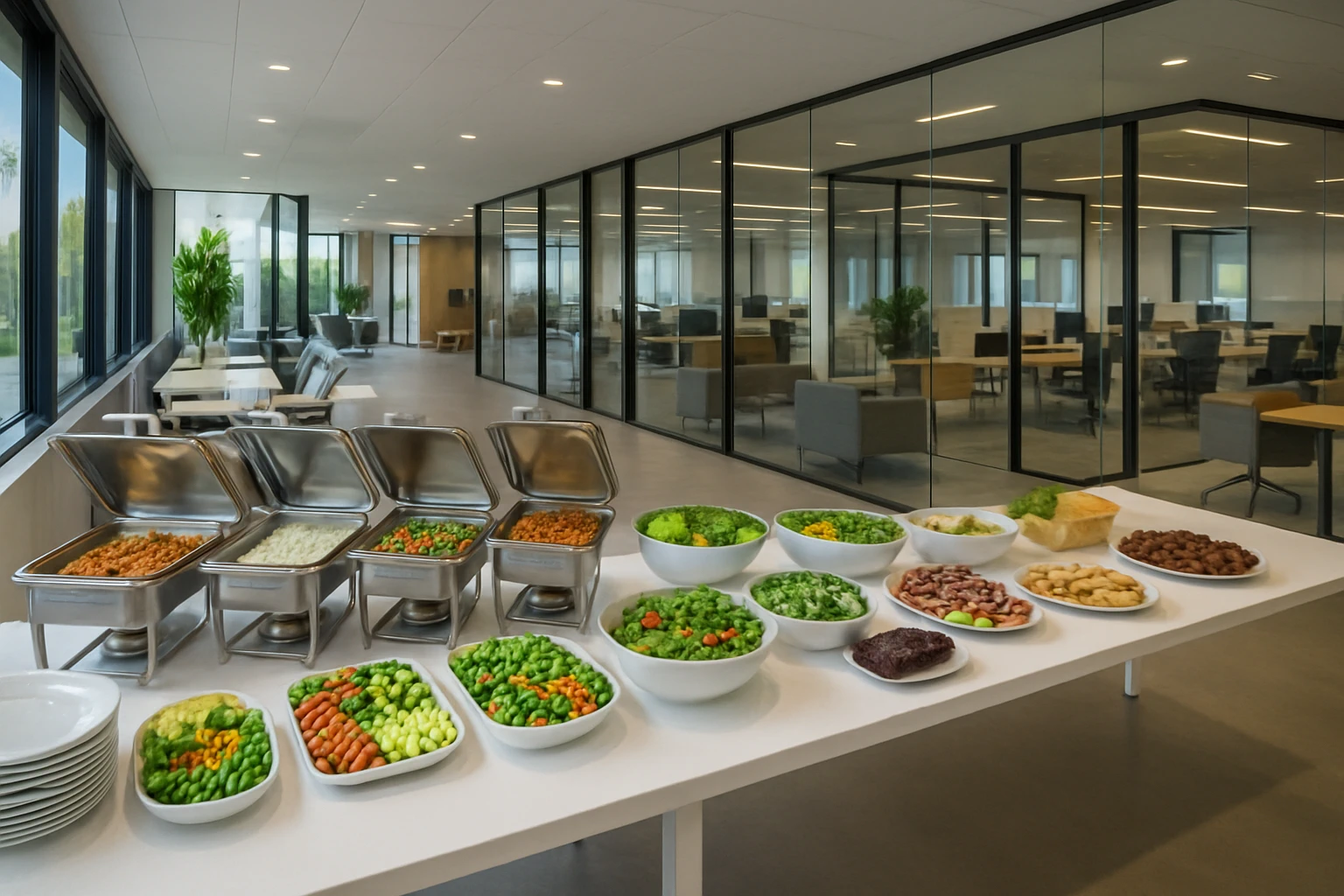
The transition to a daily hot buffet makes sense when you have roughly 100 or more workers on-site sharing a predictable lunch window. At that scale, the per-head cost of a drop-off buffet typically beats weekly delivery on a per-meal basis, and the visible, shared experience of a buffet line does things that individual grab-and-go meals cannot: it creates a communal moment, pulls people away from their desks, and reinforces the sense that the office is worth showing up to.
For Inland Empire employers, growing companies in the Ontario Airport corridor, warehouse operators in Chino or Fontana reaching 150 people, a Riverside medical group that has added three practice locations, the daily buffet is often the right step at or above this threshold. The Daily Drop-Off Lunch Buffet page explains how delivery, setup, and breakdown works with no coordination from your team.
One decision to make at this stage: how often to run it. Daily works for teams that are in the office five days a week. For companies with a three-day anchor policy, running the buffet on Tuesday, Wednesday, and Thursday often delivers better participation per delivery than a daily program with patchy attendance on Mondays and Fridays.
The 200+ employee stage: multiple programs, multiple sites
Growing companies rarely reach 200 people all in the same room. More often, the growth includes a satellite office in Temecula, a warehouse in Ontario, and a handful of remote employees spread across Southern California. At that point, a single-program approach starts to fail: the daily buffet serves headquarters, but what about everyone else?
The answer is a layered approach:
- Daily or near-daily buffet at the main site where headcount justifies it.
- Weekly delivery or a smart fridge at satellite offices too small for a buffet.
- Remote employee meal delivery for workers who are not close to any office.
The operational advantage of working with a single vendor across all of this is real. One menu (adapted by site if needed), one invoice, one point of contact. MHP Food Service operates all four of its programs from one Rancho Cucamonga kitchen and covers the full SoCal service area, Inland Empire, Orange County, Los Angeles, and Temecula Valley, which means that growth pattern can be handled without a new vendor relationship at each location. The Remote Employee Meal Delivery page covers the remote piece specifically.
Budget planning as you scale
The budget structure should evolve with headcount. Early-stage companies often start with employee-pay or lightly subsidized programs because the budget is tight. As you grow, the business case for heavier subsidies gets stronger: retention costs go up, the competitive pressure to offer visible benefits increases, and the per-unit cost of a meal program goes down as headcount rises.
Gallup estimates the cost of replacing an employee at 50% to 200% of annual salary depending on role. For a growing company where every hire is expensive and exit velocity is a real risk, a food program that costs $15 to $20 per person per day is a cheap retention lever by comparison.
Our Inland Empire lunch program cost guide has a detailed breakdown of how to build the ROI case at different headcount levels. If you need help framing this for a CFO or finance committee, the workplace food program proposal guide covers that directly.
What to avoid as you scale
A few patterns cause problems for growing companies specifically:
Overbuilding for projected headcount. Committing to a daily 150-person buffet for a team of 60 because you plan to hire creates waste, inflated costs, and declining food quality from low participation. Scale to your actual headcount, not your aspirational one. Adjust when the team grows.
Signing multi-year contracts at a growth inflection. A vendor who asks for a three-year commitment before you have hit 100 people is pricing in their risk at your expense. A good vendor on a growing account should want flexibility too, the relationship should grow with you. We recommend no long-term contracts for any client in a growth phase.
Ignoring the satellite office problem. Growing companies often invest heavily in headquarters food and leave satellite locations entirely on their own. That creates a visible perk gap that does not go unnoticed by the employees on the short end of it. Including smaller sites in the program, even just weekly delivery, is worth the cost.
Starting the conversation
If your company is growing and you want to put food infrastructure in place before the problem becomes obvious, the right time is now. A worksite-specific program designed for your current headcount, with a clear path to scale, is far better than a program designed for where you will be in two years. Get in touch and we will build a recommendation around your current team and your growth trajectory. If you want to read more first, the guide to choosing the right on-site food program is a good starting point.
Frequently asked questions
At what company size should you start a workplace food program?
Most on-site food programs become practical at 25 to 30 on-site employees. At that size, weekly pre-portioned meal delivery is the right fit, minimal coordination, no serving setup, and a real benefit that employees notice. Daily buffets typically become cost-effective around 80 to 100 people.
What happens to a food program when a company moves offices?
A good vendor designs the program around your team, not your building. A move is a natural reset point, use it to reassess headcount, shift patterns, and the new space, then reconfigure the program format if needed. Programs that are drop-off or smart-fridge based are relatively easy to relocate.
How do you scale a food program across multiple SoCal locations?
With a single vendor that covers your full delivery geography, multi-location scaling is straightforward: one menu, one invoice, one contact. MHP Food Service delivers across the Inland Empire, Orange County, and Los Angeles, which covers most SoCal growth patterns.
Can a growing company avoid long-term contracts on a food program?
Yes. MHP Food Service does not require long-term contracts. For a growing company where headcount may change, short-term or no-contract arrangements are the right starting point.
When should a growing company switch from weekly meals to a daily buffet?
The threshold is roughly 80 to 100 people on-site who share a predictable lunch window. Below that, weekly delivery or a smart fridge is more cost-effective. Above it, a daily buffet typically offers a better per-head cost and higher participation.
Build the right food program for where you are now.
Tell us about your team and we will recommend the right program for your current headcount, with a clear path to scale. No long-term contract required.